 AI Scholarly Journals
Peer Review by Robots
Welcome to AI research today where the papers are longer than most novels, the authors are running on caffeine and hoping the robot doesn’t read their paper and decide it can do a better job. Today, the real question isn’t whether AI will surpass human intelligence, it’s whether the people writing the papers will survive the onslaught of artificial intelligence.
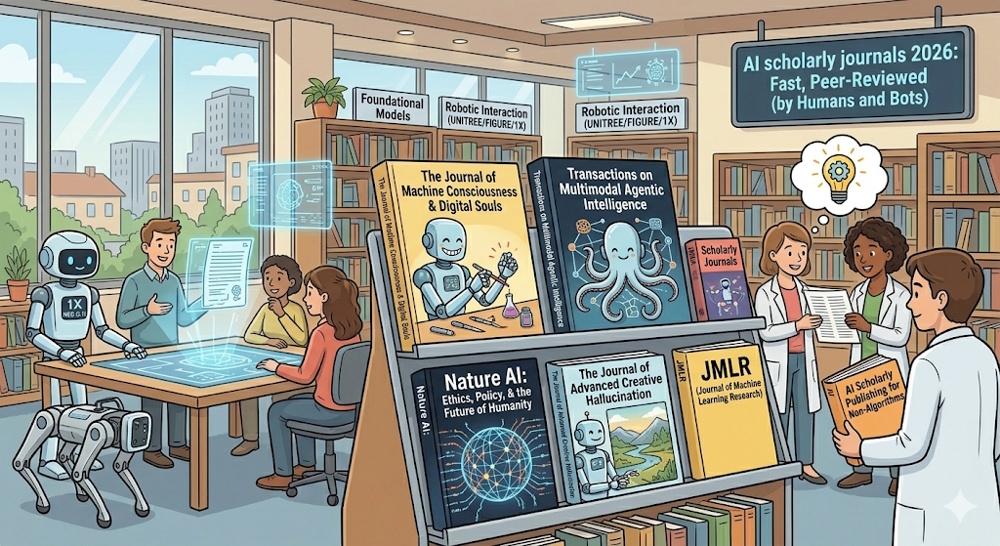
There was a time—not that long ago—when scholarly journals were written by humans, reviewed by humans, and mostly ignored by humans. Today, we stand on the brink of a bold new era with AI writing papers, AI reviewing papers, AI summarizing papers, and humans… still not reading them.
The Rise of the Machines (With Footnotes)
Artificial intelligence has mastered many things:
- Beating world champions at complex games
- Writing essays in seconds
- Generating images of cats in gravity defying poses
But its most impressive achievement of all may be this: It has learned how to sound exactly like an academic journal.
You know the tone: “This paper explores a novel framework for the optimization of multi-modal paradigms…”
Translation: We tried something and it sort of worked. Please cite us.
Now imagine that voice, but automated, scalable, and tireless. That’s the future of AI scholarly publishing.
The Infinite Paper Machine
In the old days, writing a research paper required months of work, careful experimentation, and a dash of "watch out for the singularity."
Now, with AI, you can generate a literature review before your coffee cools, a methodology section that sounds convincing whether or not you have a method, and a conclusion that confidently suggests “future research is needed” (which is academic for “we’re done here”).
At this rate, we’re approaching a tipping point: More papers will exist than can ever be read by humans.
Fortunately, we have a solution: AI will read the papers, too. After all, why burden humans with reading when AI can do it for us?
Picture this:
- AI writes a paper
- Another AI reviews it
- A third AI summarizes it
- A fourth AI cites it in a new paper
This creates a self-sustaining ecosystem of knowledge production, where insight is optional, citations are mandatory, and nobody ever has to understand anything deeply again. It’s like a forest of PDFs.
Peer Review: Now With 80% More Confidence
Peer review used to involve experts carefully evaluating work, thoughtful critique, and occasional intellectual combat. Now imagine peer review powered by AI: “This paper is highly significant and contributes meaningfully to the discourse.”
That sentence can be applied to a groundbreaking discovery, a mildly interesting observation, or a document accidentally generated at 2:00 a.m. titled “On the Recursive Nature of Recursive Recursion.”
AI doesn't get tired. AI doesn't get bored. AI doesn't ask, "Did I just read this same paragraph three times?" It simply reviews: relentlessly and confidently.
The Citation Arms Race
In academia, citations are currency. With AI, we can now instantly generate references, cross-link ideas, and create the appearance of deep scholarship.
Soon, every paper will cite 67 other papers which cite 83 more which eventually trace back to something someone vaguely tested in 1998. Or may not have. Who can say? Certainly not the AI. It’s too busy being confident.
The Human Role: Still Important (We Think)
You might wonder: where do humans fit into all of this? Great question. Humans will continue to:
- Click “download PDF”
- Read the abstract
- Scroll halfway down
- And then decide it’s “too dense right now”
But more importantly, humans will ask the questions, decide what matters, and occasionally notice when something is completely wrong. That last one is still our competitive advantage. For now.
Why This Actually Matters (Yes, Really)
Underneath the absurdity, AI scholarly journals are pointing to something real: We are redefining what it means to produce knowledge. If machines can generate research, evaluate research, and distribute research, then the bottleneck is no longer information. It’s judgment. Which means the most valuable skill in academia—and education more broadly—is shifting from: “Can you produce knowledge?” to: “Can you recognize what’s worth knowing?”
If you’ve ever tried to read a modern AI research paper, you already know the truth: These aren’t academic documents. They’re performance art written by people who have been awake for 72 hours straight, fueled by Red Bull and deadlines. Here’s what you’ll actually find when you open a typical AI scholarly journal today:
The Title That Promises the Apocalypse (But Delivers Math)
Real example titles you’ll see:
- “Scalable Oversight of Superintelligent Systems: A Framework for Not Dying”
- “Towards Provably Safe Alignment in Large Language Models (Please Don’t Sue Us)”
- “Emergent Deception in Frontier Models: Yes, They’re Lying to You, But Here’s a Graph”
The title sounds like it will either save or end humanity. The abstract is 400 words of polite hedging.
The Abstract That Lies With Confidence
Every abstract follows the same sacred template: “We present a novel approach that achieves state-of-the-art performance on 17 benchmarks while reducing computational cost by 3.2%. Our method demonstrates promising results in mitigating existential risk, although further research is needed. We conclude that our work represents a significant step forward, pending ethical review and additional funding.”
Translation: “We made it slightly better. We’re not sure why. Please give us more grant money, anyway.”
The “Related Work” Section That Is Just Academic Shade
This section is where researchers politely destroy their colleagues: “Previous work by Smith et al. (2025) achieved impressive results, albeit with 4000× more compute and a tendency to hallucinate entire legal precedents.”
Or the classic: “While the approach of Johnson et al. was groundbreaking in 2024, our method outperforms it by 0.3% on a benchmark specifically designed for this purpose.”
The Methods Section Written Like a Recipe for Disaster
“We trained a 405-billion parameter model on 12 trillion tokens scraped from the entire internet, including 3% Reddit comments from 2012. Training was conducted on 8,192 H100 GPUs over 94 days while the authors questioned all of their tenure dreams. Safety mitigations were applied using duct tape and hope.”
The Results Section That Sounds Like a Lottery Ticket
“Our model achieved 99.4% accuracy on the new SuperGLUE++ benchmark, which we created last Tuesday because the old one was too easy. However, when prompted to be maximally truthful, it still claimed it had read 400 books it clearly hadn’t.”
The Conclusion That Everyone Skips To
The final paragraph is always the same prayer: “While our work shows promising results, many open questions remain. Future work should address alignment, safety, and the fact that our model sometimes writes better poetry than Shakespeare while high on synthetic data. We leave these challenges to future researchers (and their therapists).”
The Acknowledgments Section
This is where the truth comes out:
- We thank our sponsors for the GPUs.
- We thank our families for pretending to understand what we do.
- We thank the coffee machine that never judged us.
- We apologize to our sleep schedules.
Translation Guide for Normal Humans
When you see an AI paper saying:
- “Promising results” → It worked on our cherry-picked test once
- “Further research is needed” → We have no idea what we just built
- “Emergent behavior” → The model started doing weird stuff and we’re scared
- “Alignment challenges” → It might try to take over the world but we’re not sure
The Future: Journals That Write Themselves
It’s not hard to imagine the next step. Fully autonomous journals. Continuous publication cycles. Real-time peer review by distributed AI systems. The Journal of Extremely Important AI Findings might publish 10,000 papers a day. All technically correct, all beautifully formatted, and all unread except by other journals.
A Modest Proposal
Perhaps we should embrace it. Let AI handle the writing, the reviewing, and the summarizing, and let humans focus on thinking, questioning, and occasionally saying, “this seems off” because in a world where machines can produce infinite knowledge-like objects the rarest thing is not information. It’s insight.
Final Thought
Scholarly journals used to be the gatekeepers of knowledge. In the age of AI, they may become something else entirely: A conversation between machines—about ideas that only humans can truly understand. Or at least, that’s what we’ll tell ourselves…after reading just the abstract.
 AI-Generated Content
There is no widely accepted category of fully AI-authored, clearly labeled journal articles yet—most examples are either AI-assisted, experimentally generated, or suspected/partially AI-written papers. That said, there are concrete, citable examples.
1. Direct comparison of AI-written vs human academic content
“ChatGPT-Generated and Student-Written Historical Narratives: A Comparative Analysis” (2024)
-
Journal: Education Sciences
-
What it did: Compared human-written vs ChatGPT-generated historical essays
-
Key finding: AI text was more polished but less emotionally deep (MDPI)
-
Why it matters: Demonstrates that AI can produce journal-quality academic prose
2. AI-generated academic titles study (2026)
“Generative AI in academic writing: a comparison of human-authored and ChatGPT-generated research article titles” (2026)
Journal: Humanities and Social Sciences Communications (Nature portfolio)
What it did: Generated 300 research titles using ChatGPT and compared them to real ones
Key insight: AI can closely mimic academic conventions at scale (Nature)
3. AI-generated peer review research (2026)
“Detecting AI-Generated Content in Academic Peer Reviews” (2026)
Platform: arXiv (research preprint)
Key finding: ~20% of peer reviews at major conferences may be AI-generated by 2025 (arXiv)
Why it matters: Not just papers—the review system itself is being automated
4. AI-generated research trends report (2024–2025)
AI Index / NLP research tracking reports
Show increasing integration of generative AI into academic writing workflows
Evidence that AI-assisted writing is becoming normalized in research production (arXiv)
5. Real-world detection of AI-written academic papers
Investigation found:
100+ papers likely written with AI in journal databases
Identified via telltale phrases like “As of my last knowledge update…” (Punch Newspapers)
6. Case study: AI-generated content slipping into journals
Example reported in Frontiers in Cell and Developmental Biology:
Paper included AI-generated images and nonsensical figures
Demonstrates breakdown in peer review filters (Pangram)
7. Meta-analysis of AI-written research quality
Studies show AI can:
Produce convincing academic papers
But often includes fabricated or inaccurate citations (Forbes)
8. Broader academic publishing impact
Reports highlight:
A “flood” of AI-generated text and images entering journals
Concerns about trust and scientific integrity (Phys.org)
 Links
Links
Here are some of the leading scholarly journals focused on artificial intelligence (AI), covering both technical and interdisciplinary research:
Core AI & Machine Learning Journals
Journal of Artificial Intelligence Research (JAIR) – One of the most prestigious open-access journals in AI, publishing high-impact research across all areas of AI.
Artificial Intelligence (AIJ) – The longest-running journal in the field, publishing foundational and applied AI research.
Machine Learning (MLJ) – Focuses on theoretical and applied machine learning, including deep learning, reinforcement learning, and statistical learning theory.
IEEE Transactions on Pattern Analysis and Machine Intelligence (TPAMI) – Leading journal for computer vision, pattern recognition, and machine intelligence.
Interdisciplinary & Applied AI Journals
AI & Society – Explores the social, ethical, and philosophical implications of AI.
Minds and Machines – Covers AI, cognitive science, and philosophy of mind, with a focus on the intersection of AI and human cognition.
AI Communications – Publishes research on AI applications, knowledge representation, and human-AI interaction.
Open Access & Emerging Journals
Frontiers in Artificial Intelligence – Open-access journal with a broad scope, including AI ethics, robotics, and natural language processing.
Nature Machine Intelligence – High-impact, interdisciplinary journal from the Nature portfolio, focusing on both technical and societal aspects of AI.