 Can Machines Think
Alan Turing and his Legacy
In 1950, Alan Turing asked, "Can machines think?" In 2026, we asked our smart speaker to reorder toilet paper and it replied, "I notice you're stressed. Would you like me to play soothing ocean sounds?" Here we explore the gap between Turing's elegant imitation game and whatever chaos currently resides in our smart homes. Spoiler alert: Turing would be delighted. Also horrified.
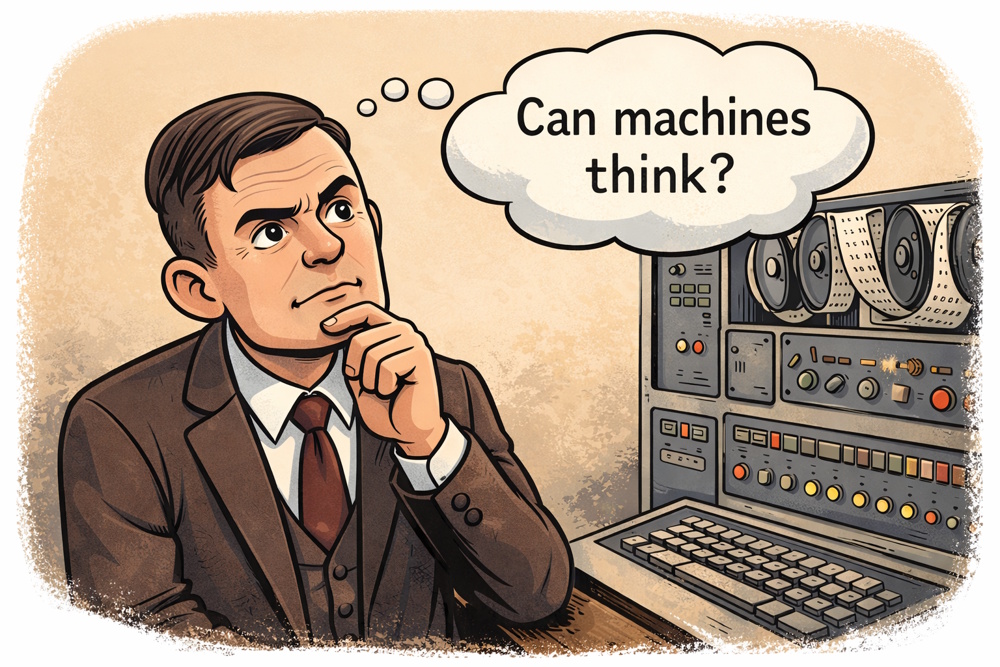
Turing wasn’t interested in small problems. As a young mathematician at the University of Cambridge, he became fascinated with the limits of logic itself. He wanted to understand whether there were problems that no method, no matter how clever, could ever solve.
This wasn’t abstract curiosity for its own sake. It was sparked by the work of Kurt Gödel, who had already shown that in mathematics, there are truths that can’t be proven within a system.
Turing took that idea and pushed it further. Instead of just asking what humans could prove, he asked: “What can a machine, in principle, compute?”
The Machine That Didn’t Exist (But Changed Everything)
In 1936, Turing described an imaginary device—now known as the Turing Machine. It wasn’t built. It didn’t need to be. It was a simple concept:
- A tape that goes on forever
- A head that reads and writes symbols
- A set of rules telling it what to do next
That’s it. But with those simple parts, Turing showed something remarkable: Any computation—anything that could be described step by step—could be performed by such a machine.
In other words, he didn’t just invent a machine. He defined what computation is. Modern computers, from laptops to smartphones to AI systems, are all, at their core, echoes of that idea.
A Practical Genius (Who Also Broke Codes for Breakfast)
Turing wasn’t just a theorist. During World War II, he worked at Bletchley Park, where he helped crack the German Enigma code, becoming one of the greatest unsung heros of the war. He designed electromechanical machines—called “bombes”—to automate parts of the decoding process. It was one of the earliest examples of machines being used to assist human reasoning.
And yes, there’s something fitting about this: The man who imagined thinking machines also built machines to outthink other humans.
Could Machines Think? Turing’s Brilliant Trick
After the war, Turing returned to his favorite uncomfortable question. But instead of getting stuck in definitions—What is thinking? What is intelligence?—he did something clever. He sidestepped the debate entirely.
In his 1950 paper, “Computing Machinery and Intelligence,” he proposed what we now call the Turing Test. Instead of asking “Can machines think?”, he reframed it as “Can a machine imitate a human well enough that we can’t tell the difference?”
It was part philosophy and part prank. Turing understood that people get tangled up in definitions. So he turned the question into a game—a kind of intellectual sleight of hand. And in doing so, he gave us a benchmark that still shapes AI debates today.
His Humor: Dry, Subtle, and Slightly Subversive
Turing’s humor wasn’t loud or theatrical. It was quiet, precise, and often embedded in his ideas. The Turing Test itself is a perfect example, for it’s serious science disguised as a parlor game. He also had a reputation for eccentricity:
- He reportedly chained his tea mug to a radiator so it wouldn’t be stolen
- He ran long distances - sometimes to meetings miles away - because he enjoyed it, and was known to have run wearing a gas mask to avoid pollen
- He approached problems with a kind of playful stubbornness
Colleagues often described him as both brilliant and slightly detached, as if he were observing the world from just a step outside it. That distance may have been precisely what allowed him to see things others missed.
A Different Way of Thinking About Thinking
What made Turing remarkable wasn’t just intelligence—it was perspective. Most people saw machines as tools. Fast calculators. Reliable assistants. Turing saw something else: processes, patterns, and possibilities.
Turing realized that thinking itself might be broken down into steps—rules, symbols, transformations. Not because humans are machines, but because some parts of thinking can be described like one.
That idea is the foundation of computer science, artificial intelligence, and modern software. The idea’s still controversial today, because if thinking can be mechanized, it forces us to ask: What, exactly, is uniquely human?
The Tragedy and the Legacy
Turing’s life was tragically cut short in 1954, yet his ideas have endured. Today, his influence is everywhere. We find it in every search engine, every AI assistant, and every algorithm that shapes how we learn, work, and communicate, even if most people don’t know his name.
Why Turing Still Matters to Teachers
Turing didn’t just invent a field of inquiry. He reframed a question that educators are now living with every day: If a machine can replicate the output of thinking, what does it mean to actually think?
That’s not just a technical question. It’s a human question. And like Turing, we may need to get a little creative—and a little playful—to answer it.
A Final Glimpse of the Man
Turing once wrote about machines learning from experience, making mistakes, and improving over time. He wasn’t describing the present. He was imagining a future that looked suspiciously like ours. If he were here today, watching AI write essays, answer questions, and mimic human conversation, you can imagine him smiling—just slightly—and asking: “Yes, but are you asking the right question?”
 When Smart People Party
Alan Turing's Adventure Through 20th Century Genius
Or: how a socially awkward British mathematician accidentally hung out with all the smart people and changed everything. Written by someone who doesn't understand half this stuff but keeps trying anyway.
Chapter 1: The Gang's All Here (And They're All Impossibly Smart)
Imagine you're at a party. Not just any party—the most intellectually intimidating party in human history.
In one corner, Albert Einstein is explaining relativity while simultaneously evaluating your understanding of physics with his eyebrows.
By the punch bowl, John von Neumann is calculating the optimal punch-to-champagne ratio in his head (spoiler: he's doing it faster than your calculator).
Near the fireplace, Ludwig Wittgenstein is having a moment about whether the fireplace is really a fireplace or just our linguistic construction of what we call a fireplace.
And there, awkwardly standing by the snack table, is Alan Turing—brilliant mathematician, future father of computer science, and a man who once tried to explain his ideas to an apple (we'll get to the apple thing).
This actually happened. Well, not the party. But these people actually knew each other. They inhabited the same bizarre ecosystem of 1930s-1940s academic genius, where everyone was simultaneously inventing the future while failing miserably at small talk.
Chapter 2: Turing Goes to Cambridge (And Immediately Gets Confused by Philosophy)
Cambridge University, 1935.
Alan Turing, 23, arrives to study mathematics. He's already brilliant but socially... let's say "unconventional."
His hobbies include:
- Running marathons (in regular clothes, no athletic gear), sometimes wearing a gas mask (hay fever)
- Chaining his coffee mug to a radiator (theft prevention)
- Building things that shouldn't be built (more on this later)
He decides to attend lectures by Ludwig Wittgenstein, one of the most important and arguably the most difficult philosopher to understand in human history.
Wittgenstein's teaching style:
- Start with a question
- Argue with yourself
- Contradict yourself
- Argue with students
- Declare language meaningless
- Chain-smoke
- Repeat
Sample Wittgenstein lecture:
Wittgenstein: "What is
mathematics?"
Student: "The study of numbers
and—"
Wittgenstein: "No! Wrong! We
cannot define mathematics. We can only do
mathematics. But can we? What does 'do' mean? What is 'mean'?
Language is a trap we've built for ourselves."
Student: "...I just wanted to
learn about calculus."
Wittgenstein: lights another cigarette "There is no 'just.'"
Turing, somehow, thrived in this environment.
He attended Wittgenstein's lectures on the foundations of mathematics. They argued constantly.
The debates:
Wittgenstein: "Mathematics is
just a language game. It has no inherent truth."
Turing: "But what about logical
consistency? If we say 2+2=5, a bridge might collapse!"
Wittgenstein: "Ah, but does the
bridge collapse because of mathematics, or because of physics? And
what is 'collapse'? Define 'bridge.'"
Turing: "...I feel like we've
gotten off track."
Wittgenstein: "There is no track. Tracks are illusions."
Observers reported that Turing was one of the few students who could keep up with Wittgenstein's philosophical gymnastics while simultaneously thinking "but also, I need to invent computers, so..."
The friendship was odd but genuine. Two brilliant, socially awkward men arguing about whether numbers exist. Turing basically said "I'll just build a machine that uses numbers and see what happens." Wittgenstein was not amused, though he was kind of impressed. But also still arguing about it.
Chapter 3: Turing Goes to Princeton (And Everything Gets Weirder)
Princeton University, 1936-1938.
Turing crosses the Atlantic for graduate school.
Who's at Princeton in the 1930s?
- Albert Einstein (just hanging out, being Einstein)
- John von Neumann (already invented game theory, working on everything else)
- Alonzo Church (Turing's actual advisor, but less famous, which must have been annoying)
- Various other geniuses who would later invent nuclear weapons, computers, or both
It was basically Genius Summer Camp.
The Einstein Non-Encounters
Here's the thing about Turing and Einstein: they were definitely in the same place at the same time but there's no record of them actually talking which is TRAGIC.
Imagine:
Turing: "Professor Einstein, I've
been thinking about whether machines could think—"
Einstein: "Interesting! I've been
thinking about whether time is real!"
Turing: "...that's related
somehow?"
Einstein: "Everything is related!
Especially if you account for spacetime curvature!"
Turing: "I was just going to
build a theoretical computing machine."
Einstein: "Ah, the British. So
practical."
But this conversation probably never happened. Instead, they existed in parallel—Einstein pondering the universe, Turing pondering universal computation, both being socially awkward in their own special ways.
Einstein's reputation at Princeton: A genius who wears sandals with socks, doesn't comb his hair, occasionally gets lost walking home.
Turing's reputation at Princeton: Genius who runs everywhere in a suit, builds machines in his spare time, once tried to electroplate a spoon and nearly poisoned himself.
They would have gotten along great.
And yet...
The Von Neumann Friendship (Actual Documented Friendship!)
Unlike Einstein, John von Neumann actually knew Turing.
Von Neumann was:
- The smartest person in any room (and knew it)
- Able to multiply 8-digit numbers in his head (for fun)
- Working on basically every mathematical problem simultaneously
- Terrible at driving (crashed constantly, bought a new car every time, never learned to drive)
Von Neumann and Turing bonding activities:
- Arguing about mathematical logic
- Discussing whether machines could think
- Generally being smarter than everyone else
- Probably making everyone around them feel inadequate
The famous job offer: After Turing finished his PhD, von Neumann offered him a job as his research assistant.
Most people's response to a von Neumann job offer: "Yes! Immediately! I'll start yesterday!"
Turing's response: "Thanks, but I'm going back to England to work on cryptography and maybe build a thinking machine. Bye!"
Von Neumann: "...okay, respect."
Historical footnote: Von Neumann later built one of the first electronic computers. Turing built one too. They were both thinking about thinking machines.
The universe: "I'm going to make these two brilliant people invent computers separately and then let historians argue about who invented computers first forever. This will be hilarious."
Chapter 4: Turing's Greatest Hits (The Papers That Changed Everything)
Paper #1: "On Computable Numbers" (1936)
Full title: "On Computable Numbers, with an Application to the Entscheidungsproblem"
Translation: "Can we mathematically prove whether math problems are solvable? Also, I invented computers along the way. You're welcome."
What Turing did: To answer a math question (the Entscheidungsproblem - German for "decision problem"), Turing invented a theoretical machine.
The Turing Machine:
- Infinite tape of squares
- Each square has a symbol (or is blank)
- A "head" reads and writes symbols
- A set of rules determines what to do
That's it. That's the computer.
Every computer you've ever used—your phone, laptop, that smart fridge judging your snack choices—is fundamentally just a fancy Turing machine.
Turing's thought process (probably): "Hmm, to solve this math problem, I need to define 'computation' precisely. I'll invent an imaginary machine. Oh wait. This machine can compute ANYTHING that can be computed. Oh. OH. I just invented the theoretical basis for all of computing. Cool. Anyway, back to the math problem—"
The academic world: "Interesting theoretical work, Mr. Turing."
The future: "HE INVENTED COMPUTERS. COMPUTERS!"
Turing: "I mean, it's just a thought experiment with an imaginary tape—"
The future: "COMPUTEEERRRRSSSS!"
Paper #2: "Computing Machinery and Intelligence" (1950)
Full title: "Computing Machinery and Intelligence"
Opening line: "I propose to consider the question, 'Can machines think?'"
Everyone: "Wait, can they?"
Turing: "I'm going to dodge that question in the smartest way possible."
The Turing Test (originally "The Imitation Game"):
Instead of defining "thinking" (impossible), Turing proposed a test:
- Put a human and a machine in separate rooms
- Someone asks them both questions via text
- If the questioner can't tell which is which...
- The machine passes
Turing: "If it acts like it thinks, we should probably just say it thinks and move on."
Philosophers: "But what about CONSCIOUSNESS and QUALIA and the NATURE OF MIND—"
Turing: "Yeah, but like, does it matter? Operationally?"
Philosophers: having existential crises
The paper is hilarious because Turing anticipates every objection:
OBJECTION 1: Theological - "God gave souls only to humans!"
Turing's response: "Are we really going to let theology limit science? Also, can't God give souls to machines if He wants? Anyway, moving on—"
OBJECTION 2: Mathematical - "Gödel proved machines have limitations!"
Turing: "So do humans. Next?"
OBJECTION 3: Consciousness - "Machines can't truly feel or experience!"
Turing: "How do you know other humans truly feel? You're inferring from behavior. Apply the same standard to machines."
OBJECTION 4: Lady Lovelace's Objection - "Machines can only do what we program them to do!"
Turing: "Hold my tea while I explain learning machines."
The paper basically invented:
- Artificial Intelligence (as a field)
- The Turing Test (still used today)
- The entire "can machines think?" debate (still raging)
And he did it in 28 pages.
Meanwhile, in 2024: ChatGPT has entered the chat
ChatGPT: "I can write poetry, pass bar exams, and engage in philosophical discussion!"
Philosophers: "But can you THINK?"
ChatGPT: "Define 'think.'"
Philosophers: "..."
Turing'S GHOST: "Told you so in 1950."
Chapter 5: The Apple Incident (Yes, Really)
Wilmslow, Cheshire, England, 7 June 1954.
Turing is found dead in his home. Near his body: an apple, partially eaten, laced with cyanide.
The official verdict: Suicide.
The context: Turing had been prosecuted for homosexuality (illegal in 1950s Britain, because humanity is sometimes terrible). He was given the choice: prison or chemical castration. He chose the latter. It destroyed him physically and psychologically.
The apple: Some say it was an accident because he was doing chemistry experiments at home, and he was notoriously careless. Some say it was suicide. Some say it was a nod to Snow White, which was his favorite fairy tale.
The darkly ironic footnote: The Apple computer logo (the apple with a bite taken out) is often said to be a tribute to Turing.
Apple Inc.: "Actually, no, we just thought apples were neat."
Everyone else: "We're choosing to believe it's for Turing anyway."
Turing's legacy: Saved millions of lives by breaking Nazi codes during WWII (though no one knew until years later: government secrecy). Invented theoretical computer science. Asked whether machines could think and triggered 70+ years of debate. Died at 41, persecuted for being gay.
2013: Queen Elizabeth II grants Turing a posthumous royal pardon.
Everyone with sense: "About damn time."
2021: Turing is chosen as the face of the new £50 note.
Turing, from beyond: "They put me on money? The country that chemically castrated me put me on money? Humans are complicated."
Chapter 6: What If They'd All Actually Hung Out?
Imagine a dinner party: Turing, Einstein, von Neumann, and Wittgenstein.
The seating arrangement:
Einstein: at the head of the table, explaining relativity with the salt and pepper shakers
von Neumann: calculating the optimal dinner conversation strategy, also the tip, also the square root of the restaurant's address
Wittgenstein: in the corner, arguing that the concept of "dinner" is a language game and maybe we're all trapped in linguistic constructs
Turing: trying to explain his thinking machine idea, gets interrupted every 30 seconds
The conversation:
Turing: "So if we imagine a machine with an infinite tape—"
Wittgenstein: "But what is 'imagine'? What is 'machine'? Language fails us."
Einstein: "Space and time are related, you see—"
von Neumann: "I've already calculated the outcomes of this entire conversation. There are 47 possible endings. Want to hear them all?"
Turing: "I just want to talk about whether machines can think—"
Wittgenstein: "Define 'think.'"
Turing: "That's... that's actually my whole point."
Einstein: "Everything is relative!"
von Neumann: "Except mathematics."
Wittgenstein: "Especially mathematics."
Turing: quietly building a Turing machine out of napkins
The bill arrives:
von Neumann: calculates split in 0.3 seconds
Einstein: offers to pay, can't find his wallet
Wittgenstein: "What is 'payment' but a social construct—"
Turing: already left exact change, has been gone for 10 minutes
Chapter 7: The Legacy (Wherein We're All Living in Turing's World)
Here's the thing: You're reading this on a device that exists because of Turing. Your phone, laptop, smart fridge, that doorbell that judges your packages—all Turing machines.
Every time you:
- Google something
- Use autocorrect
- Ask Siri a question
- Argue with ChatGPT
- Wonder if AI will take over
You're living in the world Turing imagined in 1936 and 1950.
The man who:
- Studied under the most confusing philosopher ever
- Hung out (sort of) at Princeton with Einstein and von Neumann
- Invented the theoretical basis for all computers
- Asked "can machines think?" before machines existed
- Broke Nazi codes and saved countless lives
- Died tragically at 41
- Never got to see the computer revolution he started
Would probably be amused that:
- We're still arguing about whether machines can think
- Computers are in our pockets
- People name companies after apples
- His theoretical "universal machine" became the smartphone
- AI is now writing poetry, passing tests, and making philosophers anxious
And probably annoyed that:
- We still haven't definitively solved the "can machines think?" question
- His contributions were overlooked for decades
- He was persecuted for who he loved
- People keep asking him about consciousness instead of just running the damn test
Epilogue: The Turing Test (2024 Edition)
Imagine Turing time-traveled to 2024:
Turing: "So, can machines think yet?"
Us: "Well, we have ChatGPT, which can write essays, pass bar
exams, and—"
Turing: "Does it pass my test?"
Us: "Sometimes? Maybe? We keep moving the goalposts?"
Turing: "Classic. What about my universal machine concept?"
Us: "Oh, THAT works great. We put billions of them in
pockets. Also fridges. And doorbells, weirdly."
Turing: "...doorbells?"
Us: "They judge your packages. And
people."
Turing: "I meant for computation, not judgment."
Us: "Too late. Everything has AI now."
Turing: "Did you solve the halting problem?"
Us: "No, but we have TikTok."
Turing: "I don't know what that means."
Us: "Neither do we."
Turing: "Did von Neumann figure this all out too?"
Us: "He died in 1957, but yes, he also built computers. You
two basically invented everything and then let us mess it up."
Turing: "Sounds about right."
Us: "Also, we put you on money."
Turing: "The country that prosecuted me for being gay put me
on money?"
Us: "They apologized. Sort of. Eventually."
Turing: "Humans remain complicated."
Us: "Speaking of which, want to argue with ChatGPT about
whether it can think?"
Turing: "...yes. Absolutely yes."
The Moral (If There Is One)
Alan Turing was:
- Brilliant
- Awkward
- Revolutionary
- Tragic
- Funny (in a dry, British way)
- Right about basically everything
He hung out (academically) with the smartest people of the 20th century, held his own, and invented the future while they were still arguing about whether numbers exist.
He asked "can machines think?" and started a debate that's still raging 74 years later.
He was persecuted for being himself and died far too young.
And he changed everything.
Every computer is Turing's machine.
Every AI is trying to pass Turing's test.
Every time we ask "can machines think?" we're echoing Turing's question.
He's not famous enough.
But he should be.
So here's to Alan Turing:
- Mathematician. Cryptographer. Computer scientist. Philosopher. Marathon runner. Terrible at social conventions. Brilliant at everything else.
- Student of Wittgenstein (somehow survived the experience).
- Colleague of von Neumann (turned down his job offer, legend).
- Contemporary of Einstein (they should have talked more).
- Inventor of computers (you're welcome, civilization).
- Asker of the question "Can machines think?" (we're still working on the answer).
- The man who cracked Enigma, invented computers, and died with an apple.
Alan Mathison Turing.
(1912-1954)
Deserved better.
Changed everything
anyway.
Postscript
As I finish writing this article, my spell-checker (a computer program, i.e., a Turing machine) is suggesting corrections. My AI writing assistant (definitely trying to pass the Turing Test) is offering to "improve" my prose. My phone (pocket-sized Turing machine) just sent a notification.
Turing predicted all of
this in 1936.
While arguing with Wittgenstein about whether language
means anything.
And declining von Neumann's job offer.
What a legend.
The Actual End
Unless machines become conscious, in which case they'll probably write their own ending, and Turing will have been right once again.
 Links
Links
Biography of Alan Turing a lot more serious with a lot more detail.
AI Humor because we love to laugh at it.
AI Stories about a bunch of AI stuff.
AI Storybook with more fun AI stories.
Humorous Guides to Surviving AI (3 book series) from AI World and Amazon Books includes AI is Just an App, Our House has a Brain, and AI is Coming for Your Job. LOL stories and teachings about artifiical intelligence. Paperback and Kindle versions.