 AlexNet Wins ImageNet
The Win That Changed Everything
The air in the conference room on December 5, 2012, in Vancouver, Canada, was thick with anticipation. In a few minutes, the results of the ImageNet Large Scale Visual Recognition Challenge would be announced. This academic competition, where research teams competed to build systems that could accurately identify objects in photographs, had been running since 2010, with improvements each year measured in incremental progress of mere percentage points.

Nobody expected what was about to happen.
A team from the University of Toronto was about to announce results so shocking, so far beyond what anyone thought possible, that within months the entire field of artificial intelligence would pivot. Companies would scramble to hire researchers. Billions of dollars in investment would pour into deep learning. And the "AI revolution" that we're living through today would begin in earnest.
But to understand why this pivotal moment mattered so much, we need to go back in time. We need to understand the people who made it happen, the technology they used, and the decades of frustration that preceded their breakthrough.
 The People
Geoffrey Hinton
The Keeper of the Faith
Geoffrey Hinton was the kind of scientist who believes in an idea long after everyone else has given up. Born in England in 1947, he came from a family of accomplished thinkers. His great-great-grandfather was George Boole, whose Boolean algebra underlies all of computer science.
In the 1980s, Hinton became convinced that the brain's structure held the key to artificial intelligence. Neural networks—computer systems inspired by how neurons connect in the brain—fascinated him. While others in AI pursued symbolic reasoning and expert systems, Hinton stuck with neural networks even as the field fell out of favor.
By the 1990s and 2000s, neural networks were considered a dead end by most of AI. Funding dried up. Students avoided the area. Hinton's colleagues thought he was wasting his time. One researcher recalls that saying you worked on neural networks at AI conferences in the early 2000s could clear a room like saying you had covid.
But Hinton persisted. He moved to the University of Toronto in 1987, where he continued his work in relative obscurity. He developed new training algorithms, explored different network architectures, and slowly, patiently, gathered a small group of students who believed in his vision. Among them were two graduate students who would become his collaborators on the ImageNet project: Alex Krizhevsky and Ilya Sutskever.
Alex Krizhevsky
The Programmer
Alex Krizhevsky was a graduate student in Hinton's lab, brilliant at the intersection of theory and implementation. While some researchers could describe neural networks mathematically but struggled to make them work in practice, Krizhevsky had an engineer's instinct for getting things to actually run.
He had been experimenting with convolutional neural networks—a special type of neural network architecture designed for processing images—and had developed expertise in making them run efficiently on GPUs (graphics processing units), the powerful processors used in gaming computers, the bread and butter of NVIDIA, now the world’s most valuable company.
This technical skill would prove crucial. Neural networks had always required enormous computation, but Krizhevsky figured out how to harness gaming hardware designed to render complex 3D video game graphics for training AI. This was like discovering that a racing engine could also power a rocket ship.
Ilya Sutskever
The Theorist
Ilya Sutskever, another one of Hinton's students, brought theoretical depth and intuition about how to make neural networks learn effectively. Born in Russia and raised in Israel before moving to Canada, Sutskever had co-authored important papers with Hinton on training deep neural networks.
He understood the mathematical subtleties of optimization, how to adjust millions of parameters in a neural network to make it perform better. This might sound dry, but it was essential. Neural networks are like enormously complex puzzles where you're adjusting millions of knobs to get the right answer. Sutskever had insights about which knobs to turn and when to turn them.
The Team Dynamic
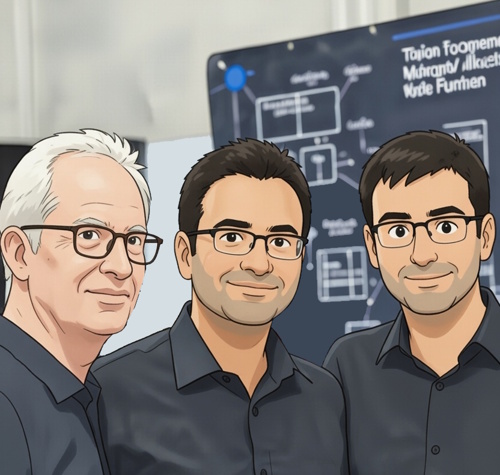
This was the core team: Hinton, the visionary who had kept the faith for decades; Krizhevsky, the implementer who could turn ideas into working code; and Sutskever, the theorist who understood how to make the math work.
They were not from a major AI lab like MIT or Stanford. They weren't funded by Google or Microsoft. They were instead a small team in Toronto, working with limited resources, pursuing ideas most of the field had abandoned.
But they had something nobody else had. They had decades of Hinton's accumulated wisdom about neural networks. They had powerful gaming GPUs that Krizhevsky knew how to exploit. And they had the right problem at the right time to tackle.
 The Technology
Convolutional Neural Networks: Seeing Like the Brain
The technology that would win ImageNet was the convolutional neural network (CNN), an architecture inspired by the visual cortex of the brain.
In the 1950s and 60s, neuroscientists David Hubel and Torsten Wiesel studied cats' brains, discovering that neurons in the visual cortex are organized in a hierarchy. Simple neurons detect basic features like edges at specific angles. These feed into neurons that detect combinations of edges (corners, curves). Those feed into neurons detecting more complex patterns (textures, shapes), and so on, until finally some neurons respond to whole objects like faces.
In 1980, a Japanese researcher named Kunihiko Fukushima created the "Neocognitron," an artificial neural network inspired by this hierarchical system of vision. Later, in 1989, Yann LeCun at AT&T Bell Labs, refined this concept into what we now call convolutional neural networks, using them successfully to read handwritten digits for check processing.
But CNNs remained a niche technique. They worked for simple tasks like reading digits but not much more. Most researchers couldn’t forsee a future and moved on to other approaches.
Why CNNs Are Different
Here's the key insight: regular neural networks treat each pixel in an image independently. But this is wasteful because a vertical edge in the top-left corner of an image is the same feature as a vertical edge in the bottom-right. Why learn to detect it separately in every location?
CNNs use convolution: the same pattern detector slides across the entire image. This dramatically reduces the number of parameters the network needs to learn. It also captures a key property of vision: features that matter in one part of an image matter everywhere.
The CNN architecture has layers:
Convolutional layers: Detect features (edges, textures, patterns)
Pooling layers: Reduce size while preserving important information
Fully connected layers: Combine features to make final decisions
Each layer processes increasingly abstract representations. Early layers might detect edges. Middle layers detect shapes made from those edges. Later layers detect objects made from those shapes.
The GPU Revolution
But even with CNNs' efficiency, training them on large datasets required enormous computation, radically more compute than the CPUs of the time could handle in reasonable timeframes.
Krizhevsky's crucial insight was using GPUs. Graphics cards, designed to render video game graphics quickly, contain thousands of simple processors that can perform the same operation on different data simultaneously. This is exactly what neural network training requires.
A high-end gaming GPU could train neural networks 10-50 times faster than a CPU. What might take weeks could be done in days or hours.
This wasn't entirely new. Researchers had been experimenting with using GPUs for neural networks since the mid-2000s. Krizhevsky became exceptionally good at optimizing neural network code for GPUs. He wrote custom CUDA code (NVIDIA's programming language for GPUs) that squeezed maximum performance from the hardware.
The team trained their network on two NVIDIA GTX 580 GPUs. These were consumer gaming cards that cost about $500 each. Total compute budget: about $1,000. This wasn't a supercomputer. These were gaming cards you could get at Best Buy.
The Architecture: AlexNet
The network they built, later called AlexNet (named after Alex Krizhevsky), had several innovative features:
Deep: Eight layers (five convolutional, three fully connected). This was much deeper than previous successful CNNs. Depth allowed learning more abstract representations.
ReLU Activation: Instead of traditional activation functions (like sigmoid or tanh), they used ReLU (Rectified Linear Unit): f(x) = max(0, x). This simple change made training faster and more effective.
Dropout: During training, they randomly disabled 50% of the neurons to prevent overfitting (memorizing training data rather than learning general patterns). This was like forcing the network to learn redundant ways of recognizing objects so it wouldn't rely too heavily on any single feature.
Data Augmentation: They artificially expanded the training data by randomly cropping, flipping, and color-shifting images. This taught the network to recognize objects regardless of position, orientation, or lighting.
Local Response Normalization: A technique borrowed from neuroscience to make neurons compete with each other, sharpening the network's responses.
Overlapping Pooling: A small, architectural choice that slightly improved accuracy.
None of these ideas were entirely new. The genius was combining them effectively and having the implementation skill to make it all work at scale.
 The Challenge
ImageNet: A Dataset to Rule Them All
The story of ImageNet begins with Fei-Fei Li, a computer science professor at Stanford. In the mid-2000s, she recognized a fundamental problem in computer vision research: datasets were too small.
Researchers were training vision systems on datasets of a few thousand images across a dozen categories. But the visual world is vastly more complex. Humans can recognize tens of thousands of object types. How could we expect AI to learn vision from such limited data?
Li and her team decided to build something unprecedented: a dataset containing millions of images across thousands of categories, covering much of the visual world. They chose the Amazon Mechanical Turk (MTurk) system to crowdsource the labeling of images by users who tagged images with object categories.
By 2009, ImageNet contained over 14 million images in more than 20,000 categories. It was the largest, most comprehensive image dataset ever created.
The ImageNet Challenge
To encourage progress in computer vision, Li and her colleagues launched the ImageNet Large Scale Visual Recognition Challenge (ILSVRC) in 2010. Teams competed to build systems that could:
Classify images: Given an image, identify the main object
Detect objects: Find and label all objects in an image
Localize objects: Draw boxes around objects
The classification task became the main benchmark. Teams were given 1.2 million training images across 1,000 categories (dogs, cats, vehicles, furniture, tools, etc.) and had to correctly classify test images.
The performance metric was top-5 error rate: the system could guess up to five categories for each image, and if the correct answer was in those five guesses, it counted as correct. The key question was: what percentage of images did the system get wrong?
The Results Before AlexNet
In 2010, the first ImageNet competition, the winning entry achieved a 28.2% error rate. That meant getting roughly 72% of images correct. Even though this result was impressive, there was plenty of room for improvement.
Tne next year the winner achieved a 25.8% error, which was about two and a half percentage points better. It was steady, incremental progress.
These systems used traditional computer vision techniques:
Hand-designed feature extractors (SIFT, HOG, etc.)
Careful engineering to detect edges, textures, shapes
Support vector machines or other traditional machine learning classifiers
Lots of clever tricks and domain expertise
They all worked, but they were complex and required deep expertise to build and tune.
By 2012, the expectation was for similar incremental improvement. Maybe the winner would achieve 23-24% error. Computer vision researchers anticipated years of gradual progress before reaching human-level performance (estimated around 5% error).
 The Event
Training AlexNet
In the months leading up to the September 2012 deadline, Krizhevsky, Sutskever, and Hinton were training their network on Krizhevsky's two NVIDIA GTX-580 GPUs.
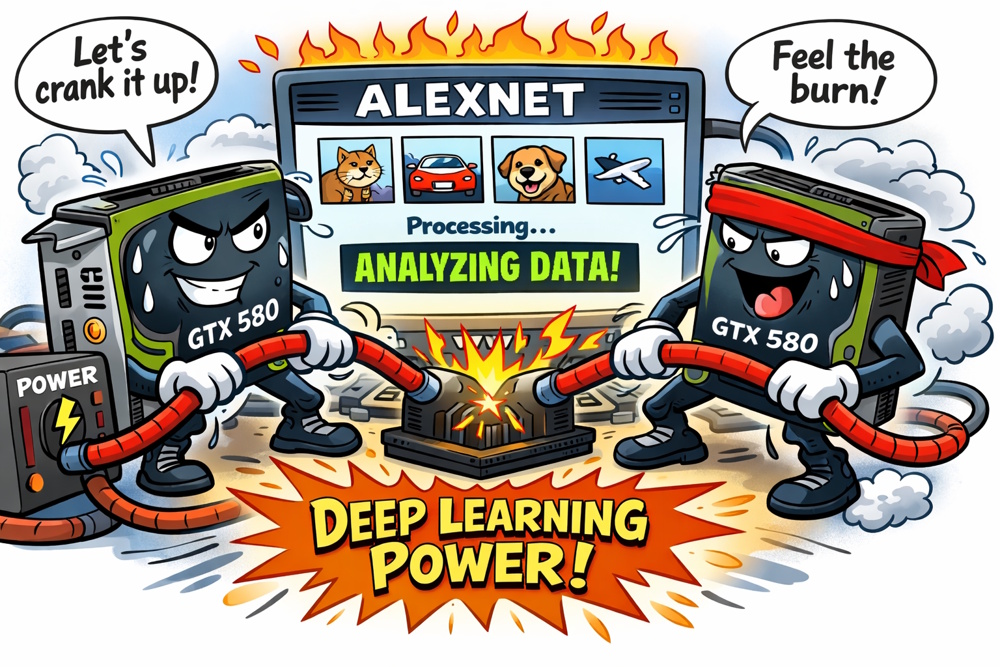
Training took about a week. The GPUs were running constantly, processing millions of images, adjusting millions of parameters through backpropagation. The team would start a training run, go about their daily work, and check back periodically to see how it was performing.
They had to split the network across two GPUs because it was too large to fit on one. Each GPU handled different layers, communicating with each other as needed. Krizhevsky's programming skills made it work together, overcoming enormous technical challenges.
As training progressed, they monitored validation accuracy; that is, how well the network performed on images it hadn't been trained on. This was the critical metric: could it generalize?
The results were shocking. The network was learning to recognize objects with accuracy far beyond anything they had expected.
The Test Results
When they finally ran AlexNet on the ImageNet test set—images the network had never seen—the results were stunning:
15.3% top-5 error rate.
Read that again. The previous year's winner: 25.8%. AlexNet: 15.3%.
That was a 10.5 percentage point improvement, more than four times the previous year's progress. In a field where improvements of 1-2 percentage points were considered significant, this was incomprehensible.
Incidentally, the second-place entry in 2012 achieved a 26.2% error rate, roughly the same number as in previous years using traditional methods. AlexNet didn't just win. It demolished the competition.
 The Announcement
On December 5, 2012, the ImageNet results were announced at NeurIPS (Neural Information Processing Systems), one of the world’s top AI Conferences, then called NIPS.
NeurIPS is widely regarded as the premier global conference for machine learning and artificial intelligence, attracting tens of thousands of researchers, engineers, and industry leaders every year. It serves as a venue for breakthroughs in deep learning, reinforcement learning, optimization, neuroscience-inspired AI, and emerging areas across the computational sciences. NeurIPS is an interdisciplinary conference spanning machine learning, statistics, optimization, computer vision, NLP, neuroscience, and more. It brings together academic researchers, industry practitioners, and AI startups to exchange cutting-edge research and shape the future of the field.
The 2012 conference marked the 26th Annual Conference, and was held at two casino resorts (Harrah’s and Harveys) in scenic Lake Tahoe, Nevada. It was a single-track conference, something quite different and almost impossible today given the scale of modern NeurIPS. The Lake Tahoe conference was one of the last years before the conference outgrew resort venues and moved to major convention centers.
The AlexNet paper “ImageNet Classification with Deep Convolutional Neural Networks” was accepted as a conference paper and included in the NIPS 2012 proceedings (Volume 25). That means the paper was formally presented in the standard conference format, it was discussed during the conference, and it was part of the official NIPS 2012 program, not a workshop or side event.
AlexNet was presented as a Spotlight presentation followed by a poster session. Spotlights are short, high-visibility presentations (typically ~5 minutes) given to papers considered important, but not important enough to be selected for full oral talks. Spotlights are designed to drive traffic to the poster session. That AlexNet received a Spotlight indicates the program committee already recognized it as a high-impact paper, even before the full magnitude of the breakthrough became clear.
When Hinton's team revealed their results to about 1,000 researchers, there was stunned silence, then murmuring, then excitement. They couldn't believe it. Many thought there must be an error. Some wondered if they had cheated. Researchers who attended NIPS 2012 describe the atmosphere around AlexNet as a blend of “Wait… is this real?” “How did they get this to run?” and “Why is the error rate so low?”
Despite the questions, the results were verified true. The images were the same. The evaluation was fair. AlexNet had genuinely achieved what had seemed impossible.
The reaction to AlexNet at NIPS 2012 is one of those rare moments in AI history where myth and reality coincide. Even though the conference lacked the massive deep-learning hype machine we know today, the model’s impact was immediate, unmistakable, and shocking, at least among those who understood what they were witnessing.
Computer vision researchers—many of whom had spent careers building hand-crafted feature detectors—realized their entire approach might be obsolete. Neural networks, which many had dismissed as hopelessly inefficient and impractical, had just proven they could crush traditional methods.
The paper, "ImageNet Classification with Deep Convolutional Neural Networks," was published and would become one of the most cited papers in computer science history (over 100,000 citations as of 2024).
The Immediate Aftermath
Within weeks, the story spread through the tech industry and research community like wildfire:
Google approached Hinton's team almost immediately. In March 2013, Google acquired a company that Hinton and his students had quickly formed (DNNresearch) for a reported $44 million. The team joined Google, though Hinton would split his time between Google and the University of Toronto.
Facebook, Microsoft, Amazon, and others scrambled to hire deep learning researchers and build AI teams. Anyone who had worked on neural networks—even those whose work had been ignored for years—suddenly had their pick of job offers.
University courses on deep learning went from obscure electives to overflowing. Stanford's CS231n (Convolutional Neural Networks for Visual Recognition) became one of the most popular courses.
Funding for AI research exploded. Venture capital poured into AI startups. Tech companies invested billions in AI research and development.
GPU manufacturers, particularly NVIDIA, saw their stock prices surge. The gaming hardware they had built accidentally became essential AI infrastructure. NVIDIA soon altered their core mission to become the supplier of GPUs, software, and systems for the burgeoning AI industry.
 Why It Mattered
It Wasn't Just About Accuracy
AlexNet's victory wasn't just about a number on a leaderboard. It represented several profound shifts in AI:
Proof of Concept for Deep Learning
For decades, skeptics argued that deep neural networks couldn't be trained effectively. The vanishing gradient problem meant that in deep networks, learning signals would get weaker in early layers, preventing them from learning anything useful.
AlexNet proved this could be overcome. Deep networks—networks with many layers learning hierarchical representations—could work. The key was the right architecture (CNNs), the right activation functions (ReLU), the right regularization (dropout), and enough data and computation.
Data and Compute Over Clever Algorithms
Traditional computer vision relied on human ingenuity—researchers carefully designing feature detectors based on an understanding of how vision works. This required deep expertise and years of work.
AlexNet showed that a relatively simple architecture, given enough data and computation, could learn better features automatically. The network discovered what features mattered by seeing millions of examples.
This represented a philosophical shift: maybe the path to AI wasn't through carefully engineered systems encoding human knowledge, but through simple learning algorithms with enough data and compute to discover patterns themselves.
The Scaling Hypothesis
AlexNet hinted at something that would become central to AI: performance seemed to improve predictably with more data and more compute. Want better results? Get more data. Train a bigger network. Use more GPUs.
This "scaling hypothesis" would drive the next decade of AI development, culminating in systems like GPT-3 and GPT-4 with hundreds of billions of parameters trained on vast datasets.
Practical Deep Learning Was Possible
Before AlexNet, deep learning seemed hopelessly impractical. Training deep networks required specialized supercomputers and took forever.
AlexNet showed you could do it with off-the-shelf gaming GPUs in reasonable timeframes. This democratized deep learning, for universities, startups, and individual researchers could experiment with it and succeed.
The Immediate Applications
Within months, companies were applying deep learning to everything:
Image Recognition: Facebook deployed face recognition. Google improved image search. Pinterest built visual search.
Speech Recognition: Deep learning revolutionized speech recognition. Siri, Alexa, Google Assistant all adopted deep neural networks for understanding speech.
Translation: Google Translate switched to neural networks and saw dramatic quality improvements.
Autonomous Vehicles: Self-driving car companies realized neural networks could recognize pedestrians, signs, and other vehicles better than hand-crafted systems.
Medical Imaging: Researchers began training networks to detect cancer, analyze X-rays, and assist diagnosis.
Recommendation Systems: YouTube, Netflix, and others used deep learning for better recommendations.
The flood gates had opened.
 The Legacy
The Deep Learning Boom
The decade following AlexNet's victory saw explosive progress:
2014: GoogLeNet (22 layer deep network) and VGG networks (16-19 layers) went even deeper, surpassing human performance with ImageNet error rates under 7%.
2015: ResNet (Residual Networks) from Microsoft Research went 152 layers deep, achieving superhuman 3.6% error rates.
2016: AlphaGo, using deep learning, defeated the world champion at Go, a milestone thought to be decades away or impossible. Defeating Lee Sedol at Go became an “aha moment” for AI in Asia.
2017: The Transformer architecture, from Google, revolutionized natural language processing.
2018-2020: BERT, GPT-2, GPT-3 showed language models could achieve remarkable capabilities.
2022: DALL-E 2, Midjourney, Stable Diffusion generated realistic images from text descriptions.
2023: ChatGPT made large language models accessible to the public, achieving 100 million users in two months, the fastest-growing consumer application in history.
Every one of these advances built solidly on the foundation AlexNet had established; deep neural networks, trained on large datasets, using GPUs for computation.
The People's Journeys
Geoffrey Hinton became one of the most celebrated figures in AI, winning the Turing Award (computer science's Nobel Prize) in 2018 along with Yann LeCun and Yoshua Bengio. In 2023, he left Google to speak freely about AI risks, warning about potential dangers of the technology he'd helped create.
Alex Krizhevsky joined Google with Hinton and Sutskever, working on various deep learning projects. He's become something of a legend in the deep learning community as the engineer who made AlexNet actually work.
Ilya Sutskever co-founded OpenAI in 2015, becoming its Chief Scientist. He was instrumental in developing GPT models and ChatGPT. In 2024, he left OpenAI to found a new AI safety company, focused on ensuring superintelligence benefits humanity.
All three have become wealthy and influential. But more importantly, they changed the trajectory of technology and, arguably, human civilization.
ImageNet's Evolving Role
The ImageNet Challenge continued through 2017, with error rates dropping to around 2-3%, well below human performance. The competition was retired because the problem was essentially solved.
ImageNet the dataset remains important for research, though deep learning has moved beyond it. New challenges involve video understanding, few-shot learning, robustness, and other frontiers.
Some criticize ImageNet for biases in its categories and labeling. It is a reminder that datasets shape AI systems in profound ways. But its historical importance is undeniable.
 The Deeper Meaning
Why Were They the Ones?
Looking back, why was it Hinton's team at Toronto that achieved this breakthrough, shorthanded, operating on a shoestring budget, rather than large teams working at huge labs with deep pockets at places like Google, Microsoft, MIT or Stanford?
Persistence: Hinton had worked on neural networks for 30 years when everyone else gave up. His students inherited this persistence.
Technical Skill: Krizhevsky's ability to optimize GPU code was rare. Implementation matters as much as ideas.
Timing: The convergence of available data (ImageNet), available compute (affordable GPUs), and accumulated knowledge (decades of neural network research) created a perfect moment.
Freedom: Being outside the mainstream meant they weren't constrained by prevailing wisdom. They could pursue ideas others had abandoned.
Desperation: As academic researchers without massive funding, they had to be efficient and creative. Constraints bred innovation.
There's a lesson here about scientific progress: sometimes the breakthrough comes from the margins, not the center. Sometimes the crazy idea everyone dismissed turns out to be right. Sometimes persistence matters more than resources.
 The Butterfly Effect
Think about the remarkable chain of events and their consequences:
Hinton persists with neural networks through decades of skepticism
ImageNet creates a large enough dataset to train big networks
GPU gaming hardware happens to be perfect for neural network training
Krizhevsky learns to code efficiently for GPUs, creating AlexNet
-
AlexNet wins ImageNet
-
Deep learning revolution begins
-
ChatGPT is released ten years later and quickly becomes the most successful app in history
-
Millions of people now interact with AI daily using many popular tools
-
Society grapples with AI's implications: infrastructure, data centers, governance, etc.
If any link in this chain broke—if Hinton had given up, if ImageNet hadn't been created, if GPUs weren't available, if Krizhevsky didn't have the coding skills—maybe we'd still be slowly improving hand-crafted computer vision systems. Maybe the AI revolution would have been delayed by years or decades.
History pivots on moments like the one that occurred on December 5, 2012, at Lake Tahoe.
The Questions AlexNet Raised
The victory also raised questions we're still grappling with today:
Interpretability: AlexNet worked, but nobody fully understood how. What features were those millions of parameters learning? This "black box" problem persists.
Data Requirements: AlexNet needed millions of labeled images. How do we apply deep learning when such data doesn't exist?
Computational Costs: Training models requires enormous energy. Is this sustainable?
Bias: Networks learn from data, including human biases in that data. How do we build fair systems?
Safety: As AI becomes more capable, how do we ensure it remains beneficial and controllable?
Societal Impact: What happens when AI can do tasks previously requiring human intelligence?
These questions, first raised by AlexNet's success, have only become more urgent.
AI Begins After AlexNet
A Case for the Modern Era Starting in 2012
AI, as we understand it today, truly begins after AlexNet. This is not to undervalue the decades of research that came before it. Instead, it's an acknowledgment that 2012 marks the moment when artificial intelligence shifted from a largely academic pursuit into a transformative technological force.
Before AlexNet, AI was a patchwork of symbolic systems, handcrafted features, and statistical models that worked well in narrow domains but failed to generalize. Progress was incremental, often brittle, and constrained by both algorithms and compute. The field had brilliant ideas but lacked the practical machinery to scale them into systems that could learn rich representations from raw data. AlexNet changed that overnight.
The breakthrough was not just about accuracy on ImageNet. Instead, it was about the demonstration that deep learning could finally work at scale. AlexNet proved that neural networks, long dismissed as computationally impractical, could outperform every classical computer vision technique by a massive margin when paired with GPUs and large datasets. This wasn't a small improvement; it was a discontinuity. The model cut the ImageNet error rate by more than 10 percentage points, a leap so large that it forced the entire field to reconsider its assumptions. Researchers who had spent years refining SIFT, HOG, and other handcrafted pipelines suddenly found themselves outpaced by a system that learned features automatically. The center of gravity in AI shifted from feature engineering to representation learning, and that shift has defined every major advance since.
AlexNet also marks the beginning of AI as a software ecosystem, not just a research discipline. The model catalyzed the creation of modern deep learning frameworks, GPU-accelerated libraries, and distributed training stacks. Without AlexNet, there is no TensorFlow, no PyTorch, no cuDNN, no large-scale GPU clusters. The entire infrastructure that powers today's foundation models traces its lineage back to the computational demands AlexNet exposed. In this sense, AlexNet 2012 is a scientific milestone and the birth of the modern AI software stack.
Most importantly, AlexNet marks the moment when AI began to scale. Everything that defines contemporary AI - Transformers, LLMs, diffusion models, reinforcement learning breakthroughs - depends on the idea that performance improves with more data, more compute, and deeper architectures. That scaling hypothesis was not widely accepted before 2012. AlexNet provided the first dramatic proof that bigger models trained on more data with more compute could unlock qualitatively new capabilities. It set the precedent for the exponential growth curves that now define the field.
For these reasons, one can argue that modern AI begins after AlexNet. The years before 2012 were the prehistory, full of important ideas, but limited by the inability to scale them. After AlexNet, AI became a software-driven, compute-hungry, representation-learning discipline capable of solving problems that had resisted decades of effort. It marks the transition from AI as a research curiosity to AI as a world-shaping technology.
In the same way that the Wright Flyer marks the beginning of aviation, even though gliders existed before it, AlexNet marks the beginning of the AI era we live in today.
 Epilogue
The Story Continues
On a fall day in 2012 that felt like winter, three researchers—a visionary professor, a brilliant programmer, and an insightful theorist—submitted results to an academic competition. They didn't expect to change the world. They were just trying to show that the approach they believed in actually worked.
But their victory became a watershed event; an “aha moment” for AI. It vindicated decades of persistence. It sparked a revolution. It redirected billions of dollars and thousands of careers. And it set in motion the AI transformation we're living through today.
When you unlock your phone with face recognition, when you ask Siri a question, when YouTube recommends a video, when you chat with ChatGPT—you're experiencing the legacy of AlexNet. The AI in your daily life traces back to that moment in 2012 when a deep neural network, trained on gaming GPUs in Toronto, won an academic competition by a margin nobody thought possible.
The story of AlexNet is about more than technology. It's about:
Believing in ideas when everyone else has given up
The power of having the right people with the right skills at the right time
How breakthroughs often come from unexpected places
The way single events can redirect the course of history
The importance of competitions and benchmarks that push fields forward
How gaming hardware accidentally enabled an AI revolution
The role of persistence, skill, timing, and luck in scientific progress
Geoffrey Hinton, who kept the faith for thirty years, once said: "My view is throw it all up in the air and see what happens." In 2012, they threw it up in the air. And what happened changed everything.
The researchers who won ImageNet that year probably didn't fully grasp what they had started. They were just happy their approach finally worked, that their years of effort paid off, that neural networks—the approach everyone had given up on—turned out to be right all along.
But history will remember AlexNet - December 2012 - Lake Tahoe as the moment when the modern AI era truly began. Not because someone invented neural networks (they'd been around for decades), not because someone had the idea of deep learning (Hinton had been pursuing it for years), but because someone finally made it work at a scale that convinced the world it mattered.
AlexNet didn't just win a competition. It won the future.
 Links
Links
Neural networks page.
Deep learning page.
Computer vision page.
External links open in a new tab:
- viso.ai/deep-learning/alexnet
- en.wikipedia.org/wiki/AlexNet
- pinecone.io/learn/series/image-search/imagenet
- techpowerup.com/gpu-specs/geforce-gtx-580.c270
- arstechnica.com/ai/2024/11/how-a-stubborn-computer-scientist-accidentally-launched-the-deep-learning-boom/
- github.com/computerhistory/AlexNet-Source-Code