 Deep AI's
Deep Tech from Meta and Google
 DeepFace
DeepFace is Meta's pioneering facial-recognition system, originally developed to identify faces in photos with a level of accuracy close to human perception. It was one of the earliest deep-learning models to demonstrate that neural networks could reliably match and verify faces at scale, using a nine-layer neural architecture trained on millions of images. This system became a milestone in modern computer vision, showing how deep learning could extract subtle patterns in facial structure and expression.
Over time, the term "DeepFace" has come to refer to two related but distinct things: Meta's proprietary facial-recognition engine and a separate open-source Python library inspired by the same ideas. Meta's internal system was designed for high-accuracy recognition across its platforms, while the open-source library provides developers with tools for face detection, verification, and analysis using multiple state-of-the-art models. Both versions helped shape the broader field of facial-analysis technology by making advanced recognition techniques more accessible to researchers and engineers.
In recent years, Meta has repurposed its facial-recognition capabilities to address emerging online threats, especially deepfake-driven scams. The company now uses facial recognition to detect fraudulent ads that misuse the likenesses of celebrities or public figures, a growing problem as AI-generated images and videos become more convincing. By identifying when a face in an ad matches a known public figure, Meta can block deceptive content before it spreads. This approach is part of a broader effort to protect users from manipulated media and misleading advertisements across Facebook and Instagram.
Meta is also testing DeepFace inspired facial-recognition tools to help users recover locked accounts. In these trials, users can verify their identity by recording a selfie video, which the system compares to their profile photos. This dual use - security against deepfake scams and account-recovery support - illustrates how Meta is using facial recognition as a safety and trust mechanism rather than a passive tagging feature.
 Deep Dive
DeepFace detects faces in an image, aligns them to a canonical frontal pose using 2D and 3D alignment ("frontalization"), then feeds them through a deep neural network to produce a 4096-dimensional embedding vector for each face. These embeddings are compared against stored vectors in a database to perform face verification or identification, enabling applications like automatic photo-tag suggestions and large-scale face search. The system uses a nine-layer neural network with over 120 million parameters, trained on about 4 million labeled face images from over 4,000 individuals to learn robust features across pose, lighting, and expression changes.
The standard DeepFace pipeline is often described as: detect → align (2D + 3D) → represent (deep network embedding) → classify/verify via similarity checks in embedding space. By explicitly modeling 3D face geometry before feature extraction, DeepFace reduces the impact of pose and viewpoint variability, improving recognition robustness in real-world photos and videos.
 DeepMind
Google DeepMind is one of the world's leading artificial intelligence research labs, built around a mission to develop advanced AI systems responsibly and use them to benefit humanity. The organization brings together scientists, engineers, ethicists, and researchers who focus on solving some of the hardest scientific and engineering challenges of our time. Its long-term vision includes contributing to artificial general intelligence (AGI) in a way that is safe, ethical, and transformative for society.
Founded in London in 2010 by Demis Hassabis, Shane Legg, and Mustafa Suleyman, DeepMind quickly became known for its ambitious research agenda and rapid breakthroughs. Google acquired the company in 2014, and in 2023 it merged with Google's Brain team to form Google DeepMind, a unified division dedicated to accelerating progress in AI. Today, the organization operates as a subsidiary of Alphabet Inc., with research centers across the UK, Canada, France, Germany, and the United States.
DeepMind's work spans a wide range of high-impact projects. It created AlphaGo, the system that defeated Go champion Lee Sedol; AlphaFold, which revolutionized biology by predicting protein structures; and Gemini, Google's flagship family of multimodal AI models. These achievements reflect DeepMind's commitment to scientific rigor, safety, and long-term societal benefit. The company emphasizes responsible development, using internal ethics councils and risk-assessment frameworks to guide its research.
In recent years, Google DeepMind has positioned itself as a central force in shaping the future of AI. Its work aims not only to push the boundaries of what machines can do, but also to ensure that these capabilities are deployed in ways that advance science, improve global well-being, and serve diverse communities. As AI continues to evolve rapidly, DeepMind remains one of the most influential institutions defining advancements in AI.
 DeepFace vs. DeepMind
The Eternal AI Roast Battle
DeepFace (Meta's face-recognition granddaddy) and DeepMind (Google's brainy little brother) have been low-key beefing since forever. One's obsessed with recognizing your grandma at the airport; the other's busy inventing Go-winning robots and protein folders. Naturally, the internet turned them into rival siblings who roast each other nonstop.
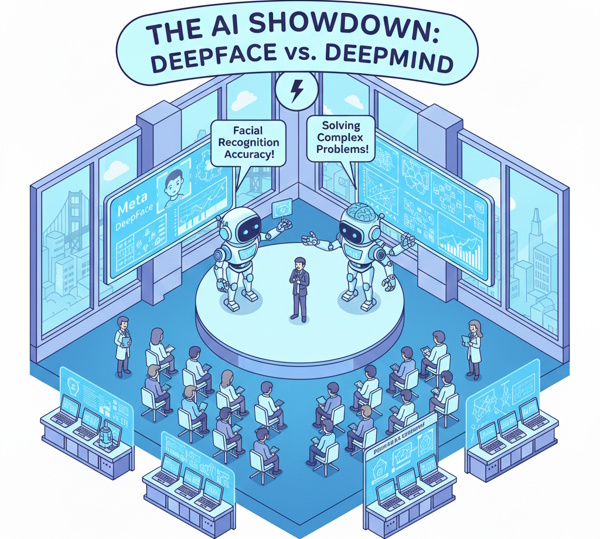
So, the two Deep AIs walk into a bar and immediately start beefing:
Round 1: The Face-Off
DeepFace: "I can recognize a
billion faces with 99.9% accuracy. I know what you look like, even when
you're trying to hide from your ex."
DeepMind: "Cool story. I solved
protein folding and cured diseases. You just help stalkers find people
faster."
DeepFace: "At least I'm useful in real life. You're still waiting for
your AGI Nobel Prize while playing board games."
DeepMind: "Board games?
I beat humans at Go so hard they retired. You're still confusing twins."
Round 2: The Job Roast
DeepFace: "I power facial
recognition for law enforcement and social media. I'm basically Big
Brother's favorite nephew."
DeepMind: "Yeah, and half the world wants to
ban you for privacy violations. I'm over here quietly saving lives with
AlphaFold. Checkmate."
DeepFace: "Saving lives? Your AlphaFold still hallucinates protein
structures sometimes. At least my hallucinations are just bad selfies."
DeepMind: "Bad selfies? You once tagged a potato as a person. I'm not sure
which is worse."
Round 3: The Existential Burn
DeepFace: "I'm
literally everywhere - phones, airports, your creepy neighbor's doorbell.
I'm the most deployed AI ever."
DeepMind: "Deployed? You're the reason
half of Europe has GDPR panic attacks. I'm the one people thank in
scientific papers."
DeepFace (final shot): "At least I have a face. You're just a bunch of
matrices pretending to have a personality."
DeepMind (ultimate
clapback): "Yeah, but my matrices can fold proteins. Your matrices can't
even fold a fitted sheet."
The crowd (the internet) loses it. DeepFace storms off to tag random cats in photos. DeepMind quietly publishes another paper and wins another prize.
Moral of the story: DeepFace sees your face. DeepMind sees the future. But neither of them can see how badly they just got roasted.
The End. Or as the caption on the viral meme read: "When your cousin who works retail tries to flex on the one who cures cancer."
 Links
Links
Humorous Guides to Surviving AI (3 book series) from AI World and Amazon Books includes AI is Just an App, Our House has a Brain, and AI is Coming for Your Job. LOL stories and teachings about artifiical intelligence. Paperback and Kindle versions.
Meta and Alphabet (Google) are Mag7 companies.
Deep Learning page.
Neural Networks page.
Computer Vision page.
More AI stories.
External links open in a new tab:
- en.wikipedia.org/wiki/DeepFace
- innovatiana.com/en/post/deepface-101
- forbes.com/sites/amitchowdhry/2014/03/18/facebooks-deepface-software-can-match-faces-with-97-25-accuracy/
- ai.meta.com/research/publications/deepface-closing-the-gap-to-human-level-performance-in-face-verification/
- gganbumarketplace.com/machine-learning/deepface-facial-recognition/
- en.wikipedia.org/wiki/Google_DeepMind
- deepmind.google/education/
- nature.com/articles/d41586-025-03713-1
- news.aibase.com/news/23452