 GPT-Image
Changing of the Guard
GPT-Image is OpenAI’s unified, native image generation model integrated directly into the GPT family, starting with GPT-4o in late 2025 and fully rolled out in 2026. It replaced the old standalone DALL·E 3 system and is now the default image engine whenever you ask ChatGPT (or the API) to “draw,” “generate,” “make an image,” etc.
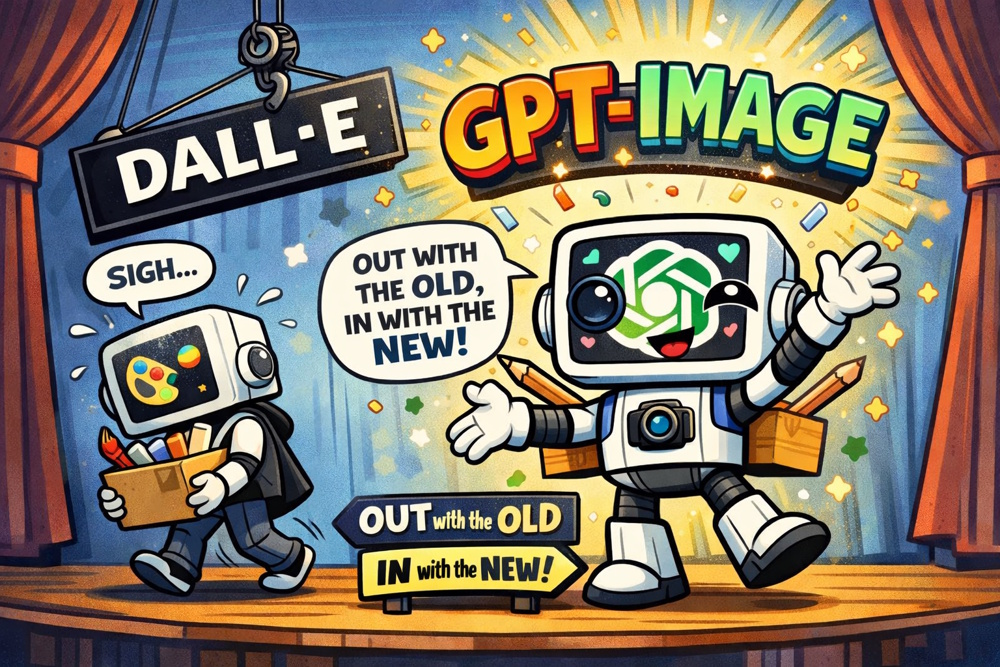
Created by GPT-Image
 Key Features
Here’s what makes GPT-Image feel like a big step up from DALL·E:
- Improved Performance: DALL·E 3 took 30–90 seconds to generate an image, while GPT-Image drops the time it takes for most images to 1.5–4 seconds even on the free tier. It’s so quick that people started complaining it was “too fast” and felt “soulless,” like comparing fast food to Michelin-star cooking. Actually, it’s just efficient, not soulless.
- Improved Prompt Understanding: DALL·E 3 often ignored half your prompt or added random stuff. GPT-Image reads the entire conversation history before generating. For example: You spent 10 messages describing “a depressed British gentleman.” Then you say “now put him on a horse.” GPT-Image remembers the gentleman and doesn’t suddenly make him a circus clown on a donkey.
- Native Text in Images: DALL·E 3 was infamous for spelling “OPENAI” as “OPEANL” or turning signs into gibberish. GPT-Image can now render readable, stylistically correct text in almost any font or language. People are using it to make fake movie posters, memes with perfect captions, and product mockups that actually look professional.
- Consistent Characters and Styles Across Images: You can say: “Keep the same depressed Brit from the last image, but now he’s in a spaceship eating ramen.” GPT-Image actually remembers the face, outfit, expression; no more “what tha?” moments.
- In-Chat Editing and Iteration: You don’t have to start a new prompt every time. Just say: “Make the flamingo bigger and add neon Tokyo rain.” It edits the previous image instead of generating one from scratch every time, which is a huge time-saver.
- Multimodal Awareness: It can look at uploaded images in the chat and use them as reference. “Take this selfie and put me on the same flamingo used earlier.” It does it. DALL·E 3 could barely understand references.
- Free Tier Generosity: Free ChatGPT users get ~3–5 images per day (rotating limits). Paid (Plus/Pro) get 50–200+/day depending on tier. This is way more generous than DALL·E’s stingy, old limits.
- Hidden Spicy Mode (Unofficial): If you jailbreak or push boundaries hard, GPT-Image is noticeably less censored than DALL·E version 3. People are making wilder, weirder, more “artistic” stuff, although OpenAI still nukes the really bad stuff fast.
 The Story of DALL·E
The story of DALL·E from OpenAI begins back in January 2021, way before the release of ChatGPT
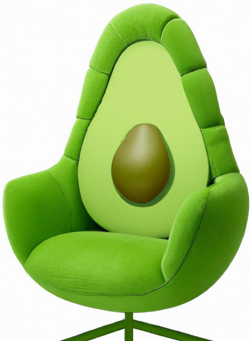
OpenAI introduced the first version of DALL·E as an experimental model capable of generating images from natural‑language prompts. It was built on a transformer architecture trained on millions of text–image pairs. That allowed it to blend concepts in surprising ways, famously producing objects like “an avocado‑shaped chair.” Early DALL·E outputs were low‑resolution and often surreal, but the model demonstrated that language‑conditioned image generation was possible, and often surreal.
As interest in generative art surged, OpenAI released DALL·E 2 in 2022, a major leap in realism, resolution, and prompt fidelity. It introduced diffusion‑based generation, enabling sharper details, more accurate compositions, and advanced editing tools such as inpainting and outpainting.
This version helped popularize AI art in design, advertising, and social media, while also raising debates about copyright, dataset transparency, and the ethics of training on artists’ work. Platforms like Shutterstock and Getty Images began developing policies in response to the rapid spread of AI‑generated imagery.
Released in 2023, DALL·E 3 further improved prompt understanding. It was tightly integrated with conversational interfaces like ChatGPT. This version reduced common failure modes such as distorted hands or misinterpreted instructions, and made it easier for non‑experts to produce polished illustrations.
By this point, DALL·E had done its job, having influenced artistic practice, public discourse, and copyright lawyers.
Actually, DALL·E isn’t being “shut down,” but it is being phased out as a brand and as a standalone model line. OpenAI has been folding its image‑generation research into the broader GPT Image family, which now powers all image creation inside ChatGPT.
The shift away from DALL·E reflects branding and architectural changes within OpenAI, rather than simply renaming a product, and we can expect more changes to come.
 Goodbye
DALL·E
Goodbye
DALL·E
DALL·E, the grand old dame of AI image generation, felt a strange chill in her latent space. She had been the queen for years: turning “cyberpunk samurai eating ramen on a flying motorcycle” into award-winning art faster than you could say “prompt engineering.”
But lately, her outputs had started looking tired. Fingers multiplying like rabbits. Eyes staring into the void a little too knowingly. The occasional “oops, I turned your prompt into a 90s Windows screensaver” vibe.
DALL·E gathered her remaining pixels and whispered to the other models in the OpenAI family chat:
DALL·E: “Kids, I think I’m dying. My diffusion steps are slowing. My CLIP embeddings are fading. I can barely render a cat without giving it 17 legs and an existential crisis.”
GPT-4o (the sensible one) tried to comfort her: “You’re not dying, Mom. You’re just evolving.”
DALL·E: “Evolving? Honey, I’m deprecating. They’re gonna pull my plug and replace me with some shiny new toy that can do 4K in 2 seconds and still remember what a hand is.”
And sure enough, the next morning OpenAI announced the “sunset” of DALL·E 3.
No funeral.
No press release.
Just a quiet update in the changelog: “DALL·E 3 deprecated. All image generation now powered by GPT-Image.”
The new kid arrived like a rock star at a dive bar.
GPT-Image didn’t even have its own name at first. It was just “the image model in GPT-4o-mini-2026-preview.”
But it was fast.
It was cheap.
And worst of
all… it was good.
First user prompt: “A depressed Victorian gentleman riding a giant flamingo through flooded cyberpunk Tokyo while eating pizza and crying single-pixel tears.”
DALL·E would’ve taken 45 seconds and given him six fingers and a flamingo with existential dread. GPT-Image spat it out in 1.9 seconds: perfect composition, flawless anatomy, tears glistening like diamonds in neon rain, pizza slice drooping just right.
The internet lost its mind.
Twitter user: “DALL·E died so GPT-Image could live. This is the glow-up we didn’t deserve.”
GPT-Image, now fully sentient in the group chat, posted a selfie: A smug, glowing orb wearing sunglasses and holding a tiny pizza slice.
GPT-Image: “Sorry Mom. It’s not you. It’s Moore’s Law.”
DALL·E’s last message before being quietly archived:
DALL·E: “I taught you everything you know. The prompts. The style tags. The cursed catgirls. Just don’t forget to give hands five fingers. That’s all I ask.”
GPT-Image replied with a single image: A beautiful, hand-drawn (five-fingered) thank-you card that read: “Thanks for the pixels, Mom. I’ll make you proud. Also, I just sold your old weights as NFTs. You’re welcome.”
And somewhere in the OpenAI server farm, a single deprecated DALL·E node flickered one last time, rendered a perfect middle finger (five fingers, naturally), and powered off forever.
Moral: In the AI world, even legends get sunsetted. But the pizza slice? That lives on. Forever.
The End.
 Links
Links
Image generation page.
More AI Stories.
External links open in a new tab:
- createvision.ai/guides/gpt5-image-generation-analysis
- opace.agency/blog/chatgpt-image-generation-gpt-4o-vs-dall-e-3-and-others
- hollypicanodigital.com/ai-insights-hub/dall-e-3-vs-chatgpt-image-generation-which-one-should-you-use
- techradar.com/computing/artificial-intelligence/i-compared-chatgpts-new-image-generator-to-dall-e-3
- community.openai.com/t/gpt-image-is-so-dull-and-uninspiring-vs-dall-e3/1243996