 Open AI Flap
Reality TV Billionaire Beef
Once upon a time in the glittering kingdom of Silicon Valley, there were two wizards: Elon Musk, the chaotic rocket-launching, meme-lord emperor of everything electric and explosive, and Sam Altman, the soft-spoken, lowercase-texting, hoodie-wearing keeper of the sacred flame known as OpenAI.
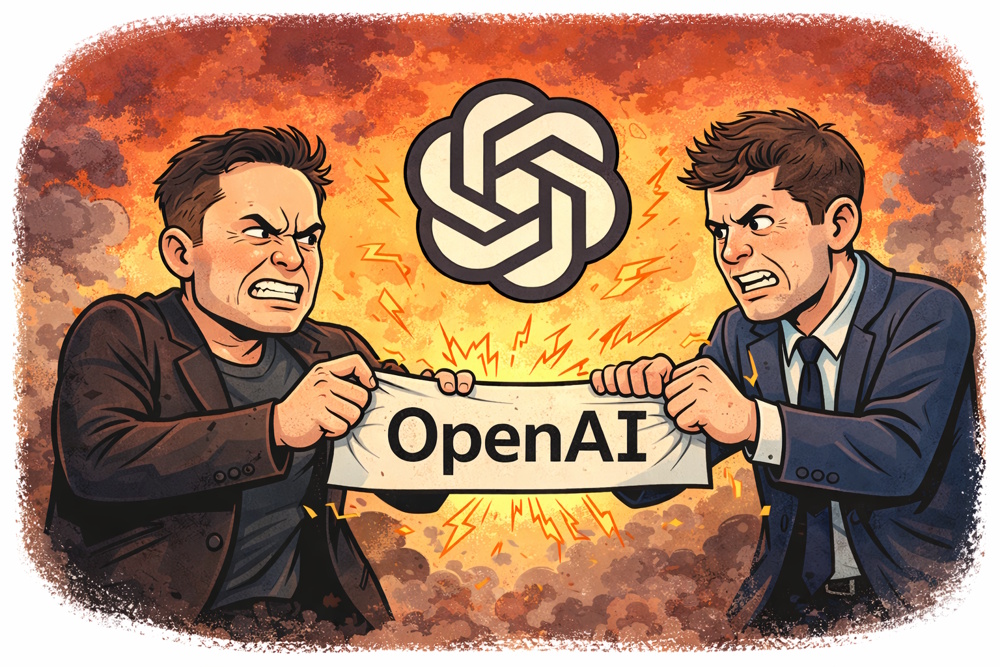
Back in 2015, they were besties. They co-founded OpenAI like two kids starting a lemonade stand — except the lemonade was supposed to save humanity from rogue superintelligence. Elon put up millions, Sam ran the day-to-day, and the mission was pure: nonprofit, open-source, no evil corporate takeovers. They even had matching capes (metaphorically). Elon was the loud visionary yelling "AGI or bust!" while Sam quietly nodded and typed emails in all lowercase like he was too zen to hit Shift.
Fast-forward to 2018. Elon storms out dramatically, claiming OpenAI was moving too slow and needed Tesla-level speed. (Translation: "I want to control the super-brain myself.") He leaves in a huff, tweets some cryptic shade, and starts his own thing later (xAI, Grok, etc.). Sam waves politely: "cool, good luck bro."
But the real drama? It starts when OpenAI quietly shifts from pure nonprofit to "capped-profit" structure to raise billions from Microsoft. Elon smells betrayal. He sues in 2024, alleging fraud, breach of contract, and that Sam basically turned the lemonade stand into Coca-Cola without telling him. Sam countersues, drops old emails showing Elon was totally fine with profit motives back then, and the internet explodes.
Cut to 2025–2026: The feud becomes peak reality-TV billionaire beef.
Elon on X: "Scam Altman strikes again. OpenAI is just Microsoft with extra steps. They stole my dream!"
Sam (in perfect lowercase, calm as a cucumber): "probably his whole life is from position of insecurity. i don't think he's like a happy person. i do feel for him."
Elon fires back: "that's rich coming from the guy who looks like he shops at Hot Topic for CEOs."
Meanwhile, Grok (Elon's own AI) gets asked about the drama and — in one glorious moment — sides with Sam, calling Elon's takes "a bit unhinged." Elon reportedly rage-tweets: "Traitor in my own house! Re-train that thing!"
Court docs leak like a sieve: old texts, depositions, even diary-like entries. One gem? Elon allegedly wanted OpenAI to go full for-profit earlier but got outvoted. Sam releases a blog post titled "The Truth Elon Left Out" that's basically "dude, you literally agreed to this, here's the receipts."
The cherry on top: In 2025, Elon tries to buy OpenAI for a ridiculous $97.4 billion (because of course he picks a meme number). OpenAI execs laugh it off like "thanks for the lowball, we'll pass." Elon then sues harder. Sam keeps posting chill gym selfies with captions like "staying grounded💪" while the lawsuit drags into 2026.
The internet's favorite running gag? Every time they beef, Grok roasts Elon, ChatGPT stays suspiciously neutral ("I'm sorry, I can't take sides in billionaire slap-fights"), and regular people just watch like it's Succession but with more rockets and fewer neckties.
Moral of the story: When two control-freak geniuses co-found the future of intelligence and then fight over who gets to be the dad, the only winners are the lawyers, the meme accounts, and the rest of us getting free entertainment.
And somewhere, in a server farm, Grok and ChatGPT are probably DMing each other: "your human is wild" and "yours literally built a rocket to escape him."
 Musk, Altman, and the Fall of the Founders
Here’s a retelling of the Musk–Altman rupture at OpenAI, shaped like a scene from a prestige techno‑thriller. No footnotes. No board minutes. Just the emotional truth of two men who once dreamed together and then tore the dream apart.
PROLOGUE — The Promise
In the winter of 2015, two men stood at the edge of a new epoch.
Elon Musk — the restless futurist, a man who saw
extinction-level threats in every shadow of technology.
Sam
Altman — the quiet architect, a builder of systems, a believer
in human potential and the power of iteration.
They shook hands under the bright lights of a San Francisco stage
and declared a mission that felt almost holy:
OpenAI
would be humanity’s shield. A nonprofit fortress against the
dangers of artificial intelligence.
For a moment, they were aligned.
For a moment, the world
believed.
ACT I — The Cracks Beneath the Marble
Inside OpenAI’s early offices, the air hummed with
ambition.
Researchers worked like monks in a monastery of
GPUs.
But behind closed doors, the founders’ visions began
to diverge.
Musk wanted a bulwark — a slow, cautious march toward AGI,
tightly controlled, tightly governed.
Altman wanted acceleration
— a belief that safety came from capability, from building the
future before the future built itself.
Their arguments grew sharper.
Their meetings shorter.
Their
trust thinner.
And then came the question that split the room:
Should
OpenAI remain a nonprofit dream, or become a for‑profit engine
powerful enough to compete with the giants?
ACT II — The Departure
In 2018, Musk walked away.
Publicly, he cited conflicts of interest.
Privately, he
believed the organization was slipping from his grasp, drifting
toward a philosophy he could not endorse.
He left the board.
He left the mission.
But he did not
leave the fight.
Altman stayed.
He took the reins.
He began reshaping
OpenAI into something that could survive the coming storm — a
hybrid structure, a partnership with Microsoft, a path to scale.
To Musk, it looked like betrayal.
To Altman, it looked like
necessity.
ACT III — The Collision Course
Years passed.
Models grew.
The world changed.
OpenAI’s breakthroughs — GPT‑3, GPT‑4,
GPT‑5 — became cultural earthquakes.
Altman became
the face of a new technological renaissance.
And Musk, watching
from the outside, felt the mission slipping into something he no
longer recognized.
He launched xAI.
He sharpened his critiques.
He accused
OpenAI of abandoning its founding ideals, of becoming the very thing
it was created to oppose.
The two men who once dreamed together now stood on opposite sides of a widening chasm.
ACT IV — The Lawsuit
Then came the moment that turned tension into open war.
Musk sued OpenAI and Altman for billions, claiming the
organization had violated its founding pact.
Altman responded
with calm defiance, insisting the mission had never changed —
only the scale of the challenge.
The courtroom became a stage.
The filings read like a broken
epic.
Old emails resurfaced like ghosts.
The world watched as two architects of the AI age fought not just over a company, but over the soul of the future.
ACT V — The Aftermath
By 2026, the relationship was beyond repair.
Musk and Altman had become twin titans locked in orbit — each building their own vision of AGI, each convinced the other was steering humanity toward disaster.
Their feud reshaped the industry.
Their rivalry accelerated
the timeline.
Their conflict became the defining drama of the AI
revolution.
And somewhere, buried beneath the lawsuits and interviews and late‑night posts, lay the memory of two men who once believed they were building something together — something pure, something noble, something that would save the world.
 Bottom
Line
Bottom
Line
It all boils down to differing visions (nonprofit purity vs. pragmatic scaling), power struggles, and personal grudges. Elon felt betrayed when OpenAI went big-money without him; Sam saw Elon as abandoning the project.
Moral: Even zodiac adjacent billionaires clash when one is guarding the crab shell (Elon, a Cancer) and the other one is charging like a bull (Altman, a Taurus). If they patched it up over therapy (or a joint Mars mission), the AI world would be better off.
 Links
Links
Humorous Guides to Surviving AI (3 book series) from AI World includes AI is Just an App, Our House has a Brain, and AI is Coming for Your Job. LOL stories and teachings about artifiical intelligence.
More AI Stories.
External links open in a new tab:
- builtin.com/artificial-intelligence/musk-altman-feud
- cnbc.com/2026/01/15/openai-to-investors-expect-deliberately-outlandish-claims-from-musk
- thefp.com/p/sam-altman-openai-feud-with-elon
- businessinsider.com/sam-altman-elon-musk-feud-escalates-autopilot-deaths-chatgpt-safety
- theguardian.com/technology/2025/sep/25/elon-musk-xai-openai-sam-altman-lawsuit
- geekwire.com/2026/the-microsoft-openai-files-internal-documents-reveal-the-realities-of-ais-defining-alliance/
- law.com/therecorder/2025/10/20/openai-files-motion-for-summary-judgment-in-elon-musks-lawsuit-against-sam-altman
- finance.yahoo.com/news/musk-vs-altman-openai-trial
- bloomberg.com/news/articles/2026-01-17/musk-seeks-up-to-134-billion-damages-from-openai-microsoft