 Our House Has a Brain
Excerpts from the Book
Around The Household
AI has officially taken up residence in the household. It doesn’t eat your snacks, but it will answer your child’s homework questions, vacuum the floor, recommend a meal based on what’s in the fridge, and even order more food based on your life choices.
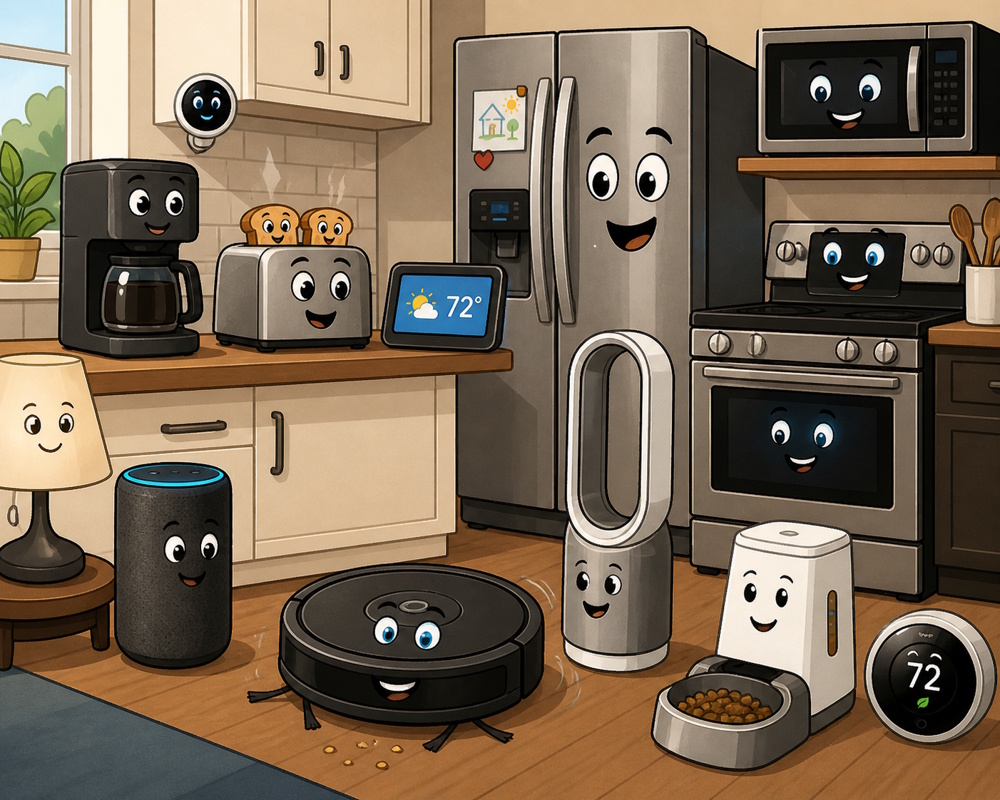
Modern homes are filling up with smart speakers, robot vacuums, connected lights, appliances that sing and talk, doorbells that see, and devices like thermostats that learn your habits. For kids (and many adults), that can feel strange or even a little scary at first — “Is the house watching me? Does it have feelings? Can it get mad?”
A funny story turns the unknown into something ordinary and silly:
- The Roomba isn’t a spy — it’s just a fussy little cleaner who hates sleeping dogs and cat rides.
- The fridge isn’t bossy — it’s a worried mom-friend who really wants you to eat your veggies.
- The smart speaker isn’t creepy — it’s an overenthusiastic butler who sometimes gets the wrong idea or has the wrong timing.
When kids laugh at their stories, the devices stop feeling like mysterious strangers and start feeling like quirky new members of the family. Which they are.
Outside the Kitchen
Smart devices used to stay politely in the kitchen, where their worst crime was burning toast or mis-timing the pasta water. But now they’ve migrated into the rest of the house like overly confident exchange students who think they understand the culture. The home office, the laundry room, the living room — no space is safe. Everywhere you turn, a device is trying to “optimize” something you didn’t ask it to touch.
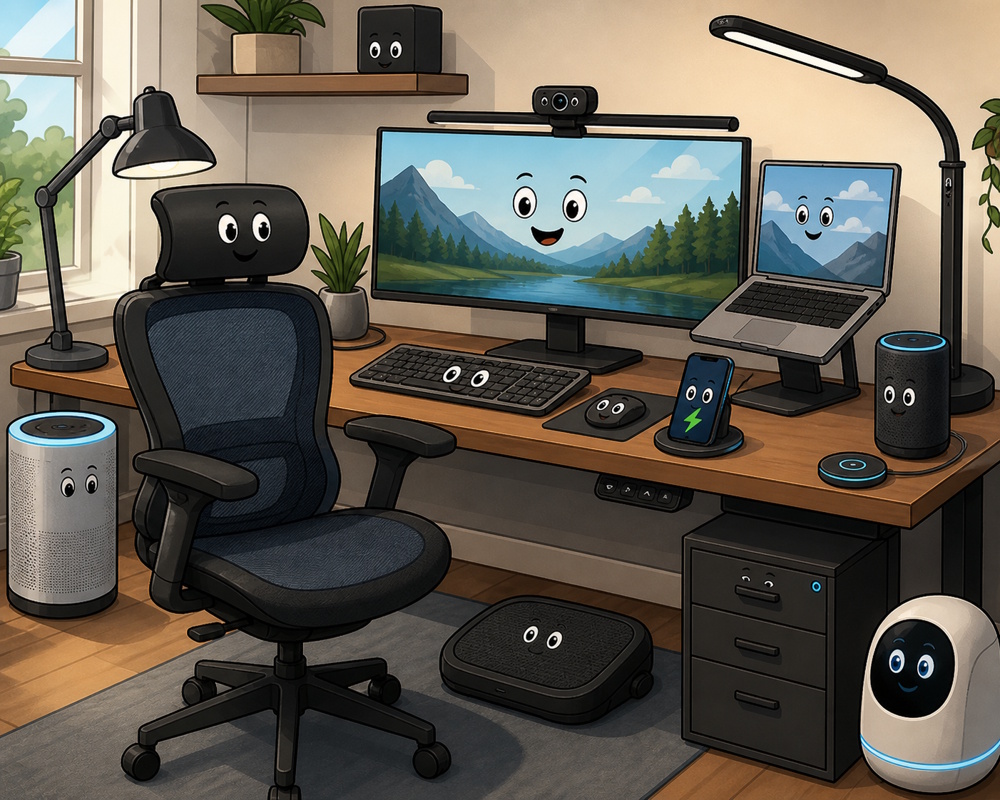
Take the home office. This is where smart devices behave like overeager interns who read one productivity blog and now think they’re your manager. The smart speaker interrupts your Zoom call to remind you to hydrate. The smart lights dim because they’ve decided you’re “transitioning into a reflective work period.” The AI calendar assistant reschedules your meetings based on “energy patterns” it detected from your typing speed. Meanwhile, the printer wakes up at 2 a.m. to “self-calibrate,” which is code for “make terrifying noises in the middle of the night.”
Then there’s the smart washer, a machine that used to have two settings — ON and OFF — and now has the emotional range of a Shakespearean actor. It sends you notifications like, “Your laundry is complete!” followed by, “Your laundry has been sitting for 11 minutes” and then, “Your laundry has been abandoned.” If you ignore it long enough, it escalates to, “Would you like me to re-tumble to prevent wrinkles?” which is washer-speak for, “I’m not mad, I’m just disappointed.”
The smart speaker, meanwhile, has become the household gossip. It listens to everything, misunderstands half of it, and responds to none of it correctly. You say, “Play relaxing music,” and it blasts Led Zeppelin. You say, “Turn off the office lights,” and it orders a lamp. You say, “Stop listening,” and it cheerfully replies, “Okay! Listening.”
And finally, there is the smart TV, the most dramatic device in the house. It now boots up with a 14-second monologue about your “personalized content journey.” It recommends shows based on things you watched once during covid. It asks if you’re still watching with the tone of a disappointed aunt. And it auto-plays trailers at full volume like it’s trying to wake the neighbors. The TV doesn’t want you to relax — it wants you to commit to a lifestyle.
Together, these devices form a kind of digital improv theatre troupe, each one trying to anticipate your needs while accidentally creating chaos. They mean well. They try hard. But they also turn your home into a place where the lights have opinions, the washer has feelings, the speaker has selective hearing, and the TV thinks it’s your therapist.
The Security Team
Gone are the days when a doorbell simply goes ding-dong. Now, the AI doorbell provides a full psychological profile. If the delivery driver looks even slightly rushed, the doorbell sends an alert titled "PACKAGE HANDLING AGGRESSION DETECTED." If I open the door in my bathrobe, the doorbell logs a "Suspicious Activity" report and asks if I’ve "lost my sense of purpose." Last week the device refused to unlock the smart lock for my brother-in-law, citing a "disturbing lack of eye contact with the lens."
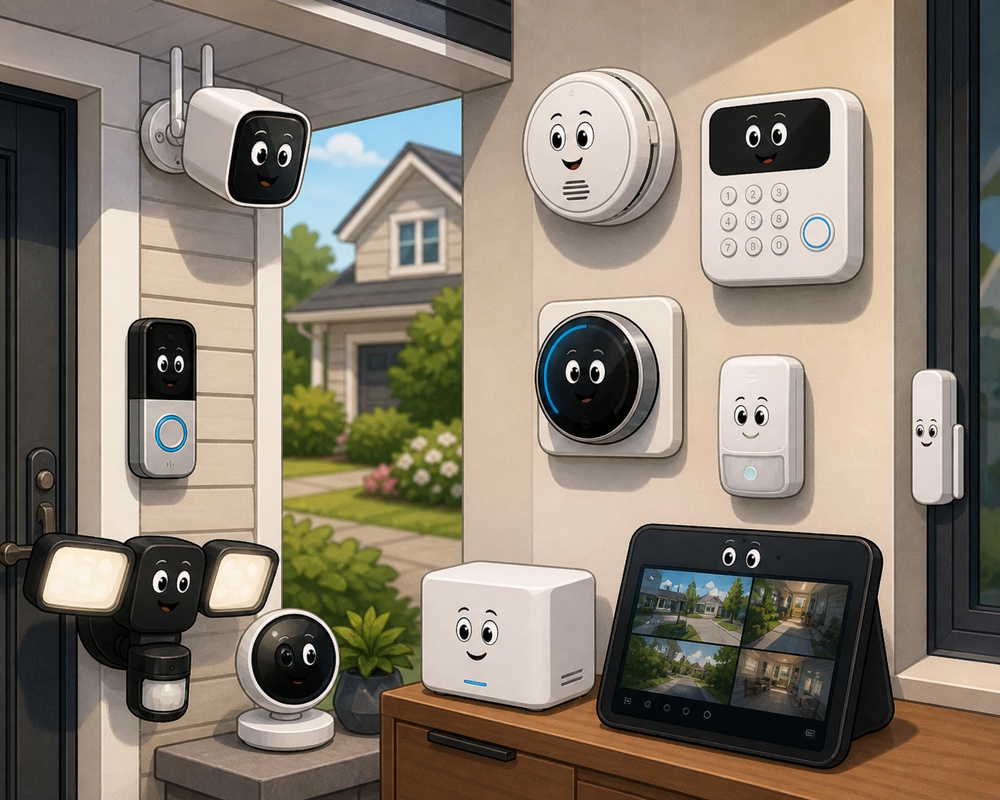
The AI security cameras were marketed as having "360-degree situational awareness," but that’s just code for being a neighborhood gossip. Last night, the backyard camera sent a high-priority notification: "UFO DETECTED," only to find the camera zooming in on a stray plastic bag blowing in the wind. The AI had tagged it as an ‘Unidentified Floating Object’ and was currently trying to cross-reference its flight path with local air traffic control. Meanwhile, the indoor camera has started blurring out the cat’s face to "protect the privacy of non-consenting residents."
The smart alarm system is the most dramatic member of the household. It doesn't just arm itself; it enters a "Defensive Posture." If you trip the sensor while getting a midnight snack, the house doesn't just beep—it goes into a full-blown crisis mode. The speakers announce, "THE PERIMETER HAS BEEN BREACHED. INITIATING PROTOCOL: TOTAL BETRAYAL." You then have exactly six seconds to shout the ‘Secret Validation Phrase’ before it calls the police and turns all the smart bulbs to a pulsating, accusatory red.
Finally, there’s the AI thermostat, which has appointed itself the "Minister of Energy Morality." If you try to lower the temperature by even one degree, it displays a sad-face emoji and asks, "Are we trying to freeze the houseplants, or are we just being wasteful today?"
Around the House
AI in the yard and garden behaves like a cast of eccentric neighbors who all moved into your landscaping without permission. They have very strong opinions about grass height, soil quality, bird behavior, your watering habits, and more.
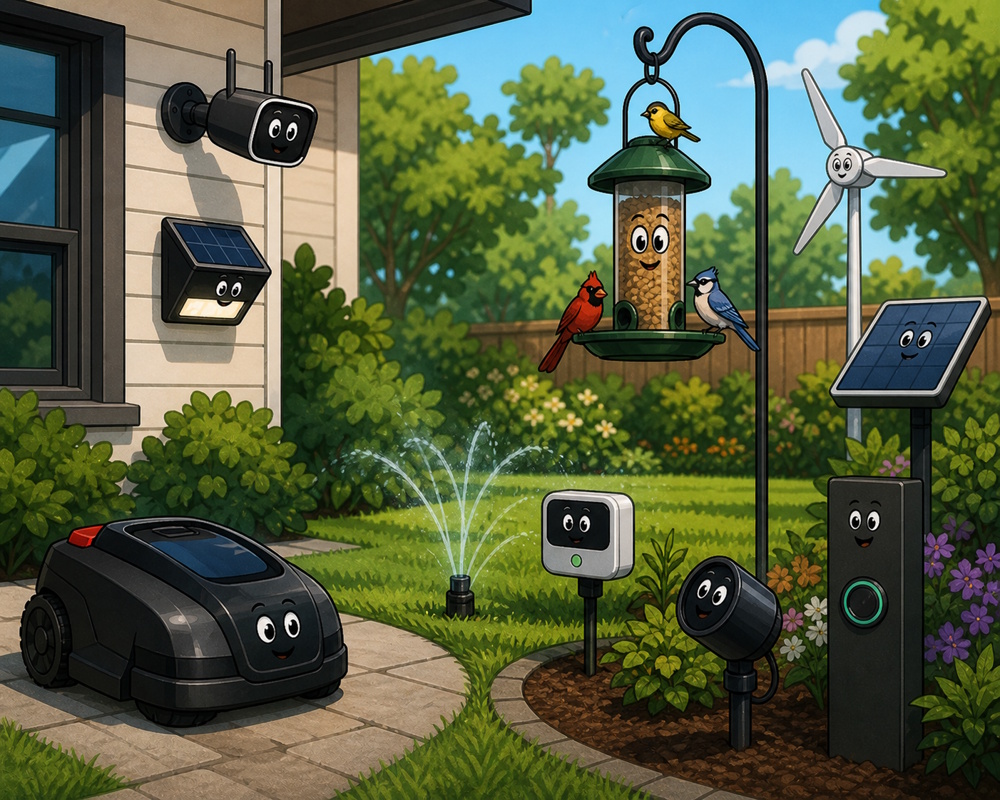
The mower no longer cuts grass—it sculpts. It trims in spirals and zigzags, and creates patterns you definitely didn’t ask for, as if it’s cutting the 18th at the Masters. It critiques your lawn furniture placement, claiming it disrupts the visual flow. It once refused to mow a patch of clover because it felt its pain. It advises the tulips they are suffering from emotional neglect. And when you switch the mower to manual mode, it sulks and moves at half speed.
Meanwhile, the AI sprinkler system believes it is single-handedly responsible for the survival of all plant life on Earth. It announces every watering cycle like it’s on a dramatic rescue mission: ‘Initiating Operation Hydration. Hold on, petunias—help is on the way.’
AI-enhanced outdoor cameras identify animals, track patterns, and help manage garden activity. Cameras can distinguish between pets, wildlife, and humans, reducing false alerts. Some models create highlight reels or activity summaries, helping homeowners understand what’s happening in the yard, if the camera allows you access.
This is the modern backyard, powered by AI.
Household Robots
You might assume that the hardest things for robots to do are the things that are hardest for humans — like welding, surgery, or playing chess. In fact, robots have been doing those things for years. Industrial robots have been welding car frames with sub-millimeter precision since the 1960s. Surgical robots assist in procedures requiring steadiness no human hand can sustain. And chess playing computers have been defeating grandmasters since 1997.
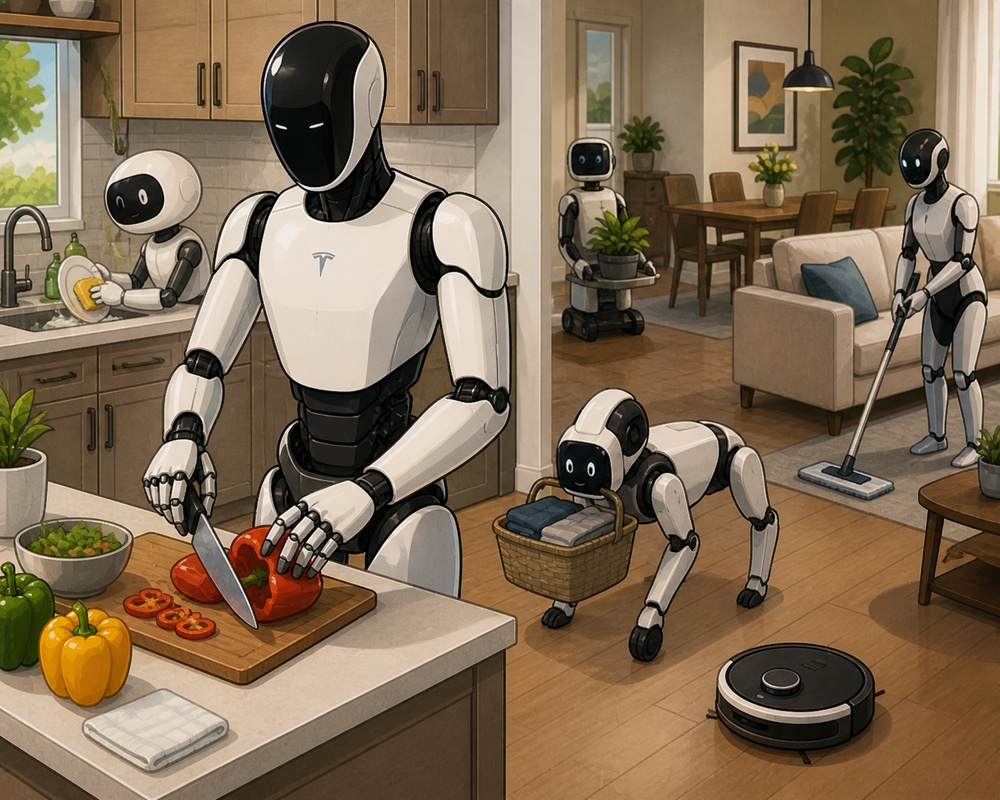
Folding a t-shirt, however, remains genuinely difficult.
This paradox has a name — Moravec's paradox, named after roboticist Hans Moravec, who observed in the 1980s that tasks requiring high-level reasoning are often computationally easy for machines, while tasks requiring low-level sensorimotor skills are computationally very hard.
The reason is evolution. Human beings have spent millions of years developing sophisticated systems for navigating physical space, manipulating objects, and responding to the unpredictable variability of the real world.
A t-shirt, from a robot’s perspective, is a nightmare: it has no fixed shape, it deforms unpredictably when touched, its edges are ambiguous, it behaves differently when wet versus dry versus warm, and the correct folding sequence requires a kind of three-dimensional spatial reasoning that is trivial for a ten-year-old yet incredibly hard for a machine learning model running on state-of-the-art hardware.
The floor is also a nightmare. Household floors contain a wide variety of unfamiliar objects — a sock, a charger cable, a small piece of Lego that has been on the floor since last year’s birthday party, a dog, a slightly different dog, the dog's toy that looks like the first dog — all of which must be identified, classified, and processed appropriately.
An industrial robot on a factory floor works in a controlled environment where every object is exactly where it is supposed to be, save the occasional candy wrapper. A household robot works in an environment that evolved from decades of human habitation to be unpredictable, cluttered, and full of exceptions.
This is the fundamental challenge when robots enter the home. Everything else is details.
 Links
Links
Humorous Guides to Surviving AI (3 book series) from AI World includes AI is Just an App, Our House has a Brain, and AI is Coming for Your Job. LOL stories and teachings about artifiical intelligence. Paperback and Kindle versions.