 Pigeon Warfare
Winning the AI Arms Race
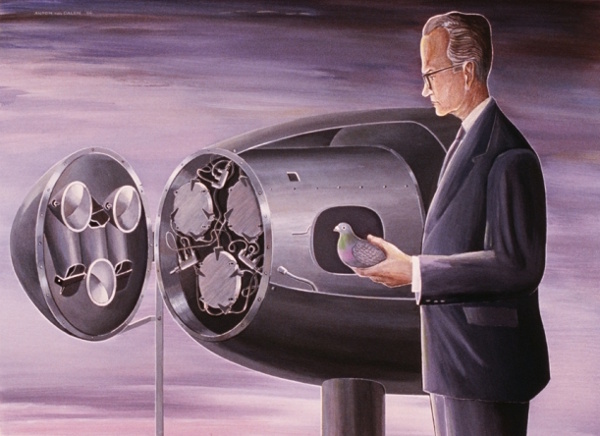
Project Pigeon (later Project ORCON, for "ORganic CONtrol") was American behaviorist B. F. Skinner's attempt to develop a pigeon-controlled guided bomb. Here's how it happened during the Cold War:
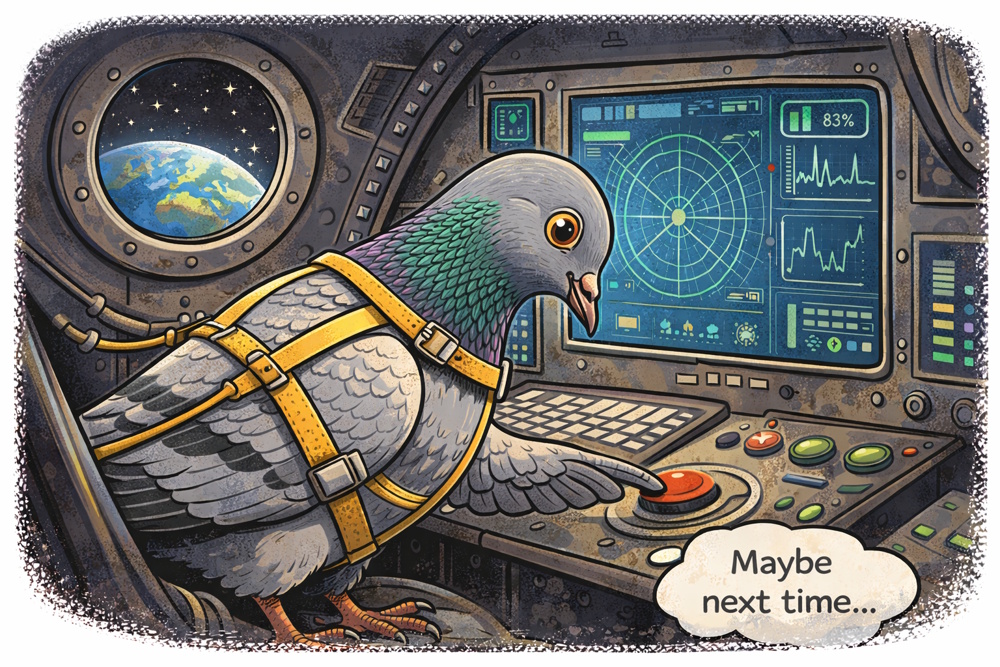
Once upon a very tense time in 1957, the Cold War was hotter than a Khrushchev speech at the UN. Sputnik had just beeped its way into orbit, humiliating the Americans, who were still trying to get their Vanguard rocket to stop exploding on the launch pad like a very expensive firework.
Washington was in full panic mode: if the Soviets could put a beach-ball-sized satellite over Ohio, what was stopping them from putting a thinking machine in the sky next?
Enter Project ORCON, one of the U.S. military's more creative ideas for winning the AI arms race before AI was even called AI.
The plan was simple, or at least it looked simple on classified paper: train pigeons to steer missiles.
Yes, pigeons.
The brilliant (and slightly unhinged) behavioral psychologist B.F. Skinner had already shown that pigeons could be conditioned to peck at targets with eerie precision. So DARPA's bright idea was: strap a live pigeon inside the nose cone of a missile, give it a little screen showing the target, and let the bird peck left/right/up/down on a joystick-like apparatus wired to the guidance fins. The pigeon sees the target drifting off-center → pecks frantically to correct → missile stays on course. Human pilot? Obsolete. Soviet interceptors? Useless against feathered kamikaze precision.
They actually built prototypes. Real ones. There are declassified photos of pigeons wearing tiny harnesses, staring at grainy screens, pecking like their lives (and the fate of Western civilization) depended on it.
Meanwhile, across the Iron Curtain, Soviet scientists weren't sitting idle. Their cybernetics program - still recovering from Stalin calling it "bourgeois pseudoscience" - had quietly pivoted to what they called "thinking machines." But because the word "cybernetics" sounded too Western, they rebranded it as "technical self-regulation of complex systems." Very Soviet. They were also experimenting with animal control: dogs wired to guide torpedoes, cats with implanted electrodes to spy on embassies (Project Acoustic Kitty's distant cousin, basically).
So picture this:
- American generals in the Pentagon war room, sweating over grainy reconnaissance photos of a pigeon coop outside a secret facility near Novosibirsk.
- Soviet marshals in the Kremlin, staring at intercepted cables describing "Project Pigeon" and concluding it must be code for something terrifying. Surely no capitalist would waste millions on actual birds.
- Both sides burning midnight oil, convinced the other had cracked artificial general intelligence when really they were just racing to see whose bird could peck straighter.
The punchline? Neither side ever deployed the pigeon/torpedo/cat systems. The Americans eventually admitted the pigeons got motion-sick in flight simulators. The Soviets quietly shelved their animal programs after one too many dogs refused to swim toward capitalist destroyers.
But here's the real kicker: while everyone was distracted by feathered missile guidance and wired cats, a quiet group of mathematicians at places like MIT and the Institute for Precise Mechanics in Moscow kept plugging away at symbolic logic, neural nets, and game theory, stuff that actually mattered.
By the time the Berlin Wall fell, the real winner wasn't the pigeon or the dog.
It was the nerds who never got invited to the classified animal-training sessions.
Moral of the story: In the Cold War AI race, the superpowers spent millions trying to turn birds into guidance systems, while the actual breakthrough was being coded in Fortran by people who probably couldn't tell a pigeon from a punch card.
And somewhere in a declassified archive, there's still a photo of a very serious-looking pigeon wearing goggles, wondering why it signed up for this.
 Links
Links
Humorous Guides to Surviving AI (3 book series) from AI World and Amazon Books includes AI is Just an App, Our House has a Brain, and AI is Coming for Your Job. LOL stories and teachings about artifiical intelligence. Paperback and Kindle versions.
More AI Stories.
DARPA page.
Sputnik Sparks: The Cold War Birth of AI Funding.
External links open in a new tab:
- en.wikipedia.org/wiki/Project_Pigeon
- cyberneticzoo.com/bionics/1940-project-pigeon-1948-project-orcon-b-f-skinner-american/
- en.wikipedia.org/wiki/Acoustic_Kitty