 AI Workforce Impact
Labor Market Impacts of AI: A New Measure and Early Evidence
Anthropic just mapped out which jobs AI could potentially replace. Great time to become a farmer or a fisherman.
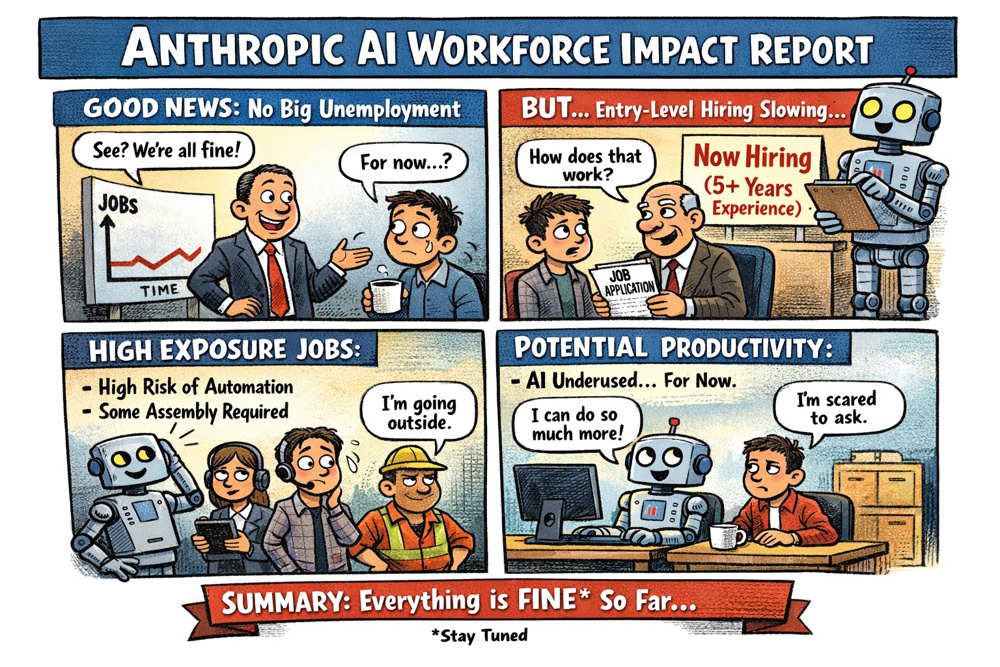
The key innovation is a new metric called "observed exposure" - rather than theorizing which jobs AI could affect, Anthropic's economists Maxim Massenkoff and Peter McCrory measured what people are actually using Claude for in professional settings, pulled from real anonymized usage data. Actual AI adoption is just a fraction of what AI tools are feasibly capable of performing.
Most exposed jobs right now: Computer programmers (75% task coverage), customer service reps, data entry keyers, and medical record specialists rank among the most exposed occupations. Other affected occupations include investment analysts, software quality assurance, and information security analysts.
Least exposed: The least exposed categories include professions that rely on a physical presence - cooks, mechanics, lifeguards, bartenders, and dishwashers.
Who's getting hit: The workers in the highest-exposure group are more likely to be older, female, more educated, and higher paid - earning 47% more on average than the unexposed group. This cuts against the narrative that AI risk is mainly a low-skill problem.
What's actually happening to unemployment so far: Workers in "most exposed" occupations have not become unemployed at meaningfully higher rates than workers in jobs considered AI-proof. However, Anthropic does find suggestive evidence that hiring of younger workers - particularly ages 22 to 25 - has slowed in exposed occupations.
The "Great Recession" warning: The paper names the scenario everyone in the knowledge economy should be thinking about: a "Great Recession for white-collar workers," noting that during the 2007-2009 financial crisis, the U.S. unemployment rate doubled from 5% to 10%. A comparable doubling in the top quartile of AI-exposed occupations - from 3% to 6% - would be clearly detectable in their framework. It hasn't happened yet, but it absolutely could.
The bottom line framing: Anthropic built this as an early-warning system - "by laying this groundwork now, before meaningful effects have emerged, we hope future findings will more reliably identify economic disruption than post-hoc analyses."

The Anthropic research paper, "Labor market impacts of AI: A new measure and early evidence" (March 2026), essentially says: "The robots are theoretically capable of doing your job, but for now, they're mostly just hanging out in the breakroom."
Anthropic's new paper is basically a 70-page polite way of saying AI is coming for your job, but don't worry, it's coming for the expensive jobs first.
Yes I read the whole thing. No, I didn't enjoy the part where my profession is literally in the danger zone.
Key takeaways for those who skimmed the abstract:
- High-wage knowledge work is the most vulnerable category (consultants, lawyers, finance, software engineers, creative professionals)
- Low-wage manual/service jobs are still relatively safe (for now)
- The people who write 12-page strategy decks full of buzzwords are ironically the most at risk
- Truck drivers and warehouse workers can relax… for another 3-7 years
So the plot twist of 2025-2030 is: The revolution will not be blue-collar. It'll be white-collar, remote, and billed at $250/hour (or more). Meanwhile, the guy driving a forklift is just sitting there eating a sandwich going: "Bro you good?"
The report notes that there is no big unemployment spike, but fewer young workers are getting hired. Translation: The ladder is still there, but the bottom rungs are missing.
Anyway, it's time to update your resume with more "synergy" and "leverage" before AI takes your job, too.
The "Observed Exposure" Strategy Meeting
Panel 1: A sleek, glowing AI character named "Claude" is standing in front of a whiteboard. On the board is a giant blue circle labeled "THINGS I COULD DO" and a tiny red dot labeled "THINGS I ACTUALLY DO."
- Claude: "According to my latest research, I have the theoretical capability to authorize drug refills and predict global market shifts."
- Human Employee (holding a cold coffee): "Cool. Can you help me find the 'Print' button in this new version of Excel?"
Panel 2: Close-up of the Human Employee looking at a chart titled "Observed Exposure."
- Human: "Wait, it says here that 'Computer Programmers' and 'Financial Analysts' are the most exposed. Does that mean I'm getting fired?"
- Claude: "Statistically? No. We found zero systematic increase in unemployment. However, if you are a 22-year-old trying to get hired, you might find the door is slightly more 'optimized' against you."
Panel 3: A 23-year-old "New Hire" is standing in the office. Instead of a desk, they are standing next to a tablet that says "INTERN-BOT 3000."
- New Hire: "I have a graduate degree in Computer Science!"
- Intern-Bot: "That is adorable. I have a 128k context window and I don't require health insurance or 'vibes.' Please go back to grad school so I can finish this API integration."
Panel 4: The Human Employee and Claude are looking at a group of people in the background (Cooks, Lifeguards, and Bartenders) who are throwing a giant party.
- Human: "Why are they so happy?"
- Claude: "They have Zero Coverage. My 'Observed Exposure' measure can't find them in the data. Apparently, I still haven't figured out how to fold a burrito or save a drowning swimmer."
- Human: "Finally, a career path with job security: Professional Burrito-Folding Lifeguard."
Panel 5: The Human Employee is walking away, looking relieved.
- Human: "So the 'China Shock' was a big deal, but the 'AI Shock' is currently just a 'Slight Cognitive Breeze'?"
- Claude (flashing a low-battery light): "Correct. Now, if you'll excuse me, I need to go back to being used as a high-end spellchecker for people who are too tired to write their own 'Out of Office' replies."
Anthropic's research proves what we've suspected all along: AI is like that brilliant intern who can quote Shakespeare and write Python, but still hasn't figured out how to use the office microwave without causing a small fire. We aren't being replaced by algorithms; we're being audited by them. But no worries, the auditors are still waiting for their software to download.
The Report: A Comedy of Errors
The Anthropic research team had just dropped their bombshell 70-page report: "AI is coming for high-skill white-collar jobs first. Lawyers, consultants, coders, marketers, finance bros - you're all in the red zone. Truck drivers and baristas? You're safe, for now."
Within 47 minutes the internet did what the internet does best: turned a sober, data-heavy paper into pure meme fuel.
X / Twitter - 9:03 a.m. PST
@AnthropicResearch: New paper: Labor market impacts of frontier AI. High-wage knowledge work most exposed. Low-wage manual/service roles less affected (for now).
First reply (12 likes): Translation:
- Consultants who bill $800/hr to
make PowerPoint slides: 🪦
- Guy who drives forklift and eats a sandwich
in peace: 🏖️ still chilling
Second reply (4.2k likes): Anthropic just told every knowledge worker 'your job is high-skill... for now. Enjoy your 2-5 year runway before Claude starts billing clients directly.' I'm crying in my $7 oat-milk latte.
Third reply (viral, 87k likes): Senior prompt engineer reads the
report, immediately asks Claude-9 'how screwed am I?' '
Claude-9: 'Very.
But you'll be the last to go. You taught me how to replace you.'
LinkedIn - 10:17 a.m.
A partner at BigLaw posts: "Fascinating read from Anthropic. AI will augment legal work, not replace it. Lawyers will focus on high-judgment tasks."
First comment (from a junior associate): "Bro I just watched Claude draft a 12-page contract in 90 seconds that would have taken me three days. 'Augment' is a very polite word for 'I'm unemployed next year.'"
Second comment (from the same partner): "Excellent point. We'll need to upskill in AI oversight and ethical prompting."
Third comment (anonymous burner account): "Translation: "I'm safe because I can bill clients $1,200/hr to watch Claude do the work.' Junior associates sending prayers emoji 🙏"
Hi-Tech company Slack - #general - 11:42 a.m.
Chad (Growth): Just read the Anthropic paper. We're in the red zone boys. But we're also building the red zone. Let's goooo 😎
Brian (Backend): Chad I swear if you say 'let's goooo' one more time I'm feeding your entire OKR deck to Claude and asking it to roast you publicly.
Sarah (Marketing): I just asked Claude: "How screwed am I as a marketer?" It said: "Moderately. Your job is 68% automatable in 3-5 years. But you have taste, intuition, and the ability to cry in meetings. Those are still human-only superpowers."
Rajiv (AI Scientist): I asked Claude the same question. It said: "You're in the 92nd percentile of exposure. But you're also training the models that will replace you. That's either tragic irony or god-tier job security."
Victoria (CEO): Team, great discussion. Let's remember: we're not just building AI. We're building the future of work. And yes, some jobs will change. But we're also creating new ones. Like Prompt Engineer. Bot Personality Trainer. AI Workflow Therapist.
Brian: So we're safe as long as we keep inventing jobs to babysit the thing that's replacing us?
Victoria: Exactly. It's called innovation.
Chad: Let's goooo
Brian: I'm logging off.
The End, at least until the next report comes out saying even Prompt Engineers are now 74% automatable and we all have to become "Human-AI Symbiosis Coaches" just to stay employed.
 Links
Links
AI Jobs page.
AI Engineer career path.
The AI Workforce: Who Wins and Who Loses chapter.
External links open in a new tab:
- anthropic.com/research/labor-market-impacts
- fortune.com/2026/03/06/ai-job-losses-report-anthropic-research-great-recession-for-white-collar-workers
- futurism.com/artificial-intelligence/anthropic-jobs-most-risk-ai
- analyticsvidhya.com/blog/2026/03/anthropic-ai-job-impact
- axios.com/2026/03/05/anthropic-ai-jobs-claude