 AI Layer Cake
More Than an App
The "layer cake" of AI, as described by NVIDIA CEO Jensen Huang, is a metaphor for the five essential layers that comprise the AI ecosystem.
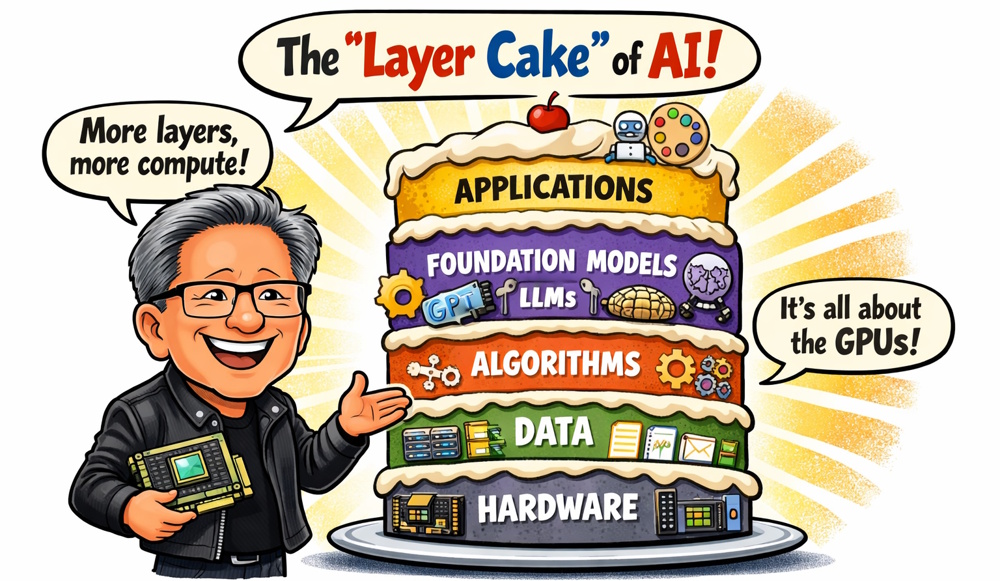
The "layer cake" of AI emphasizes that true AI power comes from mastering the entire stack, not just one part. Applications, the top layer, is the most important layer for economic value. It is also the only layer most users consume or even see. The layer cake is the complete "recipe" required to make modern AI actually work at scale in the real world. The model highlights how these layers are intertwined, and the importance of each one in the development and deployment of AI technologies.
Here are the layers, from bottom (foundation) to top (what users actually see):
1. Bottom Layer: Energy (represented in the graphic as Hardware)
The raw power. Electricity, cooling, water for data centers,
nuclear/fusion/solar grids - whatever keeps the lights on 24/7.
Jensen's
line: "No energy, no AI. You can have the best model in the world, but if
you can't plug it in, it's just an expensive paperweight."
2. Second Layer: Infrastructure (Data)
Data centers, networking, storage, cooling towers, undersea cables, power
substations - the physical and plumbing backbone. Training and inference at
scale requires massive infrastructure.
Jensen loves
reminding people: "This is where most of the money and pain lives."
We have already invested hundreds of billions of dollars. There are trillions of dollars' worth of infrastructure yet to be built. And this is reasonable because all these contexts must be processed so that artificial intelligence and models can generate the necessary intelligence to drive the applications that will eventually occupy the top layer. (Jensen Huang)
3. Third Layer: Chips (Algorithms)
GPUs, accelerators, interconnects (NVLink, InfiniBand), next-gen
architectures (Hopper → Blackwell →
Vera Rubin). This is the "brain muscle," the
actual silicon doing the FLOPs.
Jensen's flex: "Everything above this
layer sits on our shoulders."
4. Fourth Layer: Models (LLMs)
The trained weights like Llama, Grok, GPT, Claude, Qwen, Gemini, etc. The reasoning engines, multimodal beasts, and foundation models. They run on the chips, but they're built by thousands of researchers worldwide.
5. Top Layer: Applications
The icing and cherry on top is ChatGPT, Midjourney, GitHub Copilot, Tesla FSD, drug discovery tools, AI in finance/law/medicine/video games, and many other popular AI apps. This is where the money is made, where users actually interact, where the value hits the real world.
This application layer can be applied to financial services, healthcare, or manufacturing. Ultimately, economic benefits will emerge from this layer. However, it is important to note that this computing platform relies on the support of all underlying layers. This represents the largest infrastructure construction effort in human history. (Jensen Huang)
AI is not a single technology. It is a vertically integrated stack, built from electrons at the bottom (energy) to human experience at the top (applications).
 Why Layers Matter
People may conceive of AI as breakthrough technology like AlexNet (2012), AlphaGo(2016) or ChatGPT (2023). The "five-layer cake" analogy is important because it frames AI instead as an entire industrial stack, not merely as a single achievement.
AI should be conceived of as a coordinated buildout spanning energy, chips, data centers, models, and applications, and all that represents.
From power generation to global supply chains, AI's rise depends on physical and economic foundations far more than most people realize. The current moment isn't just about smarter algorithms. It's about constructing the largest infrastructure buildout in human history.
The model is also important because it clarifies where value is created. Each layer - energy, silicon, cloud infrastructure, foundation models, and applications - supports the next, showing how innovation cascades upward.
Chips alone don't define AI's future; instead, the entire stack must scale together. This perspective helps governments, investors, and companies understand why AI growth drives massive spending on data centers, energy systems, and specialized hardware. It also explains why NVIDIA sits at the center of the ecosystem: the chip layer is indispensable, but it only works when the surrounding layers mature in sync.
The layer-cake metaphor is also important because it shines a light on the economic and workforce impact of AI. Rather than portraying AI as a job destroyer, each layer creates new roles, ranging from energy infrastructure to model training to application development. This structure supports long-term economic growth, with tens of billions of dollars in annual data-center investment and new opportunities across healthcare, skilled trades, and software.
By defining AI as a multi-layered system that expands human capability, Huang presents AI technology as a broad societal transformation, and helps us understand the scope and implications of the AI phenomenon.
 AI Layer Cake (Humor)
Once upon a very expensive Tuesday in 2026, Jensen Huang walked onto the stage at Davos wearing his signature black leather jacket and a grin that could power a small data center. The crowd hushed.
He didn't say "hello."
He didn't say "welcome."
He just pointed to a giant glowing diagram behind him containing a five-layer cake made of light, circuits, and pure hubris.
Jensen (voice booming like a man who's never been told no): "Ladies and gentlemen, this is the Layer Cake of AI. Five layers. No shortcuts. No skipping dessert. You want the cherry on top? You gotta eat the whole thing."
He clicked the remote.
Bottom Layer: ENERGY
A cartoon power plant appeared with coal, gas, solar, fusion, and a tiny hamster on a wheel labeled "Elon's secret weapon."
Jensen: "You can have the sexiest model in the world, but if you don't have the juice, it's just an expensive paperweight. We're not building AIs. We're building power vampires. And they're thirsty."
The audience laughed nervously. Someone in the front row checked their phone bill.
Second Layer: INFRASTRUCTURE
Giant pipes, cooling towers, undersea cables, and a cartoon Jensen personally welding a data-center roof at 3 a.m.
Jensen: "This is the plumbing. No plumbing, no party. You think training a 405B model is hard? Try getting enough water to cool it without upsetting the entire state of Oregon."
Crowd chuckled. A guy from Google quietly left the room.
Third Layer: CHIPS
A towering stack of B200s, Rubin, and a mysterious "Rubin Ultra" that wasn't even announced yet.
Each chip had tiny arms flexing like it was posing for a bodybuilding contest.
Jensen (proud dad energy): "These are my children. They're beautiful. They're expensive. They hate each other's guts. But together? They eat your old H100s for lunch."
Someone in the audience whispered "I love you, Jensen." He pretended not to hear it.
Fourth Layer: MODELS
A swirling galaxy of Llama, Grok, Claude, Qwen, Gemini, and a dozen others, all looking slightly annoyed to be sharing the same cake.
Jensen: "These are the brains. They argue. They hallucinate. They write love letters to your ex at 3 a.m. But without my kids underneath? They're just very expensive autocomplete."
Top Layer: APPLICATIONS
Tiny cartoon of humans holding phones, robots folding laundry, self-driving cars doing donuts, and a digital doctor diagnosing someone with "too much screen time."
Jensen (pointing at the cherry on top): "And this is where the money lives. This is the part that pays for the whole damn cake. So don't come crying to me when your cute little app can't run because you skimped on the infrastructure layer. You want the cherry? You pay for the flour, the eggs, the power bill, and the therapy for the GPUs who hate each other."
He paused. The room was silent. Then Jensen leaned into the mic, eyes gleaming like a man who's seen the future and already billed it.
Jensen: "So next time someone asks you 'What's the secret to AI?' Tell them the truth: It's a layer cake. And if you skip a layer, you just end up with sad frosting and a lot of regret."
He took a single bite of a real cake someone had placed on the podium. Then he looked straight into the camera.
Jensen: "Now go build me a bigger cake. I'm hungry."
The crowd erupted.
Somewhere backstage, a junior engineer whispered to his friend: "He didn't even mention software."
His friend whispered back: "He doesn't have to. He owns the oven."
Moral: In the AI game, you can have the fanciest cherry, but if your cake has no bottom, you're just serving frosting in freefall.
The End.
 Links
Links
Humorous Guides to Surviving AI (3 book series) from AI World and Amazon Books includes AI is Just an App, Our House has a Brain, and AI is Coming for Your Job. LOL stories and teachings about artifiical intelligence. Paperback and Kindle versions.
Data Centers page and Data Center Stories.
Infrastructure page.
More AI Stories.
External links open in a new tab:
- blogs.nvidia.com/blog/davos-wef-blackrock-ceo-larry-fink-jensen-huang
- qz.com/jensen-huang-nvidia-speech-davos-2026
- news.futunn.com/en/post/67705330/jensen-huang-discusses-ai-s-five-layer-cake-theory-at
Jensen Huang Videos:
- https://www.youtube.com/watch?v=hoDYYCyxMuE WEF 2026
- https://www.youtube.com/watch?v=3Y8PvfUwaEw AI buildout needs trillions of dollars