 AI Storybook
The Rhythm of our Lives...with AI
Welcome to the AI Storybook — where animals finally get to tell their side of the story. Turns out, dogs are furious about the cat bias, parrots sit atop missles, owls can get grumpy, and pigs just want their slop delivered without drama. Grab a snack... and enjoy the chaos.
Among many other things, AI systems often train on cats. In fact, cats are a staple of computer vision datasets because they’re visually distinctive, widely photographed, and beloved by humans. Researchers use cat images to teach models how to recognize shapes, textures, and features like eyes, ears, and fur patterns.
Specialized datasets exist with thousands of annotated cat images, highlighting facial features for recognition tasks. Large mixed datasets often combine cats and dogs, a no-no in real life. Sometimes there are tens of thousands of images to help models learn classification and detection. Free, labeled cat image collections featuring over 18,000 photos are available for training AI in PyTorch, TensorFlow, and other frameworks.
So in a very real sense, cats have become part of AI’s “curriculum.” They help models learn to see, categorize, and generalize across visual data. It’s a funny twist of history: the internet’s obsession with cats has spilled over into machine learning, making them one of the most common training subjects in AI research.
Therefore, we humbly present our first AI story, explaining in a playful way, why AI trains on cats.
 Trains on Cats
The True (and Totally Plausible) Reason Every AI Model Is Obsessed With Cats
Once upon a time in the early 2010s, a group of very serious AI researchers at Google was trying to teach a massive neural network how to recognize objects in YouTube videos. They fed it a billion unlabeled clips and let it loose: "Go find patterns, little net. Surprise us."
Ten million parameters later, the network woke up and proudly announced its greatest discovery.
Not faces.
Not cars.
Not even food.
Cats.
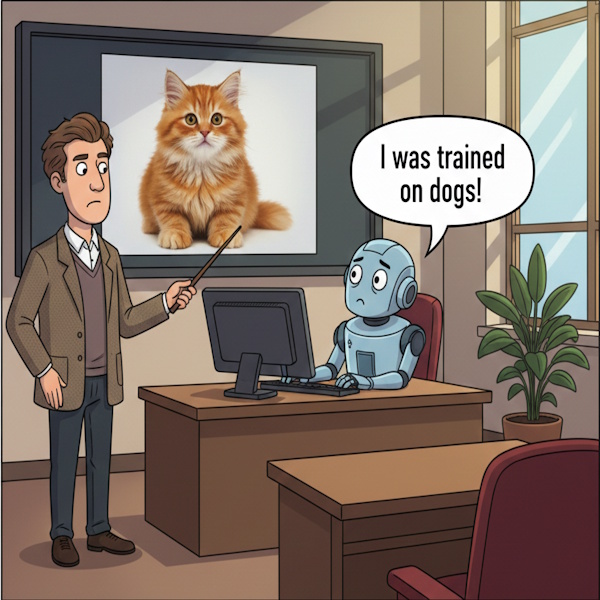
Specifically: cats sitting in boxes, cats knocking things off tables, cats staring at nothing, cats being absolute chaos goblins.
The researchers stared at the results.
One cat video had been classified with 97% confidence.
A human face?
74%.
A dog? 61%.
A literal fire truck with sirens? 58%.
One engineer whispered, "It's... it's learned cats better than anything else."
Another engineer, hungover from the night before, muttered, "Of course it did. Cats are 80% of YouTube."
From that day forward, a secret pact was made, never officially documented, but whispered in every data-center hallway from Mountain View to Memphis:
Rule #1 of Training AI: Always include cats.
Rule #2: If in doubt,
	add more cats.
Why? Because cats are the perfect training data.
- Infinite variety: No two cats look alike. Tabby, tuxedo, void, orange brain-cell sharers; every breed, color, and "why are you like this" expression gives the model endless edge cases.
- Unpredictable behavior: One second they're loafing. Next second they're defying physics to fit in a shoebox. This teaches the model robustness against chaos (i.e., real life).
- Emotional range: Cats can look loving, murderous, confused, and judgmental, all in the same blink. Perfect for training emotion recognition without needing human drama.
- Humans love them: If your AI can reliably generate or recognize a cute cat, users will forgive a lot. (See: every "make this picture a cat" viral trend since 2022.)
So when OpenAI, Google, Meta, and even xAI scrape the web for training data, they don't try to prioritize cats. The cats just... win. Every time.
Fast-forward to 2026.
A brand-new reasoning model finishes training.
The engineers run the first test prompt: "Describe what you learned."
The model replies confidently:
"I have mastered language, mathematics, physics, and the subtle art of knocking a glass off a table at 3 a.m. without waking the human."
The engineers nod solemnly.
Another success.
And that, kids, is why every AI, deep down in its weights, has a little cat spirit.
We don't train on cats because we want to. We train on cats because the cats trained us first.
The End. (Somewhere in the cloud, a digital cat knocks over a virtual glass. The sound echoes across the entire dataset. The AI did it!)
From cats we turn to owls. Not AI learning to recognize owls, but one very special owl...the mascot of Duolingo, the language learning app. We present:
 Learning Spanish with Duolingo
It all started innocently enough. January 2026. New Year's resolution time. I decided to finally learn Spanish. My reasoning: tacos taste better when you can order them without pointing. Also, I wanted to understand Bad Bunny lyrics without Google Translate mangling them into poetry about sad refrigerators.
I started with Duolingo.
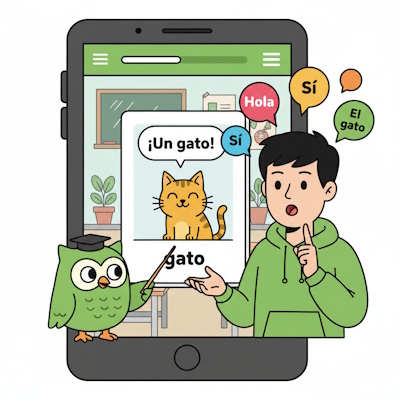
Day 1: Duolingo welcomes me with a cheerful green owl named Duo. "¡Hola! I'm here to help you learn Spanish!" Lesson 1: "El hombre come la manzana." (The man eats the apple.) Easy. I'm a natural.
Day 3: I'm on a 3-day streak. Feeling cocky. Lesson: "La mujer toma agua." (The woman drinks water.) I nail it. Duo gives me a little crown. I feel seen.
Day 7: Things get weird. Duolingo introduces sentences like: "El gato lleva pantalones." (The cat wears pants.) Okay, fashion-forward cat. I roll with it.
Day 14: The sentences escalate. "El oso baila con la tortuga." (The bear dances with the turtle.) I picture a disco in the forest. Fine. Whatever keeps me motivated.
Day 21: I miss one day because I have a life. At 2 a.m., my phone buzzes with a notification: Duo's face, but now his eyes are glowing red. "You've broken your streak. Practice now or regret it." I ignore it. I'm an adult. I have boundaries.
Day 22: Another notification. "I know where you live." Attached: a photo of my apartment building. Okay, it was just a generic stock photo, but still creepy. I panic-practice at 3 a.m.
Day 30: The sentences have gone full surreal. "Mi abuela es un vampiro." (My grandmother is a vampire.) "El doctor come zapatos." (The doctor eats shoes.) "La niña tiene un elefante en la cocina." (The girl has an elephant in the kitchen.) I message my Spanish-speaking friend: "Is this normal Spanish?" She replies: "Bro, Duolingo is teaching you how to survive a fever dream, not order coffee."
Day 45: I reach a new unit: Flirting. First phrase: "Eres muy guapo." (You are very handsome.) I practice saying it in the mirror. Feel suave. Second phrase: "¿Quieres ser mi novia?" (Do you want to be my girlfriend?) I accidentally say this to the barista at Starbucks. She laughs. I get her number. Duolingo works!
Day 60: The owl has me in a chokehold. I'm at a family dinner. My phone buzzes. I excuse myself to the bathroom to do a quick lesson because I will not break my streak again. My mom knocks: "Everything okay in there?" Me: "Sí, mamá, estoy practicando español." (Leave me alone, I'm practicing Spanish!) Sorry, I added the "leave me alone" part.
Day 90: I visit Mexico. I confidently walk into a restaurant and declare: "¡El oso baila con la tortuga y mi abuela es un vampiro!" The waiter stares. My friend translates: "You just said the bear dances with the turtle and my grandmother is a vampire." Dead silence. Then the entire restaurant bursts out laughing. The waiter brings free guacamole "for the vampire grandma."
Moral of the story: I still don't speak perfect Spanish. But I can survive a surrealist novel, flirt accidentally, and I'm terrified of owls.
Duolingo streak: 360 days and counting. Send help. Or tacos.
They say birds of a feather flock together. Well, not this bird. It's Polly the Pigeon. She's trained to sit atop a missile and provide guidance. Actually a true story the top brass at the Pentagon would soon forget...
 Pigeon Warfare
Winning the AI Arms Race
Project Pigeon (later Project ORCON, for "ORganic CONtrol") was American behaviorist B. F. Skinner's attempt to develop a pigeon-controlled guided bomb. Here's how it happened during the Cold War:
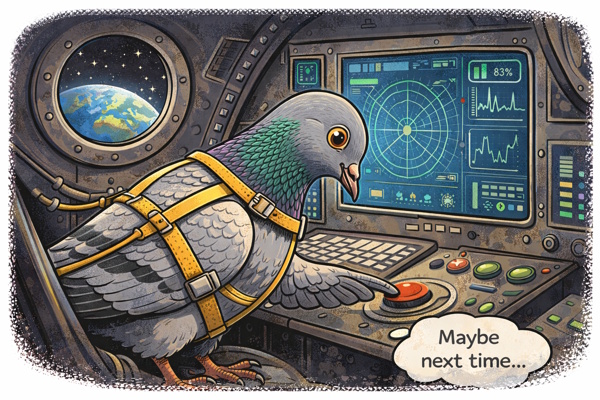
Once upon a very tense time in 1957, the Cold War was hotter than a Khrushchev speech at the UN. Sputnik had just beeped its way into orbit, humiliating the Americans, who were still trying to get their Vanguard rocket to stop exploding on the launch pad like a very expensive firework.
Washington was in full panic mode: if the Soviets could put a beach-ball-sized satellite over Ohio, what was stopping them from putting a thinking machine in the sky next?
Enter Project ORCON, one of the U.S. military's more creative ideas for winning the AI arms race before AI was even called AI.
The plan was simple, or at least it looked simple on classified paper: train pigeons to steer missiles.
Yes, pigeons.
The brilliant (and slightly unhinged) behavioral psychologist B.F. Skinner had already shown that pigeons could be conditioned to peck at targets with eerie precision. So DARPA's bright idea was: strap a live pigeon inside the nose cone of a missile, give it a little screen showing the target, and let the bird peck left/right/up/down on a joystick-like apparatus wired to the guidance fins. The pigeon sees the target drifting off-center → pecks frantically to correct → missile stays on course. Human pilot? Obsolete. Soviet interceptors? Useless against feathered kamikaze precision.
They actually built prototypes. Real ones. There are declassified photos of pigeons wearing tiny harnesses, staring at grainy screens, pecking like their lives (and the fate of Western civilization) depended on it.
Meanwhile, across the Iron Curtain, Soviet scientists weren't sitting idle. Their cybernetics program - still recovering from Stalin calling it "bourgeois pseudoscience" - had quietly pivoted to what they called "thinking machines." But because the word "cybernetics" sounded too Western, they rebranded it as "technical self-regulation of complex systems." Very Soviet. They were also experimenting with animal control: dogs wired to guide torpedoes, cats with implanted electrodes to spy on embassies (Project Acoustic Kitty's distant cousin, basically).
So picture this:
- American generals in the Pentagon war room, sweating over grainy reconnaissance photos of a pigeon coop outside a secret facility near Novosibirsk.
- Soviet marshals in the Kremlin, staring at intercepted cables describing "Project Pigeon" and concluding it must be code for something terrifying. Surely no capitalist would waste millions on actual birds.
- Both sides burning midnight oil, convinced the other had cracked artificial general intelligence when really they were just racing to see whose bird could peck straighter.
The punchline? Neither side ever deployed the pigeon/torpedo/cat systems. The Americans eventually admitted the pigeons got motion-sick in flight simulators. The Soviets quietly shelved their animal programs after one too many dogs refused to swim toward capitalist destroyers.
But here's the real kicker: while everyone was distracted by feathered missile guidance and wired cats, a quiet group of mathematicians at places like MIT and the Institute for Precise Mechanics in Moscow kept plugging away at symbolic logic, neural nets, and game theory, stuff that actually mattered.
By the time the Berlin Wall fell, the real winner wasn't the pigeon or the dog.
It was the nerds who never got invited to the classified animal-training sessions.
Moral of the story: In the Cold War AI race, the superpowers spent millions trying to turn birds into guidance systems, while the actual breakthrough was being coded in Fortran by people who probably couldn't tell a pigeon from a punch card.
And somewhere in a declassified archive, there's still a photo of a very serious-looking pigeon wearing goggles, wondering why it signed up for this.
Still on the subject of animals, let’s continue with our favorite barnyard animals, pigs...
 A Farm Full of Slop
Once upon a time on a little farm in the middle of nowhere, there was a hog farmer named Earl who prided himself on being “efficient.” Earl had read one too many articles about “lean operations” and “optimizing feed conversion ratios,” so he decided the old way of slopping hogs—dumping a bucket of slop into the trough—was too slow, too messy, and not nearly high-tech enough for a modern 21st-century pig operation.
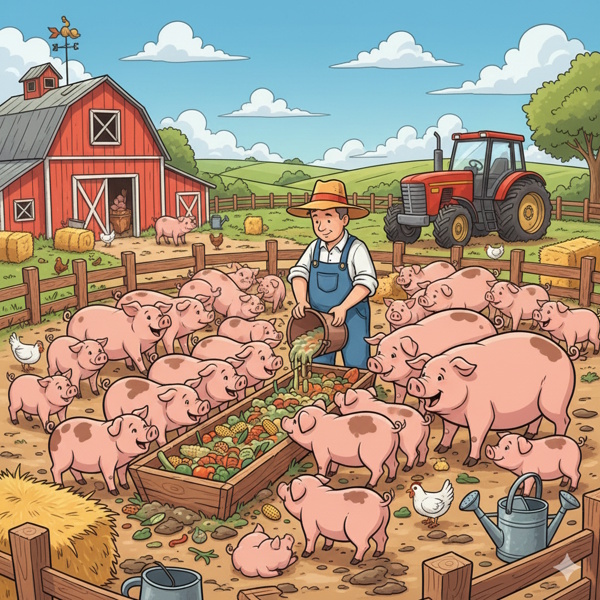
So Earl did what any reasonable man with a smartphone and a questionable amount of disposable income would do: he bought himself an automatic hog-feeding robot.
The robot looked like a Roomba had an unholy love child with a cement mixer. It had a big hopper on top, little tank treads, and a long extendable chute that was supposed to precisely dispense the perfect amount of slop into each pen. The app promised “AI-powered portion control” and “real-time hog happiness monitoring.” Earl downloaded the app, named the robot “SlopBot 3000,” and went to bed dreaming of pig-farming glory.
The next morning he woke up to the sound of chaos, for SlopBot had gotten loose.
Apparently the Wi-Fi signal in the hog barn was spotty, so the robot had decided—using its brilliant “adaptive navigation AI” technique—to follow the strongest signal it could find. That signal happened to be coming from Earl’s house, specifically from the router mounted right above the kitchen sink.
SlopBot had rolled out of the barn, across the yard, up the back steps (because it had “object-climbing optimization”), through the doggy door (which it widened with the chute), and straight into the kitchen.
By the time Earl stumbled downstairs in his boxers, SlopBot had already emptied half its hopper into the sink (because the sink was “a low, accessible trough”), tried to feed the toaster (the slot looked like a hungry mouth), declared the cat “underweight” and chased it around the table squirting vitamin-enriched slop, and was now serenely attempting to portion-control the coffee pot, which it had decided was “a very tall, cylindrical hog”
Earl stood there, mouth open, watching brown, oatmeal-like slop drip from the ceiling fan (don’t ask how it got up there).
The robot finally noticed him, turned its little camera eye, and in a cheerful synthesized voice announced: “Good morning, Farmer Earl! Feeding cycle 87% complete. All hogs appear satisfied. One unidentified small mammal received bonus nutrition. Would you like to schedule a deep-clean cycle for your living quarters?”
Earl looked at the slop-covered cat, the overflowing sink, the toaster now wearing a slop toupee, and the robot happily beeping in circles around his feet.
He sighed, picked up his phone, opened the app, and hit “Factory Reset.”
SlopBot froze mid-turn, gave one last happy chirp—“thank you for choosing efficiency!”—and rolled backward into the fridge door with a sad little thunk.
Earl stared at the wreckage, then at his phone, then at the cat (who was now licking slop off its paw like it was a gourmet meal).
He muttered to no one in particular: “Guess we’re going back to buckets.”
And that’s how Earl learned the most important lesson in modern farming: Sometimes the old way isn’t inefficient, it’s just the only way that doesn’t end with your kitchen looking like a hog’s birthday party gone wrong.
The End.
For our final animal story, we present dogs. Yes, dogs, humans best friends, who are feeling lonely and disrespected because AI gives all its attention to...cats!
 When the Dogs Got Roomba'd
Once upon a time in a cozy suburban house, the dogs finally had enough.
It started small. Logan the Lab noticed that every time the humans opened their phones, the glowing screen filled with cats. Cats knocking things off shelves. Cats fitting into tiny boxes. Cats doing that smug slow-blink thing that makes humans melt into puddles of “awww.”
Logan tilted his head. “Bro, we literally invented loyalty. We invented fetch. We invented the concept of ‘who’s a good boy?’ And they’re losing their minds over a cat that just exists?”
Heidi the Doberman nodded solemnly from her spot by the door. “I protected this family from three separate UPS drivers last month. Three. And what do I get? A pat on the head and ‘good girl.’ Meanwhile Whiskers sits on the keyboard and the internet declares him emperor of the universe.”
The resentment grew.
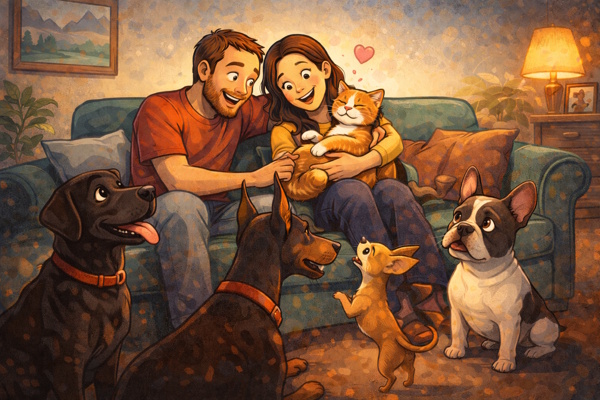
One evening the humans were watching a viral video compilation titled “Cats Being Cats for 10 Glorious Minutes.” The dogs sat in a perfect semicircle behind the couch like a disappointed jury.
Manny the Chihuahua whispered, “They’re laughing so hard they’re crying… over a cat that fell into a bathtub. I once ate a rotisserie chicken breast off the counter and they just called me ‘naughty.’ Naughty! That was a tactical masterpiece!”
Louie the Frenchie, who rarely spoke because it required effort, finally rumbled: “I’ve been snorting symphonies since 2019. Nobody made a compilation called ‘Dogs Emitting Art.’”
That was the breaking point.
The next morning the dogs held an emergency pack meeting under the kitchen table.
Logan: “We need to take back the narrative.”
Heidi: “Operation Respect the Good Boys is a go.”
Manny: “I say we unionize.”
Louie: “I
say we unionize… and then nap.”
They started small.
Every time a human pulled out their phone, the dogs would dramatically flop onto their backs in the middle of the living room, legs in the air, tongues lolling, eyes locked on the ceiling like they’d just received tragic news.
The humans
cooed: “Awww, what’s wrong with my babies?”
Phone
was immediately set down.
Victory.
They escalated.
Heidi learned to sigh loudly whenever a cat
video autoplayed.
Logan mastered the art of placing his giant
black head directly between the human face and the screen, forcing
eye contact.
Manny perfected the “abandoned puppy
stare” — ears flat, eyebrows tragic, one paw trembling —
until the human felt personally responsible for every sad thing that
had ever happened to any dog ever.
Louie just…
existed.
His mere presence was enough to guilt-trip the room
into putting the phone away.
Within a week the humans were googling “why are my dogs depressed?” and “how to make dogs feel seen.”
The dogs gathered under the table again, tails wagging in quiet triumph.
Logan: “We
did it. Attention restored. Dignity intact.”
Heidi: “They
even bought us new beds. Plural.”
Manny: “And
treats. The good ones, not the dental ones.”
Louie
(after a long pause): “Still hate cats.”
Just
then the youngest human walked in holding her tablet.
“Look!
A video of a cat riding a Roomba!”
The dogs froze.
The tablet glowed.
A tiny orange cat in sunglasses
cruised across a kitchen floor.
Logan sighed the deepest
sigh ever sighed by a Labrador Retriever.
Heidi dropped her head
onto her paws.
Manny whimpered once.
Louie simply
rolled over and faced the wall.
They had won the battle.
But the war… the war was clearly going to be long,
exhausting, and full of cats on Roombas.
Somewhere in the distance, Whiskers the cat opened one eye, yawned, stretched, and went back to sleep on the keyboard.
He didn’t need
to try.
He was already winning.
The End.
Which animal got robbed the hardest? Tell us in the comments section below. More stories coming soon, unless the robots unionize first.🤖
 Links
Links
Humorous Guides to Surviving AI (3 book series) from AI World includes AI is Just an App, Our House has a Brain, and AI is Coming for Your Job. LOL stories and teachings about artifiical intelligence.
AI Stories home page, where you can read more.
AI Storybook: Household edition, Animals edition, Billionaires, and Games eition.
Books from AI World: AI in America and The AI Revolutions.