 AI in America
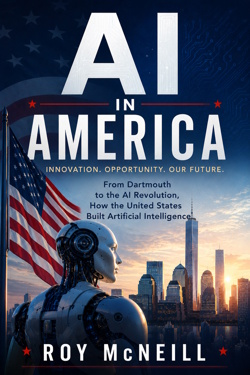 |
AI in America AI in America is the definitive popular history of the most consequential technological enterprise of the past century told not as a march of inevitable progress, but as a deeply human story of booms and busts, brilliance and blunder, stubborn visionaries, and crushing winters. This is not a book about algorithms or programming. It is the story of the people, ideas, institutions, breakthroughs, failures, rivalries, and moments of inspiration that shaped one of the greatest technological revolutions in history.  |
How America created Artificial Intelligence, why it claims Supremacy in AI, and the plans to keep it
In the summer of 1956, while Elvis Presley topped the charts, Marilyn Monroe launched her film career, and Dwight David Eisenhower cruised to re-election, a small group of professors gathered in a quiet New England college town and issued one of the boldest intellectual declarations in modern history: every aspect of human intelligence could be precisely described and ultimately replicated by a machine.
That two-month workshop at Dartmouth College did not make headlines. It did not win Nobel Prizes. It was barely noticed outside select academic circles. Yet it quietly launched the field we now call AI - Artificial Intelligence - and it did so on American soil, fueled by American curiosity, American post-war investment, and an American willingness to bet big on the impossible.
AI in America tells that story in full: how a nation of risk-takers, dreamers, and empire-builders turned a summer vacation into the most powerful technology of the 21st century. From Cold War funding and Silicon Valley garages to the trillion-dollar empires of the Magnificent Seven, from the arms race with China to the looming question of Superintelligence, this is not just the history of a technology. It is the story of America's unique mixture of academic daring, military muscle, venture capital, and cultural spectacle, and why sustaining AI supremacy in a global economy will demand more than innovation alone.
 Dive into
the chapters below. The journey begins in Hanover, New Hampshire, 1956.
Dive into
the chapters below. The journey begins in Hanover, New Hampshire, 1956.
0 |
But first, the AI Lexicon: A
Quick Guide to the Jargon Before exploring the story of AI in America, it's helpful to pause and understand the language of AI itself. The field of AI is filled with jargon, acronyms, and shifting meanings. Beneath the buzzwords lie clear and powerful ideas that shape the technology transforming our lives. |
1 |
The Summer That Coined
'Artificial Intelligence' 1956 was a very big year indeed in America, but there was one significant event that went larely unnoticed. In a small town in New Hampshire several academics met to discuss a topic few in America knew anything about; something called - for the first time - "artificial intelligence". |
2 |
Sputnik Sparks: The Cold War Birth of AI Funding Sputnik and ICBMs fueled the fire that ignited U.S. funding for high technology. AI was the indirect recipient of some of the funds, and while these programs didn't write checks for AI, they in effect trained the people, built the labs, and developed the computers that made AI research possible. |
3 |
Silicon Valley Rises: The Garage-to-Global Empire Story In the midst of Silicon Valley lies Stanford University, the catalyst that transformed the Santa Clara Valley from farmland into the world's tech capital. It has been ground zero for AI research since the field's inception, producing innovations, companies, and leaders who shaped Silicon Valley. |
4 |
The Rise of Machine Learning and Neural Networks Artificial Intelligence in America has always evolved in waves, with periods of explosive discovery followed by long winters of disappointment. No wave transformed the world more profoundly than the rise of machine learning and deep neural networks. |
5 |
The AI Empires: How the Mag7 Built the Future By the middle of the 2020s, seven American companies stood at the pinnacle of artificial intelligence. They are the "Mag7"; Microsoft, Apple, Amazon, Alphabet (Google), Meta, NVIDIA, and Tesla. Together they control the hardware, software, data, and platforms that power the modern AI economy. |
6 |
AI
Showcases: Watson, AlphaGo, ChatGPT, and Beyond In the story of AI, no country has put on a show quite like the United States. From televised triumphs to global software phenomena, America has turned AI from an academic pursuit into a spectacle of progress. Each major breakthrough became both a technological milestone and a cultural moment. |
7 |
Crypto
Meets AI: Blockchain's Unexpected Alliance It begins with two technologies born of very different impulses: one, the drive to build machines that can think and learn; the other, the ambition to create money, trust and exchange systems without intermediaries. As we enter the mid-2020s, their paths increasingly overlap. |
8 |
The
Great AI Arms Race: America vs. China The two most powerful nations on the planet are engaged in a race towards AI dominance. The AI race between China and the United States is one of the defining geopolitical and technological contests of our time. Each country has different strengths, weaknesses, strategies, challenges, and risks. |
9 |
Governance Wars: Government vs. Corporations in the AI Age AI began as an academic dream, a thought experiment about machines that could think. Today, it has become the foundation of economies, militaries, and digital societies. But as AI systems grow in power and autonomy, a fundamental question has emerged of who controls AI; governments or corporations? |
10 |
Ethics on
the Edge: Bias, Privacy, and the Moral Maze AI did not arrive in a moral vacuum. From its earliest conception in American universities and tech labs, AI has been more than code and computation, for it has been a reflection of the society that built it. The U. S., birthplace of the modern AI industry, now finds itself at the center of a profound ethical debate. |
11 |
The
Workforce Reckoning: Jobs, Skills, and the AI Disruption Every industrial revolution reshapes the workforce, but none as quickly or as invisibly as the rise of AI. Machines no longer just replace human hands; they now replicate human thought. From office towers to warehouses, hospitals to Hollywood, AI has become both collaborator and competitor. |
12 |
AGI on the Horizon: Can America Keep the Lead Artificial General Intelligence (AGI), machines that can reason, learn, and act across domains as humans do, has long been the holy grail of artificial intelligence research. For decades, it existed mostly in theory and science fiction. Today, the conversation has shifted from 'if' to 'when'. |
13 |
AI Internet: The Internet You Thought You Knew The Internet was yesterday's revolution: AI Is Today's. For decades, the internet connected computers. Today, AI connects intelligence. A new layer is forming on top of the web, an emergent digital ecosystem where intelligent agents browse, build, retrieve, summarize, analyze, transact, and collaborate without human intervention. |
14 |
AI Infrastructure: The Backbone of America's Intelligence
Revolution In appearance, AI may seem to be powered by algorithms, models, and data. In reality, AI runs on infrastructure. And not ordinary infrastructure, but the most expensive, compute-intensive, energy-hungry, high-precision technological backbone ever built. |
15 |
AI in Human Relationships: Love in the Age of Algorithms For many people in America, the first exposure to chatbots was not ChatGPT; it was ELIZA, and it occurred 60 years ago. Developed in 1965, ELIZA is one of the most influential computer programs ever written. ELIZA, and its most famous persona DOCTOR, continues to inspire users, programmers, and wider discussions about AI. |
16 |
Education
in the Age of Machines: Rewiring Schools for Tomorrow When the story of American education in the 21st century is written, it will likely be divided into two eras; Before AI and After AI. The classroom has evolved into a profound reimagining of how students learn, how teachers teach, and what it means to be educated in an age of intelligent machines. |
17 |
AI Safety: Securing Intelligence Before It Secures Us In the race to build machines that can think, learn, and act autonomously, one question has become urgent: how do we keep them safe? By 'safe', we mean not just safe from hackers or malfunction, but safe for humanity itself. |
18 |
Coding: The Language of the Machine Age If AI is the engine of the 21st century, coding is the literacy that makes the engine run. Long before America embarked on its quest for artificial intelligence supremacy, it built another revolution, one line of logic at a time. |
19 |
America's AI Legacy and the Road Ahead From a bold idea at Dartmouth College in 1956 to today's billion-parameter neural networks running in data centers across the country, the U.S. has been both the cradle and the crucible of AI. As America moves deeper into the AI century, the question is no longer whether it leads, but how it leads responsibly. |
 About the Author
Roy McNeill brings a soldier's discipline, an engineer's precision, and a philosopher's curiosity to AI in America. A decorated U.S. Army Combat Engineer Officer who worked on top-secret computer projects, he later designed systems for Microsoft, IBM, General Electric, Siemens, Genentech, Bayer, and more. With degrees from the University of Kentucky, Pepperdine (MBA), and Stony Brook (ABD in Logic and Philosophy), Roy has spent years immersed in AI's evolution - from symbolic roots to generative breakthroughs.
Today, he operates from offices in the San Francisco Bay Area and San Salvador, El Salvador, guiding small businesses to harness AI for real-world advantage. AI in America is his tribute to the innovation ecosystem that made it all possible - and his mission to keep it thriving.