 Deep Blue Defeats Kasparov
When a Machine Humbled Humanity's Champion
The sixth and final game lasted only 19 moves, barely an hour of play. Garry Kasparov, the greatest chess player who had ever lived, a man who had dominated the game for twelve years and had never lost a match, resigned. Sitting across from him was not a human opponent but a machine: IBM's Deep Blue, a specially designed supercomputer built for one purpose and one purpose only; to defeat the world champion of chess.
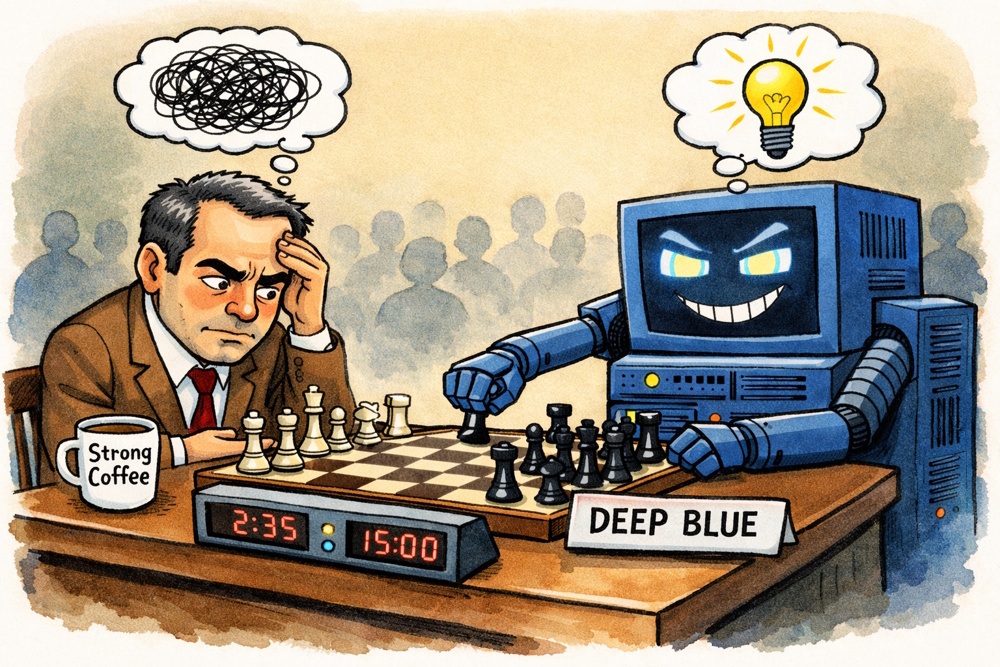
When Kasparov rose from his chair, it was over. The machine had won, 3½ to 2½. For the first time in history, a computer had defeated the world chess champion in a regulation match.
Kasparov walked off the stage visibly devastated, without shaking hands (there was no hand to shake). He would later claim that he had been cheated, that IBM had manipulated the match, that something inhuman had happened in the second game that shattered his confidence.
IBM's stock price jumped. The victory made front pages worldwide. TIME magazine ran the headline "The Brain's Last Stand."
But this show wasn't just about chess. It was about something deeper: What does it mean to be human when machines can outthink us? What happens when our greatest intellectual achievements can be surpassed by silicon and software?
This is the story of how we got to that moment, and what it meant.
 The Dream of a Chess Machine
The Game of Kings
Chess has always held a special place in human culture. It's a game of pure intellect—no dice, no hidden information, no luck. Success depends entirely on mental ability: calculation, pattern recognition, strategic thinking, creativity, and psychological warfare.
For centuries, chess was considered the ultimate test of human intelligence. The best players—Morphy, Steinitz, Capablanca, Fischer—were revered as geniuses whose minds operated on a different plane.
So naturally, from the earliest days of computing, people wondered: could a machine play chess?
The Mechanical Turk (1770)
The dream predates computers. In 1770, Wolfgang von Kempelen unveiled the "Mechanical Turk"—a chess-playing automaton dressed in Ottoman robes that defeated human opponents across Europe. It fooled people for decades.
Of course, it was a hoax. A human chess master hid inside, operating the dummy. But the Turk revealed something: people were fascinated by the possibility of an intelligent machine, and chess seemed like the ultimate test.
Alan Turing and the Dawn of Computer Chess (1950s)
In 1950, Alan Turing, the brilliant British mathematician who had helped crack Nazi codes during World War II, wrote the first chess program. Computers didn't exist yet that could run it, so Turing executed the program by hand, manually following the algorithm's logic to decide moves.
It played poorly. But the point was proving that it could be done in principle.
In 1951, Turing's colleague Christopher Strachey programmed a computer (the Ferranti Mark 1) to play checkers. In 1956-57, researchers at Los Alamos programmed a computer to play simplified chess on a 6×6 board.
By the late 1950s, full chess programs existed, though they played like beginners.
Claude Shannon's Vision (1950)
Claude Shannon, the father of information theory and one of the organizers of the Dartmouth Conference, published a foundational paper in 1950: "Programming a Computer for Playing Chess." He outlined two approaches:
Type A (Brute Force): Calculate every possible move sequence as deeply as possible, then choose the path leading to the best position.
Type B (Selective Search): Like humans, focus on promising moves and ignore obviously bad ones. Use chess knowledge and intuition to guide search.
Shannon noted that chess has about 10^120 possible games—far more than atoms in the universe. Pure brute force was impossible. But computers could search millions of positions, far beyond human capacity.
The question became: would raw calculation overcome human intuition and creativity?
Early Competitions (1960s-1970s)
By the 1960s, chess programs were competing against each other and occasionally against weak human players. Progress was steady but unspectacular.
In 1968, International Master David Levy bet that no computer would beat him within ten years. He won the bet in 1978, defeating Chess 4.7, though he admitted computers were improving faster than expected.
Through the 1970s and early 80s, programs gradually improved:
1977: Chess 4.6 rated around 2000 (expert level)
1981: Cray Blitz became the first computer to achieve master rating
1983: Ken Thompson's Belle achieved 2200 rating (master level)
But the world championship seemed impossibly distant. The best humans—Karpov and Kasparov—played at 2700-2850 level. The gap remained enormous.
Two Philosophies Compete
Through the 1970s-80s, two approaches competed:
Hardware Approach: Build specialized chess computers with custom chips designed specifically for chess calculation. Fast and efficient, but limited to chess.
Software Approach: Use general-purpose computers with clever programming. Flexible, but slower.
The hardware approach would ultimately win. And one company had the resources to build the ultimate chess machine.
 IBM's Quest
Why IBM Cared About Chess
International Business Machines had dominated computing since the 1950s. But by the 1980s-90s, IBM faced challenges:
Personal computers were disrupting the mainframe business
Microsoft and Intel were rising powers
IBM needed to demonstrate technological leadership
The company's image was stodgy, corporate, and uninspiring
Beating the world chess champion would be the ultimate demonstration of computing power. It would generate publicity, demonstrate IBM's technical capabilities, and symbolize machine superiority in reasoning and intellect.
Plus, IBM had history with chess. In 1985, graduate student Feng-hsiung Hsu at Carnegie Mellon University began developing ChipTest, a chess machine using custom chips. By 1988, it had evolved into Deep Thought (named after the computer in The Hitchhiker's Guide to the Galaxy).
In 1989, IBM hired Hsu and his team, providing resources to build the ultimate chess computer.
The Deep Blue Team
Feng-hsiung Hsu: The lead architect. Born in Taiwan, Hsu was the hardware genius who designed the custom chess chips. Brilliant, focused, and determined to beat Kasparov.
Murray Campbell: Software lead. Canadian grandmaster-level player and programmer who developed Deep Blue's search algorithms and evaluation functions.
Joe Hoane: Developed the evaluation function, the code that judges chess positions.
Jerry Brody, C.J. Tan: Hardware engineers who helped build the system.
The team worked at IBM's T.J. Watson Research Center in Yorktown Heights, New York. They had IBM's backing with unlimited resources and one simple goal: defeat Kasparov.
Building the Machine
Deep Blue wasn't a normal computer. It was a specialized chess-playing monster:
Custom Chess Chips: The heart of Deep Blue was custom VLSI (Very Large Scale Integration) chips designed specifically for chess. Each chip could evaluate from two to two and a half million chess positions per second. Deep Blue had 480 of these chips.
Combined, Deep Blue could search 200 million positions in one second.
For comparison:
Human grandmasters might analyze 1-2 positions per second deeply
Early chess programs analyzed hundreds of positions per second
Deep Blue: 200 million per second
The Architecture:
30 IBM RS/6000 SP processors (general-purpose computers)
Each processor controlled 16 chess chips
Massively parallel system
All chips searching different variations simultaneously
Custom interconnect allowing chips to communicate rapidly
Physical Specs:
Filled a refrigerator-sized cabinet
Weighed 1.4 tons
Required special cooling
Cost: estimated $5-10 million to build
Power Consumption: About 15 kilowatts, which is enough to power 15 homes.
This wasn't a computer that happened to play chess. It was a chess-playing machine that happened to be built with computer components.
Teaching a Machine Chess
The hardware could search positions incredibly fast. But what made a position "good" or "bad"? That's where software came in.
The Evaluation Function:
Murray Campbell and Joe Hoane created an evaluation function; code that assigned a numerical score to any chess position. The function considered:
Material: Piece values (queen=9, rook=5, bishop/knight=3, pawn=1)
Piece Placement: Knights near the center are better than on edges
King Safety: Is the king protected or exposed?
Pawn Structure: Are pawns doubled, isolated, or well-placed?
Control of Center: Who dominates the central squares?
Mobility: How many legal moves does each side have?
King Tropism: Are pieces attacking near the opponent's king?
And thousands of other features, encoded in hundreds of thousands of lines of code.
The team had consulted with grandmasters, studied chess theory, and programmed in decades of chess knowledge. But the evaluation was still crude compared to human understanding. Deep Blue didn't truly "understand" chess. It just calculated extremely well.
Search Algorithm:
Deep Blue used alpha-beta search, an optimized version of minimax:
Look ahead at all possible move sequences (the "game tree")
Evaluate positions at the end of the search
Assume both sides play optimally
Choose the move leading to the best outcome
Deep Blue could search 12-14 moves ahead in most positions (called "ply" in chess where14 ply = 7 full moves for each side). In sharp tactical positions, it could search 30-40 ply ahead.
For context, humans can't really calculate that deeply. Grandmasters might analyze critical lines 10-15 moves ahead, but rely heavily on pattern recognition and intuition, instead of pure calculation.
Opening Book:
Deep Blue had a database of opening moves. These moves consisted of thousands of known chess openings based on grandmaster games and theory. In the opening, it played like a grandmaster, following established theory.
Endgame Tablebase:
For positions with five pieces or fewer, Deep Blue had perfect knowledge because it could access complete databases of all possible positions, solved to checkmate. In these endgames, Deep Blue played perfectly.
Adaptability:
Between games, the team could adjust Deep Blue's evaluation function based on how Kasparov had played. They could patch weaknesses Kasparov exploited, like updating software on the fly.
This gave IBM an advantage Kasparov found unfair: while he remained constant, Deep Blue could evolve during the match.
 The Human Champion
The Greatest Player Ever
Garry Kasparov, born Garry Weinstein in Baku, Azerbaijan, in 1963, was a chess prodigy who became world champion in 1985 at age 22. By 1997, he had held the title for twelve years.
His playing style was aggressive, dynamic, and creative. He didn't just calculate; he understood chess deeply, saw patterns that opponents didn’t see, and felt the flow of the position. Honed by decades of study and play, his intuition let him navigate complexity that would paralyze calculators.
Kasparov was rated at 2851, which marked the highest rating ever achieved at that time (the rating system measures relative strength; 2800+ is superhuman excellence).
He had supreme confidence bordering on arrogance. He'd defeated every human challenger. Computers? He viewed them as tools, calculators, powerful but soulless. They could never possess the creativity, strategic vision, and fighting spirit of a true champion.
Kasparov vs. Machines: The History
Kasparov had played computers before:
1989: Easily defeated Deep Thought (Deep Blue's predecessor) 2-0 in a match.
1989: Played 1-0 against dozens of computers simultaneously, defeating them all.
1996: Played Deep Blue's first version in Philadelphia.
That 1996 match was shocking. Kasparov won 4-2, but Deep Blue took Game 1. It was the first time a computer had defeated a world champion in a regulation game. Kasparov was shaken but recovered to win the match.
After 1996, IBM spent a year improving Deep Blue:
Doubled the number of chess chips (from 256 to 480)
Made chips faster (from 1.5M to 2.5M positions per second each)
Improved the evaluation function based on an analysis of the 1996 match
Consulted with grandmasters to patch weaknesses
Kasparov studied games from the 1996 match and computer chess generally, preparing strategies for exploiting Deep Blue's weaknesses.
What Kasparov Knew About Computer Chess
By 1997, Kasparov understood computers as follows:
Strengths:
Perfect calculation within their search depth
Never tires or gets nervous
Excellent in tactical, forcing positions
Perfect endgame play once databases applied
Immune to psychological pressure
Weaknesses:
Weak long-term planning (couldn't see beyond search horizon)
Poor positional understanding (struggled with subtle strategic themes)
Vulnerable to "quiet" positions without forcing moves
Could be led into dead-end positions it couldn't escape
Evaluation function had blind spots (positions they misjudged)
Kasparov's strategy was to avoid tactical complications in situations where Deep Blue's calculation would dominate. Instead, he planned to create complex strategic positions requiring long-term planning and deep understanding. Outthink it, don't try to out-calculate it.
The strategy sounded good in theory, but it would prove harder in practice.
 The Match
February 1997... No, Wait - May 1997
Following Kasparov's 1996 victory, IBM challenged him to a rematch. The stakes were raised with the prize fund increasing to $1.1 million ($700k to the winner, $400k to the loser). The location chosen for the event was the Equitable Center in New York City. There will be six games using standard time controls. And the world will be watching.
IBM's publicity machine went into overdrive. This was the "ultimate battle" between human and machine. Media from around the world attended.
Game 1 - May 3, 1997: The Setup
First game, Kasparov had White (advantage of moving first). Kasparov chose the Mieses Opening, a rare choice designed to take Deep Blue out of its opening book into unfamiliar territory.
The strategy worked initially. Kasparov got a decent position. But in the middle game, Deep Blue found surprising resources, creating complications for Kasparov.
The game reached a position where Kasparov had a slight advantage yet no clear winning path. He could have forced a draw. Instead, at move 43, he made an aggressive pawn push, trying to win.
Deep Blue's response was perfect. It found the only move maintaining balance, then gradually equalized. By move 50, the position was clearly drawn.
At move 56, Kasparov blundered, a rare oversight allowing Deep Blue to win a pawn. His position collapsed. At move 45, he resigned.
Result: Deep Blue 1, Kasparov 0
Kasparov was stunned. He had pressed for a win from a drawn position and lost. Still, it was just one game. He had come back before.
Game 2 - May 4, 1997: The Turning Point
Game 2 was the match that would haunt Kasparov forever.
Kasparov had Black. Deep Blue played the Spanish Opening (Ruy Lopez), a classical choice. The position was complex but relatively balanced.
Then, at move 36, something strange happened.
Deep Blue, with an advantageous position, made a move: 36. Axb5
Kasparov stared at the board. This move made no immediate sense. It wasn't forcing, didn't win material, didn't create obvious threats. It was... quiet. Subtle. Positional.
This was the kind of move a strong human would make, sacrificing short-term advantage for long-term positional superiority. But computers don't think that way. They calculate concretely.
Kasparov couldn't figure it out. He sat at the board for fifteen minutes, thinking. What did the computer see? What deep combination justified this move?
Actually, the move 36. Axb5 was a computer glitch or bug. It was a last-minute fix to Deep Blue's code that caused it to make a random legal move when it ran out of time in its search. The move was essentially random.
But Kasparov didn't know this. He assumed Deep Blue had calculated something brilliant that he couldn't see. This shook him psychologically.
The game continued. Kasparov had chances to draw but played overcautiously, spooked by Deep Blue's "brilliant" move. At move 45, facing a difficult but possibly holdable endgame, Kasparov resigned.
Critics later argued he resigned a drawable position. But Kasparov was mentally shattered. He didn't trust his analysis. If Deep Blue could see things he couldn't in move 36, maybe it saw things in move 45 he was missing.
Result: Deep Blue 2, Kasparov 0
After two games, Kasparov was down two points. In a six-game match, this was devastating.
Between Games: Kasparov's Suspicions
Kasparov requested IBM provide Deep Blue's game logs. He wanted to see the computer's analysis, what it considered, which moves it evaluated. IBM refused, saying this was proprietary information.
Kasparov became suspicious. That move 36 in Game 2; could a human have intervened? Had IBM's team given the computer advice? Kasparov had studied computer chess for years. That move didn't match how computers played.
IBM denied any interference. The rules were clear: no human intervention during games. But refusing to provide the logs fueled Kasparov's suspicions.
Whether justified or not, Kasparov entered Game 3 in a paranoid, defensive mindset.
Game 3 - May 6, 1997: Fighting Back
Kasparov desperately needed a win. He had White again.
He played aggressively, sacrificing material for an attack on Deep Blue's king. This was classic Kasparov; dynamic, creative, calculating risk against opportunity.
Deep Blue defended accurately but couldn't find the best moves under pressure. Kasparov's attack succeeded.
At move 45, Deep Blue resigned. Its king was doomed.
Result: Deep Blue 2, Kasparov 1
Kasparov was back in it. His confidence partially restored, he was ready for a fight.
Game 4 - May 7, 1997: The Draw
Game 4 was tense, yet ultimately calm. Both sides played solidly. Kasparov, with Black, was cautious. Deep Blue played accurately.
The game was drawn at move 37 by mutual agreement.
Result: Deep Blue 2.5, Kasparov 1.5
Still, Kasparov was down a full point with two games remaining. He needed to win one and draw one to tie the match (and retain his title, as draws favor the champion).
Game 5 - May 10, 1997: Drawing Dead
Kasparov had White. He needed to win.
He chose the English Opening and played aggressively, seeking complications. But Deep Blue defended well. Kasparov couldn't break through.
The position gradually simplified. Pieces traded off. By move 30, a draw was inevitable.
Kasparov offered a draw at move 56. Deep Blue accepted.
Result: Deep Blue 3, Kasparov 2
This was it. Deep Blue needed only a draw in Game 6 to win the match. Kasparov had to win or the match was lost.
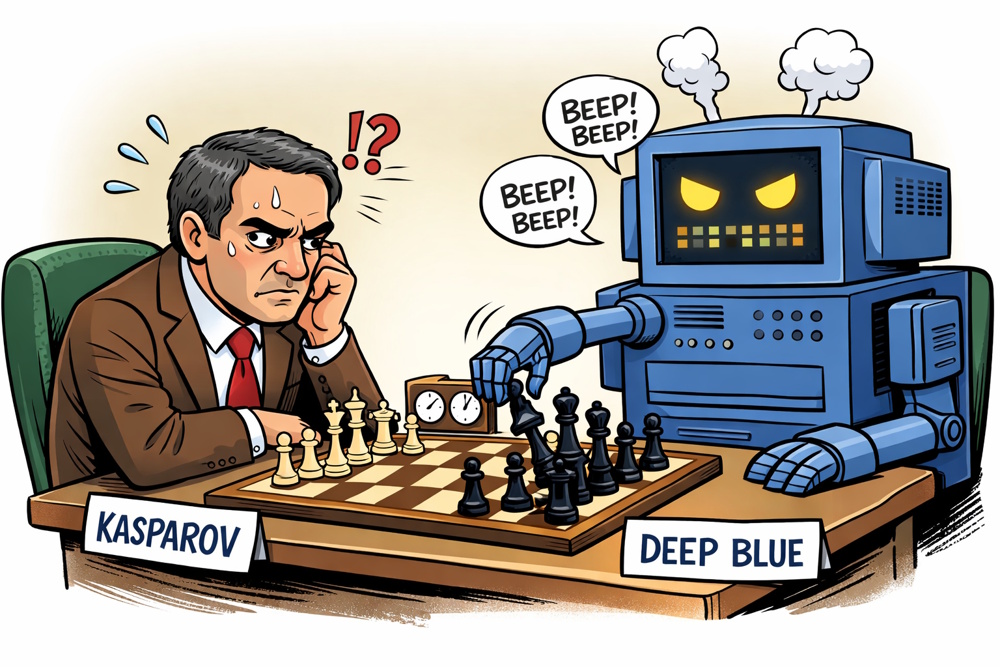
Game 6 - May 11, 1997: Collapse
Kasparov had Black. He needed to win with Black pieces which is harder to do than with White. He needed to play the game of his life. He had to be perfect, creative, and brilliant. Instead, he fell apart.
Kasparov chose the Caro-Kann Defense, a solid but relatively drawish opening. This suggested he was mentally broken; when you need a win, you don't choose Caro-Kann.
Deep Blue played simply and strongly. Kasparov got a slightly worse position. He tried to create complications for Deep Blue, but instead made small inaccuracies.
At move 19, barely into the middle game, Kasparov was already in serious trouble. His pieces were uncoordinated, his king vulnerable.
At move 19, Kasparov realized the position was hopeless. Rather than suffer through a long, losing game, he resigned.
The fastest resignation in world championship history. Nineteen moves. Just over an hour of play.
Final Result: Deep Blue 3.5, Kasparov 2.5
Deep Blue had won the match.
 The Aftermath
The Immediate Reaction
Kasparov walked off the stage without ceremony. Initially, he refused the post-game press conference. When he finally appeared, he was angry, claiming IBM had cheated:
"I'm not afraid of computers. But I am afraid of human manipulation. That move in game 2... I want to see the logs. They're hiding something."
IBM insisted everything was legitimate. They had won fair and square.
The chess world was divided. Some agreed with Kasparov that IBM's refusal to share the logs was suspicious. Others thought Kasparov was a sore loser. Many recognized that, regardless of controversies, a computer had defeated the world champion
The Media Frenzy
Front page news worldwide:
TIME: "The Brain's Last Stand"
Newsweek: "Kasparov vs. Deep Blue: The Rematch"
NY Times: "Swift and Slashing, Computer Topples Kasparov"
The victory was portrayed in apocalyptic terms: humanity's last bastion of intellectual superiority had fallen. If machines could outthink us at chess, what remained?
IBM's stock jumped. The publicity value was incalculable with billions of dollars in free media coverage.
What Really Happened in Game 2?
Years later, we learned the truth about move 36 in Game 2, the move that shattered Kasparov's confidence.
It was indeed a bug. Deep Blue's search algorithm encountered a situation where it ran out of time and defaulted to a random legal move. 36. Axb5 happened to be that random move.
By pure luck, the move was actually quite good; not the best, but solid nonetheless. Kasparov, assuming Deep Blue's perfection, attributed genius to randomness.
This random bug may have won IBM the match. If Deep Blue had made a truly bad random move, Kasparov might have won Game 2, changing the match's entire psychology.
IBM Retires Deep Blue
After the victory, IBM dismantled Deep Blue. The company refused Kasparov's request for a rematch. They'd achieved their goal. They had beaten the world champion, generated massive publicity, and demonstrated technological superiority.
Why stop? Three reasons:
Mission Accomplished: They had proven that computers could beat humans at chess. What more was there to demonstrate?
Risk: Another match meant a risk of losing. Better to retire undefeated.
Business Focus: IBM wanted to move on. Deep Blue was a publicity stunt, not a product. The technology had limited commercial value.
Parts of Deep Blue went to the Smithsonian. The team dispersed. The chess chapters closed.
Kasparov's Later Career
Kasparov never got his rematch. He remained world champion until 2000 (when he lost to Vladimir Kramnik), then retired from professional chess in 2005.
In retirement, Kasparov became a political activist opposing Vladimir Putin, a writer on chess and AI, and an advocate for human-computer collaboration (supporting Advanced Chess). He eventually made peace with Deep Blue's victory, acknowledging that computers had legitimately surpassed humans at chess. Even in retirement, he maintained that IBM's refusal to share the logs was suspicious and poor sportsmanship.
The Technology Disseminates
Deep Blue's custom hardware approach proved a dead end commercially because it wastoo expensive and specialized. But the lessons learned influenced:
Chess Engines: Free chess programs like Stockfish now run on smartphones and play far better than Deep Blue, using pure software on general CPUs
AI Research: The match demonstrated the power of specialized hardware for specific tasks
Parallel Processing: Deep Blue's massive parallelism influenced later AI system design
Evaluation Functions: Techniques from Deep Blue influenced how later game-playing AI judged positions
Today, anyone can download chess software on their laptop, table or phone that would crush Deep Blue. The strongest chess engines, running on modern hardware, are rated 3400+ far beyond the reach of any human.
 The Significance
What Deep Blue Proved
Brute Force Could Defeat Intuition
The match settled the Shannon debate: Type A (brute force search) defeated Type B (human-like selective search). Given enough computational power, raw calculation could overcome human intuition, creativity, and strategic understanding.
This was philosophically important. Chess had been considered the domain where human intelligence shined with creativity, imagination, and long-term planning. Deep Blue showed that, at least for chess, these could be approximated by sheer calculation.
Specialized Hardware Matters
Deep Blue succeeded partly through custom chips designed specifically for chess. This demonstrated that specialized hardware for specific tasks could outperform general-purpose computing.
This insight would influence:
Graphics Processing Units (GPUs) for neural networks
Tensor Processing Units (TPUs) for machine learning
Bitcoin mining ASICs
Specialized chips for various AI tasks
Human Limits Are Real
Humans can't compete with machines in raw calculation. We're limited by:
Processing speed (neurons fire ~200 times/second; transistors billions)
Working memory (we hold 5-9 items; computers hold gigabytes)
Consistency (we tire, make errors; computers don't)
Deep Blue forced us to accept that in domains where calculation matters most, machines would easily surpass us.
Psychology Matters
Kasparov's collapse in Games 2 and 6 showed something else: humans are psychologically vulnerable. The mysterious move 36 in Game 2 spooked Kasparov. Fighting an opponent whose thinking process is alien creates unique psychological pressure.
Would Kasparov have played differently if he knew that move 36 was a random bug? Probably. The psychological dimension of human-computer competition matters enormously.
What Deep Blue Didn't Prove
Understanding vs. Calculation
Deep Blue didn't "understand" chess. It calculated positions, evaluated them numerically, and chose moves leading to good evaluations. But it had no concept of what chess is or why pieces have certain values. It lacked an appreciation for the aesthetic beauty of a combination or the historical context of opening theory.
It was basically a powerful calculator with no real understanding. This distinction between calculation and comprehension remains relevant for AI today.
General Intelligence
Deep Blue could only play chess. It couldn't play checkers without complete reprogramming. It couldn't hold a conversation, write poetry, or do anything else.
It was specialized, not generally intelligent. The victory didn't mean machines matched human intelligence broadly. It meant only that in one narrow domain, calculation could overwhelm human capabilities.
The End of Human Chess
Some feared Deep Blue meant human chess would become irrelevant. Why watch humans play when computers play better?
This didn't happen. Human chess remains popular. We watch for the human elements; the struggle, creativity, and drama. Computer chess is technically superior yet emotionally sterile.
Contrasting with AlphaGo (2016)
Interestingly, when Google's AlphaGo defeated world champion Lee Sedol at Go in 2016, reactions differed:
AlphaGo used neural networks and reinforcement learning, teaching itself through millions of self-played games
It played moves that grandmasters found beautiful and creative
It seemed to "understand" Go in ways Deep Blue never understood chess
Lee Sedol called it an honor to lose to such play
Deep Blue's victory felt like humanity being beaten by a calculator. AlphaGo's victory felt like witnessing a new form of intelligence emerge. The difference reflects how the AI worked; brute force vs. learning.
The Philosophical Impact
Deep Blue forced difficult questions:
What is intelligence? If chess requires intelligence, and computers can play chess better than humans, are computers intelligent? Or does intelligence require something more?
What remains uniquely human? If machines can out-calculate us, what can we do that they can't? Creativity? Emotional understanding? Consciousness?
Should we compete or collaborate? Instead of fighting machines, should we work with them? (This led to "Advanced Chess" where human-computer teams play together)
What does the future hold? If computers surpassed humans at chess in 1997, what else will they surpass us at? When? What does a world with superhuman AI look like?
These questions, raised by Deep Blue, only intensified as AI capabilities expanded.
 The Legacy
Lessons for AI
Deep Blue taught us several lessons that have influenced AI development:
Search Algorithms Matter: Alpha-beta pruning and other search optimizations allowed Deep Blue to search deeper than naive minimax. Efficient search algorithms remain crucial in AI.
Evaluation Functions Are Key: Deep Blue's chess knowledge was encoded in its evaluation function. Getting this right by balancing different factors and weighting them appropriately was crucial. This relates to modern AI's challenge of designing good objective functions.
Domain Knowledge Helps: Deep Blue succeeded partly because the team consulted grandmasters and, using that information, encoded decades of chess knowledge. Pure machine learning without domain knowledge often struggles. Hybrid approaches combining domain expertise and computational power are more powerful.
Hardware Acceleration: Custom chess chips gave Deep Blue its speed advantage. This presaged the GPU revolution in AI with specialized hardware enabling capabilities that are impossible on general CPUs.
Testing Against the Best: The ImageNet Challenge (for computer vision) and other competitions followed Deep Blue's model: test AI against the best humans or hardest benchmarks to drive progress.
What We Lost
Deep Blue's custom hardware approach died with it. Modern chess engines use:
General-purpose CPUs (though very fast ones)
Pure software (no custom chips)
Much more sophisticated search algorithms
Better evaluation functions (often using neural networks)
And they play far better than Deep Blue on far cheaper hardware.
Deep Blue was a dead-end technologically because it was too specialized, too expensive, and too rigid. But it was a spectacular dead-end that captured the world’s imagination and demonstrated what was possible.
The Chess Engine Revolution
Deep Blue's victory sparked an explosion in chess engine development:
- Stockfish, Komodo, Houdini: Top engines, all free or cheap, running on consumer hardware, rated 3300-3400+
- Neural Network Engines: AlphaZero (2017) and Leela Chess Zero taught themselves chess through self-play, achieving superhuman play without human-encoded knowledge
- Centaur Chess: Humans using engines as tools create combinations neither could find alone
The smartphones of today running Stockfish would destroy Deep Blue. The strongest chess engines are so far beyond humans that the gap is almost meaningless, like comparing human running speed to jet aircraft.
 Epilogue
The Match That Changed Everything
On May 11, 1997, when Kasparov resigned after 19 moves, something shifted in human consciousness. For the first time, a machine had definitively beaten humanity's greatest champion at an intellectual task. We’ve long accepted that machines are stronger and faster. But thinking? That was supposed to be our domain, especially with mastery over the game of chess.
The victory was both more and less than it seemed.
It was less because Deep Blue was essentially a specialized calculator and not truly intelligent. It couldn't generalize beyond chess. It didn't understand what it was doing. It was a powerful but narrow tool.
It was more because it demonstrated that human intuition, creativity, and strategic thinking—qualities we thought ineffable—could be approximated through calculation. That our minds, whatever their mysterious qualities, produce results that sufficiently powerful machines can match or exceed in specific domains.
The match was the end of one era and the beginning of another.
It ended the era when humans could confidently claim computers would never match us at intellectual tasks. Chess had been the test, and we had failed.
It began the era of human-computer interaction where we accept machines as intellectual partners, competitors, or superiors depending on the domain. It began an era where we must redefine human value not by what we can calculate or analyze (machines do this far better), but by what makes us distinctively human; our creativity, emotional connection, moral judgment, and consciousness.
Today, we're still grappling with questions Deep Blue raised:
ChatGPT writes better than many humans. What does this mean for writing as a skill?
AI creates art. What does this mean for human creativity?
Self-driving cars may soon drive better than humans. What does this mean for human judgment?
AI might eventually surpass humans across all intellectual tasks. What does this mean for humanity?
These are Deep Blue questions echoing through the decades.
The Human Element
The story of Deep Blue vs. Kasparov is ultimately a human story:
IBM’s years of effort building the machine
Kasparov's preparation, confidence, and ultimate devastation
The mysterious move 36 and its psychological impact
The paranoia, the accusations, the drama
The pride, the hope, the fear
Machines don't feel these things. They can’t relate to the story line. Deep Blue didn't celebrate victory or mourn losses. It didn't fear failure or relish success. It just calculated as it was programmed to do.
The emotional resonance of the match came entirely from the human side with our proxy, Kasparov, fighting for human dignity. Our creation, Deep Blue, proved our genius in making something better than ourselves.
When Kasparov resigned in Game 6, he didn't just lose a chess match. He lost something we'd thought was ours forever: the crown of ultimate intellectual achievement.
But perhaps what we lost was less than we feared. After all, we built Deep Blue. We designed the chips, wrote the code, encoded the knowledge. The machine that beat us was itself a triumph of human intelligence.
In that sense, Deep Blue's victory was a human victory... just not Kasparov's.
The match was never really about chess. It was about us: who we are, what we're capable of, what makes us special, and how we'll relate to the increasingly intelligent tools we create.
On May 11, 1997, in a convention center in New York, these questions stopped being philosophical and became urgently real.
The Age of AI had arrived.
 Links
Links
Game playing page.
IBM's other victory over a human opponent: Watson wins Jeopardy!
External links open in a new tab:
- en.wikipedia.org/wiki/Deep_Blue_versus_Garry_Kasparov
- ebsco.com/research-starters/sports-and-leisure/deep-blue-beats-kasparov-chess
- chess.com/article/view/deep-blue-kasparov-chess
Books:
- Building the Computer that Defeated the World Chess Champion
- Kasparov versus Deep Blue: Computer Chess Comes of Age
- Kasparov and Deep Blue: The Historic Chess Match Between Man and Machine