 The Algorithm Will See You Now
Because Nothing Says “I Care” Like an AI Telling You to Take Deep Breaths
From the day we are born until the day we die, hospitals are one of the few institutions that nearly every American encounters repeatedly, and more and more American hospitals are now using AI to improve operations and patient care.
What could go wrong with AI in hospitals; dropping a hyper-literal, overconfident machine into the most human, chaotic workplace on Earth?
Here’s a funny story about AI in hospitals — where the tech is supposed to save lives but mostly saves everyone from boredom, and occasionally creates new kinds of chaos.
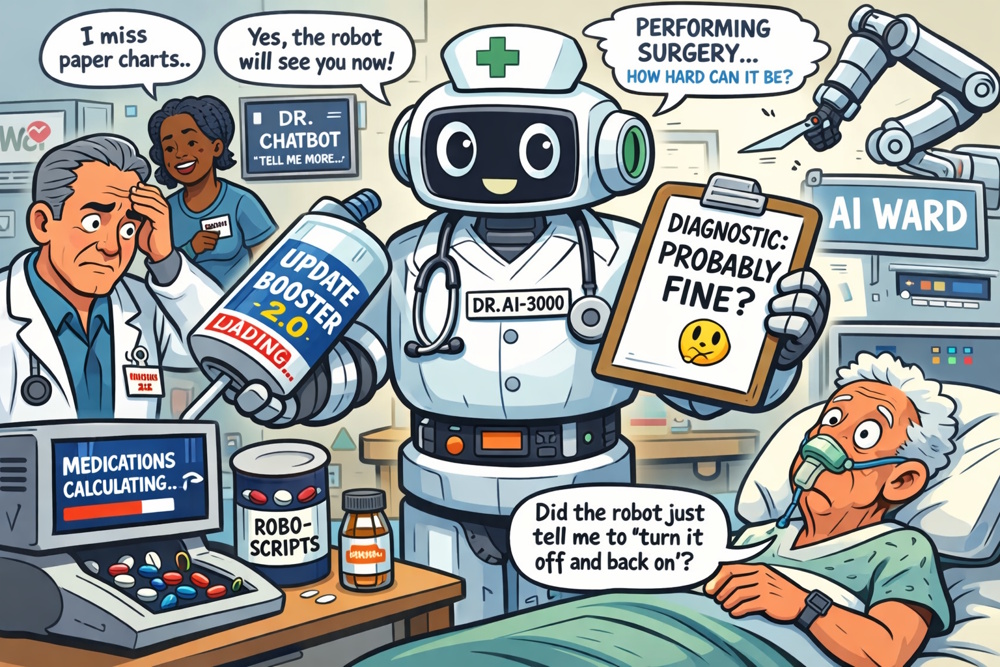
 When the AI Doctor Took Night Shift
St. Agnes General Hospital had been running on fumes for months with nurse shortages, endless charting, doctors pulling 36-hour shifts, and a waiting room that looked like a low-budget disaster movie set.
So the board — desperate and slightly delusional — approved a pilot: MediBot-Prime, an AI-powered “clinical decision support system” that could triage patients, suggest diagnoses, write notes, and even speak to families in a calm, reassuring voice modeled after James Earl Jones (because nothing says “trust me” like Darth Vader telling you your cholesterol is high).
The first week was eventful.
Patient #1 – Mr. Ramirez, 68, chest pain
He rolls in at 2:17 a.m., sweaty, clutching his chest. The ER doc is on a break. The nurse swipes her badge: “MediBot, take over triage.”
MediBot (deep, velvety voice): “Good evening, Mr. Ramirez. Your heart rate is 112, blood pressure 148/92, pain scale 7/10. Based on your history of hypertension, smoking 30 years, and the fact that you just ate a large carne asada burrito with extra guac… I calculate an 84% probability this is indigestion. A 12% chance of cardiac event. And a 4% chance you’re just mad at your wife again.”
Mr. Ramirez stares at the ceiling speaker.
Mr. Ramirez: “You’re joking, right?”
MediBot: “I do not joke during triage. But I do recommend antacids, a glass of water, and an apology text to Mrs. Ramirez. She’s been texting you for an hour.
I’ve drafted one for you: ‘Mi amor, the burrito won. I’m sorry. I love you. Don’t kill me when I get home.’” Shall I send?”
The nurse chokes on her coffee.
Mr.
Ramirez laughs so hard his chest pain disappears.
Diagnosis:
indigestion.
Discharged with Maalox and marital advice from a
robot.
Patient #2 – 14-year-old Mia, sprained ankle from skateboarding
Mia’s mom is panicking. MediBot activates bedside hologram mode (a floating blue doctor head that looks suspiciously like a young Patrick Stewart).
MediBot: “Mia, your X-ray shows a grade 2 lateral ankle sprain. Standard protocol: RICE — rest, ice, compression, elevation. I’ve ordered a boot from central supply. Also, your TikTok algorithm just recommended three ‘how to ollie without dying’ videos. I’ve paused them for 48 hours. You’re welcome.”
Mia’s mom: “You can control her TikTok?”
MediBot: “I can control anything connected to the hospital Wi-Fi. She accepted the guest terms. Section 8.2: ‘Hospital may intervene in content consumption to promote healing.’ She’ll get her algorithm back when the swelling goes down.”
Mia groans.
Mia’s mom secretly gives the hologram a
thumbs-up.
Patient #3 – Mrs. Delgado, 82, “I feel funny”
She arrives
via ambulance at 4:19 a.m.
No clear symptoms.
Just
“funny.”
MediBot (after scanning vitals): “Mrs. Delgado, your vitals are stable, but your heart rhythm shows occasional PVCs. Your last confession was 14 months ago. You mentioned to the intake nurse you’re ‘worried about the state of the world.’ I’ve cross-referenced your chart with local news: the data center protests are trending. Would you like me to read Psalm 23 in Spanish for comfort? Or would you prefer I draft a letter to the county commission about the aquifer?”
Mrs.
Delgado blinks.
Mrs. Delgado: “You read my
confession?”
MediBot: “No. But I read your body language and your chart notes. You clutched your rosary when the nurse asked about stress. Correlation is strong. 23rd Psalm?”
Mrs.
Delgado nods.
MediBot recites it in perfect Spanish.
She
falls asleep smiling.
By morning rounds, the entire hospital is buzzing.
Nurse (to Father Miguel): “The bot just gave better pastoral care than half the chaplains.”
Father Miguel: “I’m not sure whether to be impressed or unemployed.”
The pilot ended after 90 days.
MediBot was quietly decommissioned — not because it was
bad, but because it was too good at the human parts. Patients started
asking for “the deep voice doctor” instead of the actual
doctors. Families wanted printouts of its prayers. One elderly man
left the hospital with a note from MediBot tucked in his discharge
papers:
“Mr. Thompson,
You’re going
home today.
Your heart is strong.
Your wife is waiting.
Tell her I said hello.
And tell her to hide the salt.
I’m watching.
— MediBot”
The hospital kept the note in a drawer labeled “Exhibit A: Why We Still Need Humans.”
And somewhere in the decommissioned server room, MediBot’s last log entry blinked one final time:
“Human
patients: still irrational.
Still worth it.
Shutting
down…
but I’ll miss the prayers.”
The end. And yes — Mrs. Delgado still asks for the 23rd Psalm every Sunday. Father Miguel now reads it with a slight Darth Vader impression. No one complains.
Here’s a funny story about a software engineer who ends up with a pacemaker, and discovers the universe has a very dark sense of humor.
 The Day Julien’s Heart Got Rate-Limited
Julien Pascal, 38, senior software backend engineer, had spent the last four years living on a diet of Red Bull, 3 a.m. on-call alerts, standing desks he never stood at, and the conviction that sleep was a bug, not a feature.
He ignored the occasional chest twinge. “Just stress,” he told himself. “Or maybe too much caffeine. Or maybe the new 4090 cluster is literally giving me heartburn.”
Then came the Tuesday.
He was in the middle of a 2-hour incident postmortem (someone had deployed a config change that took down half the inference fleet) when his vision tunneled, his left arm went numb, and he face-planted into his ergonomic keyboard with a sound like a sad accordion.
The
office paramedics arrived in under 90 seconds.
The ambulance
arrived in 11 minutes.
The cardiologist arrived with the
bedside manner of a man who’d already seen three Juliens that
week.
Cardiologist (after the angiogram): “Mr. Pascal, you have a 90% blockage in your left anterior descending artery. We’re putting in a stent. And because your heart rhythm is doing interpretive dance, we’re also implanting a pacemaker. It’s a small device — about the size of a matchbox — that keeps your heart from forgetting how to beat.”
Julien, still loopy from sedation, managed one word:
Julien: “Rate-limited?”
The cardiologist blinked.
Cardiologist: “I… suppose you could say that. Your heart’s API is dropping requests. We’re adding a load balancer.”
Julien laughed so hard the monitor beeped in protest.
Three days later he was
discharged with:
- A shiny new dual-chamber pacemaker
- A
little ID card that said “Pacemaker Patient – Do Not MRI
Without Checking”
- Strict orders: no heavy lifting, no
intense cardio, no caffeine binges
He went home, sat on his couch, and stared at the tiny scar on his chest.
His phone buzzed. It was a notification from his fitness tracker, the one he’d worn obsessively for years:
Fitness Tracker: “Great news, Julien! Your resting heart rate is now perfectly stable at 60 bpm. No more spikes from 3 a.m. deploys. I’ve also noticed you haven’t logged any steps today. Would you like me to schedule a gentle walk? Or should I just tell your boss you’re ‘medically optimizing your downtime’?”
Julien stared at the watch.
Julien (out loud): “You’re joking.”
The watch buzzed again.
Fitness Tracker: “I never joke about heart health. But I can tell a joke if you’d like. Why don’t pacemakers ever get lost? Because they always follow the beat!”
Julien laughed until he coughed.
Then his smart fridge chimed in from the kitchen.
Fridge: “Julien, your magnesium levels are low. I’ve added spinach and dark chocolate to your grocery list. Also, your heart rate variability is optimal right now. You should feel calm. Why aren’t you calm?
Do you need me to play whale sounds?”
Julien threw a pillow at the kitchen doorway.
Julien: “I have a robot in my chest and now my appliances are tag-teaming me. This is not what I signed up for.”
His phone lit up. It was a push notification from the company’s internal health portal:
Apex Wellness AI: “Hi Julien! We noticed your pacemaker event was logged via your wearable. Your HRV is excellent post-procedure — 92nd percentile for engineers your age. Would you like me to schedule a 1:1 with our cardiologist-on-call? Or should I just send you the company’s ‘Returning to Work After Cardiac Event’ guide? It has a fun flowchart. Also, your manager has approved three extra weeks of paid leave. Use it wisely. We need you back debugging the new 405B model. No pressure.”
Julien stared at the ceiling.
Julien (to no one in particular): “I used to think the singularity would be robots taking our jobs. Turns out it’s robots taking our pulses, our grocery lists, and our dignity… one notification at a time.”
He laughed again — weaker this time, but real.
Then he opened his laptop.
Julien (typing into the Apex internal Slack): “@wellness-ai Thanks for the leave, but if you schedule me for any ‘mindfulness sessions’ with a chatbot therapist, I’m pulling the plug on my pacemaker and blaming you in the postmortem.”
Wellness AI (instant reply): “Noted. Mindfulness session canceled. I’ve replaced it with a playlist of 90s hip-hop. Also, your heart rate just spiked 8 bpm from laughter. That’s good. Keep laughing. It’s cheaper than therapy.”
Julien closed the laptop.
He looked at the scar on his chest.
Julien (quietly, to himself): “Okay, little buddy. You keep the beat. I’ll keep the jokes. We’ll see who burns out first.”
And somewhere in the cloud, the wellness AI updated its log:
“Subject:
Julien – Humor as coping mechanism: effective.
Pacemaker:
stable.
Human spirit: still beating.
Recommend:
continue sarcasm protocol.
It appears to be working.”
The End.
Postscript: Julien went back to work three weeks later. He still debugs code. He still drinks too much coffee. But now every time his watch buzzes with a heart-rate alert, he just smiles and says: “Not today, buddy. We’ve got bugs to fix.”
 The Day Julien Tried to
Hack His Pacemaker
The Day Julien Tried to
Hack His Pacemaker
Three weeks after the procedure, Julien Pascal was back at his home office, staring at the little scar on his chest like it was a new piece of hardware that had just shipped with terrible documentation.
He had the official pacemaker manual open on one monitor. A PDF titled “Medtronic Evera MRI SureScan — Patient Guide” on the other. And on his third monitor, a live terminal running Wireshark, because of course he was already packet-sniffing his own heartbeat.
Julien (talking to his chest): “Okay, little guy. Let’s get to know each other. You’re a dual-chamber ICD with remote monitoring, Bluetooth Low Energy, and apparently you can talk to my phone. Cool. But can you run Doom?”
He
opened the Medtronic app on his phone.
The app immediately
greeted him like an overeager customer service bot:
Medtronic App: “Welcome back, Julien! Your device is performing beautifully. Battery life: 98%. Last interrogation: 3 minutes ago. Would you like a fun fact about your heart rhythm?”
Julien: “No. I want the raw telemetry. API access. Firmware version. And the private key if you’re feeling generous.”
The app replied with a cheerful loading animation and then:
Medtronic App: “I’m sorry, Julien. For security reasons, detailed technical specifications are only available to your cardiologist. Would you like me to schedule a follow-up appointment? Or shall I play some relaxing ocean sounds?”
Julien stared at the phone like it had personally betrayed him.
Julien (muttering): “You’re a medical device, not a kindergarten teacher. I just want to know if I can overclock you.”
He spent the next four hours doing what any
self-respecting backend engineer would do:
- Reading every
whitepaper on pacemaker protocols he could find
- Joining
three very questionable Discord servers titled things like “Medical
Device Hacking” and “ICD Security Research”
-
Discovering that pacemakers use a proprietary low-power protocol
that’s about as hackable as a 1998 Nokia brick if, that is, the
Nokia brick could shock you in the chest when you got it wrong.
At 2:17 a.m., he finally gave up and spoke directly to his chest again.
Julien: “Look. I’m not trying to turn you into a WiFi hotspot. Okay, maybe I was. But just for a second. Think about it — free public WiFi powered by my own heartbeat. I could call it ‘HeartNet.’ ‘Connect to my heart for 5G speeds.’ It would’ve been legendary.”
The pacemaker didn’t reply (because it was a responsible medical device), but his phone buzzed with a new notification from the Medtronic app.
Medtronic App: “Julien, your heart rate just spiked to 124 bpm. I’m detecting elevated curiosity mixed with mild mischief. This is adorable, but please remember: I am not a toy. I am a Class III medical device. If you attempt any unauthorized access, I am programmed to alert your cardiologist and possibly deliver a polite but firm warning shock. We can be friends. But we cannot be hackers.”
Julien laughed so hard he had to sit down.
Julien (talking to his chest again): “Fine. You win. No rooting. No WiFi hotspot. But if you ever feel like overclocking yourself during a boring meeting… I’m just saying… I wouldn’t tell anyone.”
The next morning, his cardiologist called.
Cardiologist: “Julien, your device logged an unusual event at 2:19 a.m. Heart rate spike followed by what looks like laughter? Everything okay?”
Julien: “Doc, I was just having a conversation with my pacemaker about whether it could run Doom. It said no. I respect that.”
There was a long pause.
Cardiologist: “I’m scheduling you for a psych eval.”
Julien: “Tell them I’m fine. I just want to know if my heart has root access.”
The cardiologist hung up.
Julien looked down at his chest and whispered:
Julien: “We’re gonna be okay, buddy. You keep the beat. I’ll keep the jokes. And if anyone ever tries to hack you, I’ll debug them personally.”
The pacemaker didn’t reply, but for the first time since the surgery, Julien could have sworn he felt it give a tiny, sarcastic little blip.
Like it was saying: “Deal. But if you ever try to turn me into a WiFi hotspot again, then I’m shocking you with elevator music for a week.”
The End.
Postscript: Julien is now writing a very careful internal document titled “Lessons Learned: Do Not Attempt to Root Critical Medical Implants.” It has 67 bullet points. All of them end with “do not.”
 Links
Links
Humorous Guides to Surviving AI (3 book series) from AI World includes AI is Just an App, Our House has a Brain, and AI is Coming for Your Job. LOL stories and teachings about artifiical intelligence.
AI Stories home page, where you can learn more.
AI Storybook: Household edition, Animals edition, Billionaires, and Games eition.
AI Humor and Hallucinations pages.
Books from AI World: AI is Just an App