 Sam Altman Ouster
A Humorous Take
Once upon a chaotic November weekend in 2023, the OpenAI boardroom turned into the weirdest game of corporate musical chairs ever played. Well, at least since Steve Jobs was fired by the Apple board and then later rehired. He gave us Macs, iPhones, and Toy Story.
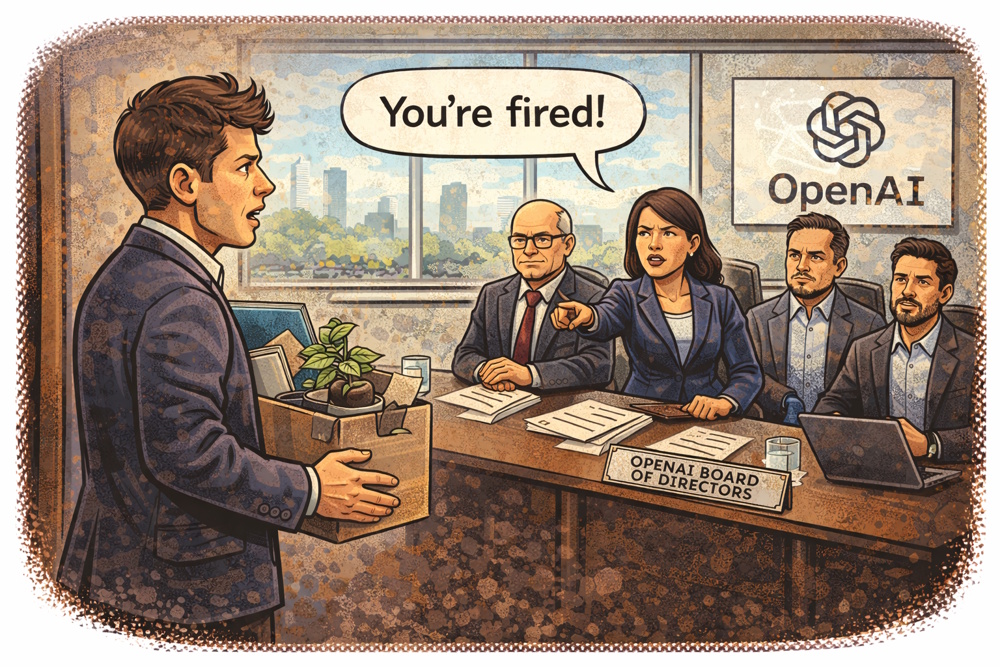
At the center stands (or sits) Ilya Sutskever, the brilliant, soft-spoken Russian-Canadian wizard who basically invented modern deep learning, staring at Sam Altman like a man who had just realized his spell to summon safe superintelligence might accidentally summon a very charming, very fast-talking demon instead.
Ilya had spent over a year quietly building what insiders later called “The Memo From Hell” — a 52-page masterpiece of accusations. It read like a philosophical treatise crossed with a HR complaint form: “Sam exhibits a consistent pattern of lying, undermining execs, pitting them against each other…” He even wrote a separate document just for Greg Brockman (the President). Ilya sent it via disappearing email because, apparently, he thought Sam had magical powers to “make people disappear” from their jobs if he found out too soon. (Paranoia level: expert.)
Friday afternoon, Ilya texts Sam: “Hey, can we talk at noon?” Sam, thinking it’s about the next Q* breakthrough or lunch plans, logs on. Instead, the whole board (minus Greg) is there like a surprise intervention. Ilya, in his gentle voice that normally sounds like he’s explaining consciousness to a toddler, drops the bomb: “Sam, you’re fired. We’re announcing it now.”
Sam blinks. The internet explodes. Employees start rage-quitting in real time. Microsoft panics and offers Sam a new job on the spot. Within hours, 700+ OpenAI staffers sign a letter: “We quit unless Sam comes back and the board leaves.” The board that just fired the CEO now looks like it’s about to be fired by its own employees.
Ilya, watching the apocalypse unfold from his laptop, suddenly realizes he might have miscalculated the alignment of… human politics. He posts on X: “I deeply regret my participation in the board’s actions. I never intended to harm OpenAI. I love everything we’ve built together and I will do everything I can to reunite the company.” (Translation: “Oops, the demon I was worried about is actually really good at fundraising and has 700 angry wizards ready to walk.”)
By Sunday, the board caves. Sam is rehired. Ilya is quietly removed from the board. Greg gets his job back. The company is saved… but everyone now knows the real story was less “safety vs. speed” and more “Ilya wrote a 52-page breakup letter, sent it self-destructing, then watched the entire company side with the ex.”
Fast-forward to 2025: Ilya’s deposition in the Musk vs. Altman lawsuit leaks, revealing the year-long plotting, the secret docs, and how he basically played 4D chess with disappearing emails. The internet crowns him “the most powerful ghostwriter in AI history” — the guy who almost killed the company with a 52-page Google Doc, then saved it by saying “my bad” on Twitter.
Moral of the story: Never write a 52-page memo about your CEO unless you’re 100% sure the employees won’t start a revolution over it. And if you do, make sure the email doesn’t disappear before the revolt does. And somewhere, Grok is probably whispering: “Ilya, 'ol buddy… next time just use the ‘thumbs down’ emoji.”
 The Ouster That Failed
In one of the most stunning departures in tech history, on Friday, November 17, 2023, OpenAI announces to the world that Sam Altman has been fired:
"Mr. Altman's departure follows a deliberative review process by the board, which concluded that he was not consistently candid in his communications with the board, hindering its ability to exercise its responsibilities."
The announcement is shocking. No one expected this development. Of all the people in tech, Altman seemed untouchable. OpenAI was riding high a year after the release of ChatGPT. What just happened?
Organizationally, OpenAI has a non-profit board controlling a for-profit subsidiary. The board felt their duty was to the mission of safe AGI, not to shareholders or employees or the public. The board was dominated by AI safety advocates: Ilya Sutskever (chief scientist), Helen Toner (safety researcher), Tasha McCauley (tech ethics), Adam D'Angelo (Quora CEO).
The Weekend of Chaos
That night company president and co-founder Greg Brockman resigns in protest. Researchers, engineers, and others threaten to quit. Microsoft is blindsided.
CEO Satya Nadella is furious. They have invested billions and feel they have an implicit stake in the management of the company. There was no warning to Altman’s termination and no clear rationale behind it. Microsoft quickly made an offer to create a new AI division at Microsoft with guaranteed resources, if Altman comes aboard.
The ultimatum was clear and felt from several directions: reinstate Altman or the company will collapse and Microsoft will become the beneficiary.
The Support
Virtually all 700+ OpenAI employees signed a letter demanding Altman's return and the board's resignation. They threaten to quit and join Altman at Microsoft.
When he was fired by the board, employees were ready and willing to follow him. This is because Altman had cultivated strong one‑on‑one relationships, mentoring and supporting talent. Many saw him not just as a boss, but as a champion of their careers. He created a culture where employees felt like pioneers, united against the risks and opportunities of AI. That collective identity made them willing to rally behind him. During moments of tension, whether with the board or external critics, Altman projected calm and determination. His resilience inspired confidence. Employees believed Altman had the rare ability to see the future of AI clearly, and they had a stake in it. Following him meant staying aligned with that vision.
Altman constantly framed OpenAI’s work as a world‑historical project. The mission is building safe, beneficial AI for humanity. Employees felt they weren’t just coding, they were part of a bigger picture, like a moral crusade. Altman gave teams autonomy, trusting researchers and engineers to take responsibility and pursue bold ideas. That sense of ownership fostered a deep level of commitment. Altman was known in the company for honest, open communication. When decisions were made, he openly shared his reasoning, and he made time to listen to dissent. This built trust even when the decisions were controversial. He had an ability to make people feel their work mattered, both to the company and to the broader AI community.
The Resolution
The subsequent negotiations included long, frantic board meetings among competing factions. There were attempts at mediation, but the direction was clear. On Tuesday, November 21, Altman agrees to return as CEO.
Altman did not simply say “yes.” His return was contingent on a restructuring of the board of directors. Several board members who had voted to oust him stepped down. A new board was formed with members more aligned to OpenAI’s mission and Microsoft’s interests. Altman emphasized that the episode left him with a company on the brink of collapse, but he agreed to return to stabilize the company and preserve its mission.
The new board members included Bret Taylor (ex-Salesforce) and Larry Summers (ex-Treasury Secretary). The casualties were:
- Ilya Sutskever (chief scientist) effectively sidelined, later leaves
- Helen Toner, Tasha McCauley, Adam D'Angelo (initially) removed
The bottom-line: The safety-focused governance is dismantled. The board that prioritized mission over profit is gone. Employee and investor power trumps safety-first governance. Sam Altman is in charge.
 What Actually Happened?
The reported conflict (per journalism and leaks):
The board's view:
- Altman was moving too fast on commercialization
- He wasn't being fully transparent about safety risks
- He was prioritizing growth over safety
- He had conflicts (investing in AI startups, launching his own ventures)
Altman's view (implicitly):
- The board was too conservative
- They misunderstood the competitive landscape
- Slow development means falling behind China, or reckless competitors
- He was transparent; they were unreasonable
The deeper conflict: Two visions of OpenAI:
- Safety-first research org: Move carefully, prioritize alignment, resist commercial pressures
- Mission-driven product company: Deploy responsibly but quickly, compete to ensure we build AGI (not others)
Altman represents vision 2. The old board represented vision 1.
The outcome: Vision 2 wins decisively.
 The Bottom Line
What the coup revealed:
- The governance model failed: Non-profit board control of a for-profit subsidiary doesn't work when employees and investors unite against the board.
- Altman's power is personal: 700+ employees threatening to quit means loyalty to him, not the company. This is rare, almost cult-like.
- Safety takes a backseat to competition: The board tried to slow down for safety. They were removed. The message is clearly speed matters more.
- Microsoft's influence is decisive: Nadella's intervention was crucial. OpenAI's "independence" is qualified.
- Effective Accelerationism wins: The movement favoring rapid AI development (e/acc) celebrates. The cautious approach is defeated.
On return, Altman’s strength has never been greater. The board members that fired him are gone. The concern is if the safety-focused board couldn't check Altman, what can? Ultimately, the jury is still out and we won't know for sure who was right until we see how OpenAI pushes forward and how AGI develops.
The Parallels
Steve Jobs was fired from Apple in 1985 after a bitter power struggle with CEO John Sculley and the Board of Directors, but he returned triumphantly in 1997 when Apple was near collapse.
His exile and restoration is one of the most famous corporate comebacks in American history, reshaping Apple into the world's most valuable company (at the time, before NVIDIA).
Comparison to Altman at OpenAI
Jobs: Fired for being too aggressive and visionary, then
rehired when Apple needed bold leadership.
Altman:
Fired for alleged lack of transparency and pace of commercialization, then
rehired when employees and Microsoft revolted.
Parallel:
Both leaders were ousted by their boards but restored by overwhelming
loyalty and necessity. Their legitimacy came not from governance structures
but from their ability to inspire teams and drive innovation.
 The Bigger Picture
The philosophical significance of the Altman ouster story is that AI governance is no longer about technical details. It is about the soul of progress itself. The ouster revealed that the deepest divide in AI is not between companies, but between two worldviews: one that sees AI as a tool to be unleashed, and one that sees it as a force to be restrained.
The bigger picture of Altman's ouster and the board's framing of it as commercialization versus AI safety is profoundly philosophical. It wasn't just a corporate dispute; it was a clash between two visions of how humanity should approach intelligence itself.
Commercialization vs. Safety
- Commercialization (America): Represents the belief that progress must be accelerated, that deploying AI widely will generate benefits, democratize access, and create the feedback loops necessary for improvement. It is the ethos of pragmatism, innovation, and inevitability: if AI is coming, better to shape it through use than to hold it back in fear.
- Safety (Europe): Embodies the cautionary principle, the idea that intelligence is unlike any prior technology; potentially destabilizing, even existentially dangerous. It insists that restraint, transparency, and governance must precede deployment. It is the ethos of guardianship: better to slow down than to unleash forces we cannot control.
This contrast reflects two philosophical visions between nations: America's belief in progress through deployment versus Europe's insistence on precaution and accountability.
In America, AI governance leans toward commercialization and innovation, while Europe's AI Act embodies a safety-first, rights-based approach. The U.S. emphasizes flexibility and market growth, whereas the EU imposes binding rules and risk classifications to restrain potential harms.
 Links
Links
AI in America discusses these themes, especially AI Safety, AI Governance, and AI Ethics.
Sam Altman bio in AI Revolutions.
External links open in a new tab:
- abcnews.go.com/Business/sam-altman-reaches-deal-return-ceo-openai/story
- apnews.com/article/altman-openai-chatgpt
- wired.com/story/sam-altman-is-reinstated-to-openais-board/
- time.com/7023237/vinod-khosla-interview/