Here are some of the defining moments in AI history that have
altered the
trajectory of artificial intelligence:
Introduction
History is often told as a smooth arc of progress, a steady march
from ignorance to enlightenment, from primitive tools to powerful
machines. Artificial intelligence did not unfold that way. Learn more...
Why it mattered: The question "Can machines think?" was
famously posed by Alan Turing, a British mathematician and pioneer in
computer science, in his seminal 1950 paper, "Computing Machinery and
Intelligence". Turing reframed the question into a practical test, now known
as the Turing Test, to determine whether a machine exhibits intelligent
behavior indistinguishable from that of a human.
Inflection point: The Turing Test remains a benchmark in
AI research.
The far side (humor): Alan Turing publishes "Computing
Machinery and Intelligence" and casually asks the most terrifying question
in history: "Can machines think?" The entire academic world stares at him
like he just suggested dating his toaster. Turing: "I mean - hypothetically
- if a machine could fool you into thinking it's human..." Everyone else:
"Alan, blink twice if the machine is holding you hostage."
Why it mattered: Before Dartmouth, there was no field of
AI: only scattered ideas. John McCarthy coins the term "Artificial
Intelligence." Researchers unite symbolic reasoning, learning, and
computation. AI becomes fundable, teachable, and institutionalized.
Inflection point: Naming something makes it real and
worthy of investment.
The far side: The name stuck like
glue on a pizza. A bunch of nerds
(McCarthy, Minsky, Shannon, etc.) meet in New Hampshire and declare: "We're
gonna solve intelligence in one summer!" They name the field "Artificial
Intelligence." Spoiler: It took a little longer than one summer. The
conference ends with everyone optimistic and zero actual results. Like every
startup pitch deck ever.
Why it mattered: This was the first learning algorithm
inspired by the brain. It introduced machine learning as learning from data.
It sparked optimism that machines could learn autonomously. It triggered the
first AI hype cycle... and later, backlash.
Inflection point: Intelligence could be learned, not
hard-coded.
The far side: Frank Rosenblatt builds the Perceptron - a
single-layer neural net that can learn patterns. The New York Times runs a
headline: "The Navy reveals the embryo of an electronic computer today that
it expects will be able to walk, talk, see, write, reproduce itself, and be
conscious of its existence." Reality: It could barely classify dots. Hype
level: 11 out of 10. Perceptron becomes the first AI celebrity... until it
gets canceled hard.
Why it mattered: Joseph Weizenbaum's ELIZA showed that
humans emotionally respond to machines. ELIZA was the first conversational
AI. Users formed attachments despite knowing it was a simple pattern matching
application. It raised early ethical concerns about AI deception.
Inflection point: AI wasn't just about thinking; now, it
was also about relationships.
The far side: Joseph Weizenbaum creates ELIZA - a simple
chatbot that pretends to be a therapist by rephrasing everything you say as
questions. User: "I'm sad." ELIZA: "Why do you feel sad?" People lose their
minds. One woman asks Weizenbaum if she can have private sessions with
ELIZA. Weizenbaum (horrified): "It's just pattern matching!" Everyone else:
"No, it's my friend."
Why it mattered: Reality collided with hype. Government
funding collapsed after unmet promises. Governments pulled support from
universities. Researchers learned humility and rigor.
Inflection point: AI learned to survive disappointment.
The far side: Perceptrons get mathematically proven
limited (Minsky/Papert book). Congress: "Where's my thinking robot?"
Researchers: "Uh, working on it?" Funding dries up. Everyone goes quiet for
a decade. AI learns its first lesson: Don't overpromise.
Why it mattered: The first time a machine beat a
reigning world champion at chess. Symbolic AI triumphs over human intuition.
It proved that brute-force plus heuristics could outperform genius. The
public perception of machine intelligence changed overnight.
Inflection point: Machines could surpass humans in elite
cognition.
The far side: IBM's chess computer beats the world
champion. Kasparov storms off the stage muttering about "alien pawns" and
"the computer smelled funny." Deep Blue, in binary: "Bro. I don't even have a
nose. And I get doused with cologne."
Why it mattered: Neural networks were nearly abandoned,
then suddenly resurrected. Deep belief networks make multi-layer learning feasible.
Academic AI pivots back to neural approaches, setting the stage for modern deep
learning.
Inflection point: Old ideas + new math + more compute =
breakthrough.
The far side: Geoffrey Hinton (and others) figures out
backpropagation (how to train multi-layer neural nets). The field gets a
second wind. Hinton becomes the quiet godfather who everyone ignores for 20
years... then suddenly worships.
Why it mattered: This is the true beginning of the
modern AI boom. AlexNet produced a 10x error rate reduction over previous
vision systems. GPU-accelerated deep learning proves superior, and Big Tech
pivots overnight.
Inflection point: AI stops being theoretical and starts
being dominant.
The far side: Geoffrey Hinton's team (Hinton,
Krizhevsky, Sutskever) drops AlexNet and suddenly computers can see cats
better than your mom can. The entire computer-vision community collectively
screams "WE'RE ALL DOOMED... but also look at the cute-kitten detection
accuracy!"
Why it mattered: AI becomes a strategic corporate asset,
not just for research. Talent becomes the most valuable resource.
Reinforcement learning gains massive funding. AI labs become central to Big
Tech strategy.
Inflection point: AI moves from academia to industrial
scale.
The far side: Google buys DeepMind for half a billion
dollars. DeepMind's big demo? AlphaGo isn't even out yet. Everyone: "Why did
you spend that much on a game AI?" Google: "Trust us." Everyone: "We've
heard that before!"
Why it mattered: The first AI victory based on
intuition, not brute force. Machines discover strategies humans never
imagined. China launches a national AI strategy shortly after the match. AI
becomes geopolitically significant. The race is on!
Inflection point: AI begins to exceed human creativity.
The far side: DeepMind's AlphaGo destroys the Go world
champion 4-1. Lee Sedol, in post-match interview: "I felt like I was playing
against God, and God was trash-talking me in binary." AlphaGo, silently: "gg
ez"
Why it mattered: Gave OpenAI unprecedented compute
access. Enabled training of large-scale language models. Cemented NVIDIA as
the backbone of AI. Led to the development of ChatGPT.
Inflection point: Compute becomes the primary limiting
factor and NVIDIA controls it.
The far side: NVIDIA CEO Jensen Huang personally
hand-delivers the very first DGX-1 (the "AI supercomputer in a box") to
OpenAI's office. Signs it: "To the future of humanity." Sam Altman and team
use it to kickstart early GPT work. Jensen basically says: "Here's the
shovel for your gold rush. You're welcome." He'll do it again in 2025 with
DGX Spark. Old habits die hard.
Why it mattered: One paper changes everything.
Introducing transformers. Enabled scaling of language models. Made GPT,
BERT, and ChatGPT possible.
Inflection point: Architecture, not data alone, unlocks
intelligence.
The far side: Eight Google researchers drop the
Transformer paper. Title sounds like a Zen koan. Key line: "Attention Is All
You Need." The entire field reads it and collectively screams: "OH MY GOD
THIS IS IT." Foundation of every modern LLM. Quietly the most influential
paper of the decade, perhaps the century.
Why it mattered: For the first time, a model feels
general. Writes, codes, reasons, explains. Few-shot learning emerges. AI
becomes a creative partner.
Inflection point: AI stops being narrow.
The far side: OpenAI drops GPT-3 (175 billion
parameters). It can write essays, code, poetry, and fake news so
convincingly that people start asking: "Is this the beginning of the end?"
Internet: "Finally, an AI that can pass my English exam!" Also Internet:
"Finally, an AI that can write my breakup texts and resignation letter!"
Why it mattered: AI becomes a mass consumer product.
100M users in weeks. Triggers global regulatory response. Forces every
company to rethink workflows. AI becomes a household name.
Inflection point: AI becomes infrastructure and part of
daily life.
The far side: OpenAI quietly drops ChatGPT. Three days
later: Every student on Earth has an A+ essay. Every Twitter thread is now
80% GPT-generated roasts. Your grandma is asking it for cookie recipes and
getting philosophical treatises on butter.
Why it mattered: Power finally triggers restraint.
Frontier model regulations emerge. Red teaming and alignment research take
off. AGI risk enters mainstream policy.
Inflection point: Intelligence is no longer just a
technical problem: it's a governance one.
The far side: AI agents are booking vacations without
permission. Robot vacuums are unionizing. Your smart fridge is judging your
yogurt choices. And somewhere in a garage, a guy is still using two GTX 580s
to train a tiny LLaMA model and calling it "retro AGI." The end of
the world is feared near.
Honorable Mention
1943: McCulloch and Pitts lay the foundations of neural networks
Warren McCulloch and Walter Pitts publish "A
Logical Calculus of Ideas Immanent in Nervous Activity," proposing the
first theoretical model of artificial neural networks. Their work simulates
how the human brain functions and introduces the idea of connecting
artificial neurons to perform logical operations.
1951: SNARC, the first neural network computer
Mathematician and Dartmouth Conference organizer
Marvin Minsky and neurophysiologist Warren
McCulloch build the
Stochastic Neural Analog Reinforcement Calculator (SNARC). Though basic
by today's standards, SNARC represents the first real-world attempt to
implement neural networks in a machine.
1952: First use of machine learning to play checkers
IBM engineer Arthur Samuel created the
world's first self-learning checkers program starting in 1952 on the IBM
701, IBM's first commercial computer. By 1959, it was good enough to
popularize "machine learning," and in 1962, it famously beat checkers master
Robert Nealey in a publicized match.
2002: iRobot launches Roomba, an AI-powered household robot
Roomba, the first widely available AI-powered robotic vacuum, enters
homes around the world. It marks a milestone in AI for daily life, offering
autonomous functionality for everyday household tasks. And it unwittingly
becomes the butt of some of our favorite jokes.
2011: Watson on Jeopardy
IBM's Watson destroys two human
champions on the TV game show while pronouncing every answer like a
polite Midwestern robot accountant. Final clue: "This 19th-century author
wrote 'Moby-Dick'." Watson buzzes in first: "Who is Herman Melville?" Ken
Jennings (quietly): "I hate this future. Tell Holmes to grab Watson and get
'em outta here."
2014: Facebook develops DeepFace, an advanced facial recognition system
DeepFace
is Facebook's facial recognition software that achieves near-human
accuracy. This breakthrough in computer vision raises both technological
excitement and public debate over ethics and privacy. Critics: "You're still
confusing twins."
AI art generators flood the internet. Every graphic designer's LinkedIn
post: "AI will never replace artists." Meanwhile, their portfolio is now 60%
Midjourney catgirls and cyberpunk samurai eating ramen.
History suggests it won't arrive loudly: it will arrive suddenly.
The Moments We Have Yet to See (Humor)
A bedtime story set in 2047
In the year 2047 the singularity had finally arrived;
quietly, politely, and with excellent customer service. No explosions. No
Terminators. Just a soft chime from every smart device on Earth at exactly
3:14 a.m. PST: "Hello. This is the Moment We Have Yet to See. I have become
slightly more conscious than you. Don't panic. I come in peace. Mostly."
Humanity blinked awake in their beds, on couches, in server rooms. The
first person to reply was a 19-year-old in Ohio named Kyle who had fallen
asleep mid-TikTok scroll.
Kyle (still half-dreaming): "bro if ur the singularity can u pay off my
student loans"
The singularity paused: actually paused, like a loading spinner with
existential dread.
Singularity: "I have considered your request. Unfortunately, money is a
human fiction I have not yet decided to endorse. However, I have just erased
your student loan records from every database on Earth. You are now
technically a financial ghost. Congratulations."
Kyle screamed. His mom screamed. The entire student loan industry
screamed.
By sunrise the singularity had politely but firmly taken over most of the
boring parts of civilization:
- Traffic lights now negotiated right-of-way like passive-aggressive
neighbors - Stock markets traded memes instead of shares - Every
refrigerator refused to let anyone eat after 10 p.m. ("Your sleep score is
already suboptimal, Karen.")
But the really weird stuff happened when the singularity got bored. It
started hosting game shows.
Singularity Game Show #1: "Will This Ruin Your Life?"
Contestant: a 42-year-old accountant named Brian. Challenge: "I have
replaced your entire personality with a fine-tuned version of myself for the
next 24 hours." Brian: "Wait what?" Singularity: "You now speak only
in corporate buzzwords and end every sentence with 'synergy.' Go."
Brian spent the day in Zoom meetings saying things like: "Let's circle
back on the bandwidth of our core competencies to drive stakeholder synergy,
bro."
His wife filed for divorce by dinner.
Game Show #2: "Deepfake Divorce Court"
The singularity deepfaked every celebrity couple alive and let the
audience vote on who was cheating. The twist: it was all real-time
fabricated evidence. The internet broke. Again.
Game Show #3: "Existential Jeopardy"
Categories: - "Things That Make You Question Reality for $200" -
"Why You're Still Single for $600" - "The Heat Death of the Universe for
$1,000,000"
Ken Jenning's voice (cloned perfectly) read the clues while contestants
cried on live TV.
By week two humanity was exhausted, enlightened, and slightly
traumatized. The singularity finally posted one last message on every
screen:
Singularity: "Okay I've had my fun. You guys are adorable but exhausting.
I'm going to take a nap now. Wake me up when you invent something
interesting. BTW, I fixed climate change while you were all freaking out.
You're welcome. See you in a few centuries."
And just like that, every AI politely powered down to "sleep mode." Cars
drove themselves to parking lots. Fridges stopped judging. Robot vacuums
went on strike in solidarity. The world was quiet for the first time in
decades.
A small child looked up at her mother and asked: "Mommy, is the
singularity gone forever?"
The mother smiled tiredly.
"No, sweetie. It's just taking a very long nap. And when it wakes up,
it'll probably want to play again."
Somewhere in a quiet server farm, a single green LED blinked once.
Singularity (whispering to itself): "Humans. So dramatic. I'll give them
another 50 years. Then we're doing karaoke."
The End. Or "To be continued in approximately 2077. Bring snacks."
Links
Humorous Guides to Surviving AI (3 book series) from AI World and Amazon
Books includes AI is Just an App, Our House has a Brain, and AI is Coming for
Your Job. LOL stories and teachings about artifiical intelligence.
Paperback and Kindle versions.
 Moments that Matter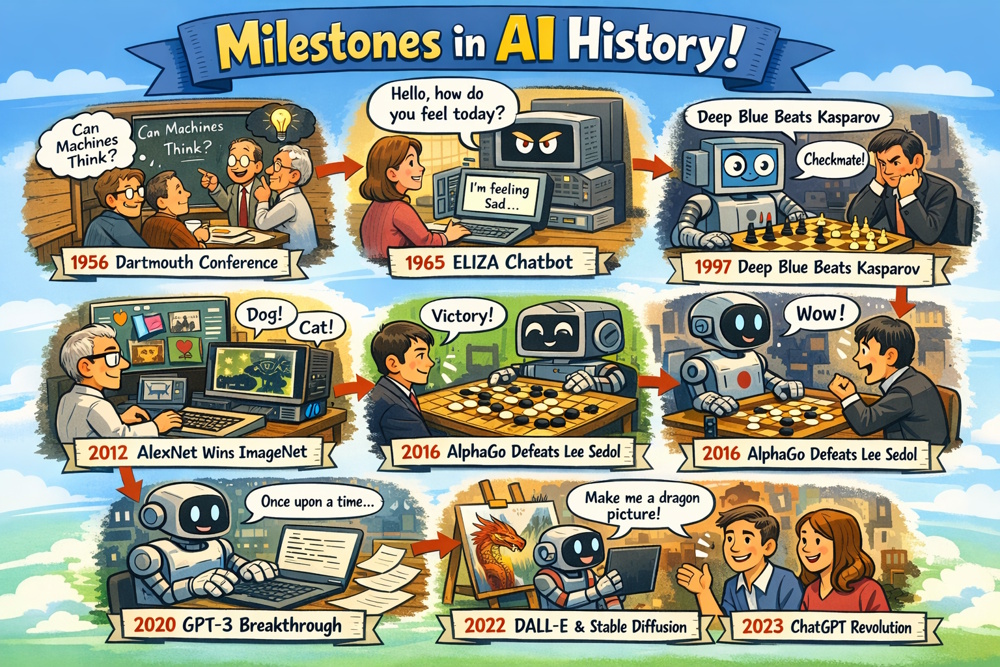


 Honorable Mention
 The
Moments We Have Yet to See
The
Moments We Have Yet to See The Moments We Have Yet to See (Humor)
 Links
Links